
Groups aim to spread awareness of domestic violence
For six years, Lauren, a sophomore majoring in international relations and neuroscience, endured verbal and emotional abuse from her father.
She felt she was never good enough, smart enough or pretty enough for him. Her father was able to fool her friends into believing that he was outgoing, charismatic and loving, she said, but behind closed doors, he was vindictive, hateful and spiteful.
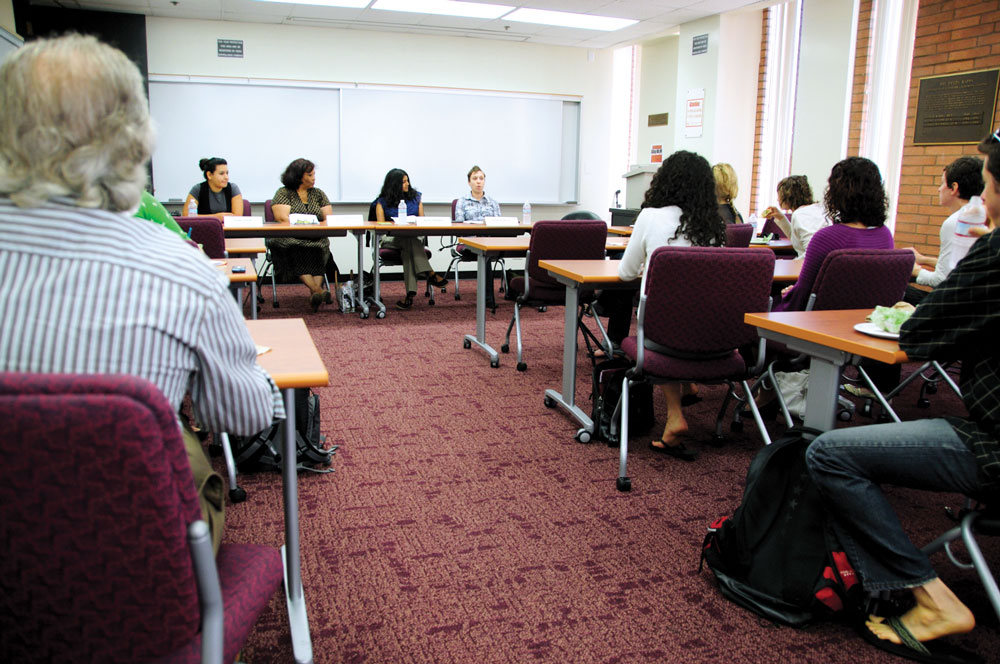
Table talk · Panelists speak to students about the influence of culture in intimate partner violence in a discussion hosted Thursday as part of USC’s Domestic Violence Awareness Week. - Young Kim | Daily Trojan
For six years, Lauren was a victim of domestic violence.
“If I heard him coming home, I would go into a different room,” she said. “The more I tried to avoid him, the more angrier he got.”
Lauren is just one victim of domestic violence at USC.
According to the National Coalition Against Domestic Violence, one in four women will be the victim of domestic violence in her lifetime.
“Choose four women you know,” said Michael Kahn, a volunteer for the USC Men Care program and a senior majoring in English, said. “What if one of those women was a victim of domestic violence? That’s why you should get educated.”
The Center for Women and Men — which runs the Men Care program — and the Women’s Students Assembly made a push this week to help students learn more about the societal problem.
In honor of Domestic Violence Awareness month, CWM and WSA cosponsored on-campus events to educate students about domestic abuse. Students made pledges not to use their hands for violence during the These Hands Don’t Hurt event, wore purple ribbons to raise awareness and decorated T-shirts to express solidarity as part of the Clothesline Project.
CWM Director Danielle Lancon said the most common type of domestic violence reported at USC is intimate-partner violence — violence between people currently or previously in a romantic relationship.
Department of Public Safety Det. Josh Voyda said less than 1 percent of calls to DPS each year are related to domestic violence. But Lancon said numbers can be unreliable.
“Most is unreported and we never find out who the students are,” she said. “The more visible we are on campus, the more likely students are … to take advantage of our services.”
CWM helps students who are victims of domestic violence find long-term solutions, including new housing, restraining orders or a new course schedule.
In the short term, students suffering from domestic violence can call DPS.
When the department receives an emergency call from a victim, officers will arrest a person if the victim has visible injuries. DPS will then contact an on-call judge to issue emergency protective orders while the suspect is still in custody.
The protective orders expire within 48 hours, however, which is why CWM assists in developing long-term solutions.
In addition to providing typical resources to students, CWM has developed the all-male peer education group USC Men Care. Todd Henneman, adviser of the Men Care program, said the group teaches men how to prevent domestic violence and sexual assault.
Rather than tag men as wrongdoers, the group’s goal is to talk to other men on campus as allies so that they feel comfortable taking action against domestic violence without fear of any gender-based stigma.
“Most domestic violence … [is] committed by men, but very few men commit domestic violence,” he said. “What Men Care does is involve the silent majority of men and to get them to speak up to show that most guys don’t approve of abusive behavior.”
The University Park Health Center’s Counseling Services offers student victims short-term counseling and can refer them for long-term counseling off campus.
Lauren said a major part of her healing process dealt with finding what she wanted for herself instead of trying to fulfill the unrealistic ideas of perfection her father demanded of her. Counseling helped her through this process, she said.
Lauren is now an advocate of domestic violence awareness and finds empowerment in talking about those issues in the WSA group on campus.
“I am making a positive difference, she said. “That’s the biggest thing I walked away from my experience with — being able to give a voice to an issue that has been silent for so long.”
Comments are closed.