
Award recognizes novelists behind films
Outside Doheny Memorial Library Saturday night, two of us took refuge beneath the building’s grand archway from the clamor of chatter, clinking cocktail glasses and jazz music resounding inside. The man in my company, average in height with hair prematurely silver, offered me a cigarette that I politely refused.
“I just needed a break from all that,” I told him.
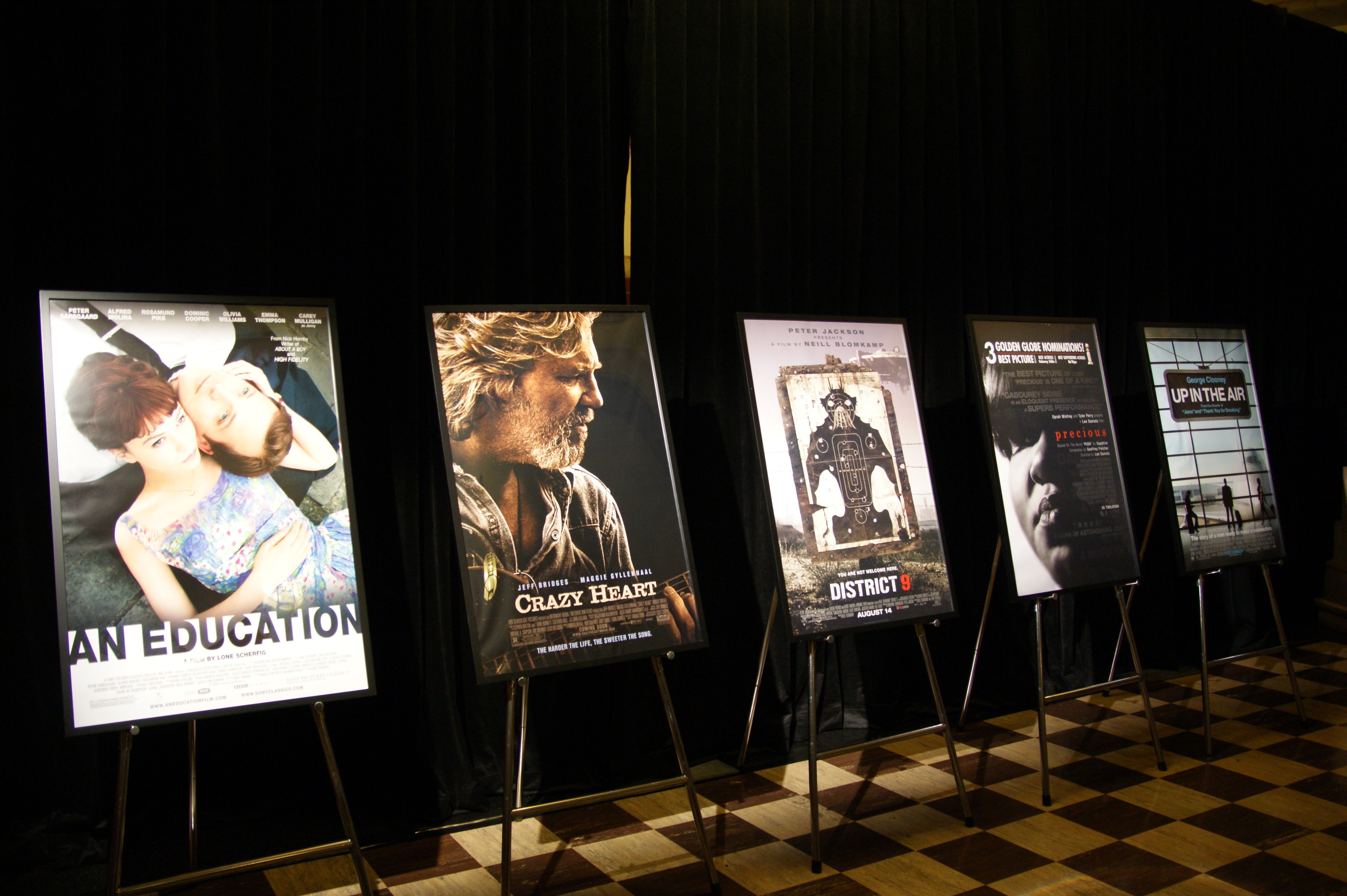
Fade in · Sponsored by USC Libraries, the Scripter award is given out each year to the film adaptation that best represents the original work. - Heather Lee | Daily Trojan
“Oh, tell me about it,” he said. And then, as unassuming as though he were someone’s dinner guest for the evening, simply along for the ride, he continued: “I’m Walter Kirn.”
Kirn has written multiple novels, two of which — Thumbsucker and Up in the Air — have been turned into films. The former was a Sundance darling; the latter has been garnering critical acclaim left and right since its December 2009 release. He also contributes regularly to esteemed publications like the New York Times, New York Magazine and Time Magazine.
But outside with his Camel filters, he was a man who lives in Montana, met his current girlfriend on Facebook and saw very little in his English degree from Princeton University.
“I had to unlearn everything I learned at Princeton,” he told me. “You can still flunk out of school and be a writer.”
It was slightly ironic, questioning the merit of higher education while on the front steps of Doheny Library. But that’s a writer for you.
Now in its 22nd year, the annual USC Scripter Award not only acknowledges screenwriters, who notoriously remain at the base of Hollywood’s totem pole, but also novelists who have produced works that have sparked interest and inspiration in filmmakers. Arguably the most low-profile film award given during award season, the Scripter is a rarity in an industry that now, more than ever, neglects the talent behind the written word.
“A lot of times, screenwriters are thought of as interchangeable. They probably get fired more than anybody else in the business,” said committee member Steven Zaillian, who penned the scripts Schindler’s List and Gangs of New York. “It’s unfortunate we’re thought of as the ones who can be fired.”
But even outside of Hollywood, the once-revered writer has become lost in an increasingly visually stimulated society.
“People forget that all films don’t spring fully formed as a film. There’s an origin — an adaptation,” added Catherine Quinlan, dean of the USC Libraries. “People forget that there’s a whole bunch of thought behind [a film], and our job is to remind them.”
This year, the Scripter Award selection committee witnessed a record number of eligible movies adapted from previously written work — 68 in total. The committee, which is composed of screenwriters, novelists and USC professors and chaired by Academy Award-nominated screenwriter Naomi Foner, reads and views every qualifying piece of material by the end of the calendar year.
Then, in what Dean Quinlan calls a “pretty egalitarian” system, committee members rank their top five favorite adaptations. From there, the Dean calibrates the number of votes and narrows it down to five finalists.
Unlike the Academy Awards and other film ceremonies, the members focus on how well each screen adaptation captured the essence of the original work.
“The film has to have more than just a germ of the story — it has to have the same feeling. I want to feel as though I’m experiencing the same thing but in a completely different way,” Dean Quinlan explained. “That means the screenwriter must have understood the book in a significant enough way that I can still understand the story.”
Among the films and writers recognized Saturday evening were Crazy Heart, adapted by Scott Cooper from Thomas Cobb’s novel of the same title; District 9, based on the short script Alive in Joburg, both written by Neill Blomkamp; An Education, adapted by Nick Hornby from the memoir by Lynn Barber, which she extended from her article for the quarterly magazine Granta; Precious, which Geoffrey Fletcher based on the novel Push by Sapphire; and Up in the Air, adapted by Sheldon Turner and Jason Reitman from Kirn’s novel of the same name.
Three of the finalists — An Education, Precious and Up in the Air — are nominated for the Oscar for best adapted screenplay.
Fletcher, a Harvard and New York University graduate, was unaware of Push’s devoted following when he was approached by Precious director Lee Daniels to write the script. Although he “fell in love” with the main protagonist in the novel’s first few pages, Fletcher claims the distance from Push’s literary significance was ultimately beneficial.
“It would’ve possibly inhibited me from taking a lot of necessary leaps. I would hold it too sacred,” Fletcher said. “But to make Push into an accessible cinematic experience while still honoring the impact of the book — that was my goal. My hope is that the spirit of the book remains in the spirit of the script and the movie, even though all three are very distinct.”
Though each art form is distinct in medium, Forrest Gump screenwriter Eric Roth, who accepted the Scripter Literary Achievement Award that evening, reminded those in attendance that “film is a product of collaboration.”
“It’s such a continuing process of rewriting, writing, writing, rewriting,” said Roth later in an interview. “But I’d say that the visions of almost all of them have been fairly true to what we conceived of originally. That’s important, because [if] you start changing things dramatically, you’ll might end up with a whole different thing.”
An hour or so after our conversation, when Up in the Air was announced as the 2010 Scripter winner, Kirn was the focal point of the swanky gathering, flanked by Reitman and Turner and clutching the sparkling Scripter plaque by his side.
“You know, I’m a novelist—we don’t usually get awards,” Kirn said, continuing with more self-deprecating humor.
“When the dean mentioned that there were all these readers out there who have intimate relationships with the book … she was telling a little white lie,” he said. “In my case, there were readers of the book that had no knowledge of its existence and could care less how it was adapted or if it became a porn film.”
In a way, Kirn was just along for the ride, unaccustomed to award shows even as amicable as the Scripter. But it is perhaps the only accolade Kirn will receive for his contribution to the Up in the Air script, for awards like the Oscars, Golden Globes and even the Writers Guild of America solely recognize the screenwriter’s rehashing of a novelist or journalist’s vision.
Certainly, if it weren’t for Reitman’s perception and sizable bank account, Kirn and his novel would still be relatively unknown to mainstream audiences. Yet if it weren’t for Kirn, Reitman would have been without a story to tell and the year 2009 without one of its most honest, thought-provoking films.
Fletcher, just as gracious as Kirn for his recognition on his first produced feature, eloquently put it: “All of us have a wonderful story inside of us; it’s just communicating it in a way that reaches the audience in a compelling manner where your inspiration survives and perhaps activates their own.”