
Facebook advocacy successful if used well
On Sept. 23, the state of Georgia executed Troy Davis for the murder of a police officer. Some believe the execution showed a foul disregard for the legal process. Others believe the court system was rightfully doing its job.
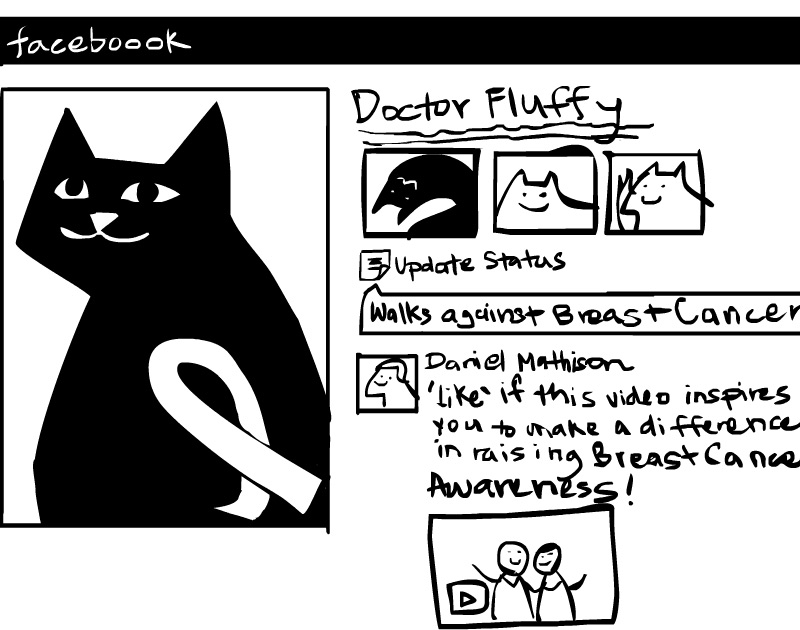
Jovanna Tosello | Daily Trojan
Both sides agree on one thing, though: The topic belongs on Facebook.
Facebook advocacy is a tricky topic.
On one hand, it’s great to see people paying attention to social problems. In many ways, Facebook is the perfect tool for spreading awareness. The audience is built in, and it’s there voluntarily.
On the other hand, Facebook advocacy — like all forms of advocacy — demands an awareness of context and manner. That’s the part where many Facebookers drop the ball.
Whereas the Davis case has been generating thoughtful debate and discussion, other Facebook trends that were supposed to raise awareness about issues such as breast cancer or child abuse have failed.
Facebook is so easy to use that many people post as casually as they speak, forgetting they’re communicating to the equivalent of a massive lecture hall. Posting about charged issues isn’t like posting about the weather. Users who don’t think through their use of advocacy risk trivializing problems that deserve to be taken seriously.
One of the most popular issues to post about is cancer. It’s understandable; many people have lost loved ones to the disease.
Why treat something like cancer less seriously than capital punishment? These are two serious topics that deserve serious responses. Unfortunately, the way people post about cancer on Facebook makes searching for the cure seem like a fun trend.
At this time last year, for example, you might have noticed a lot of women posting statuses such as “I like it on my desk,” or “I like it in my closet.”
“You like what, where?” men asked.
“It” was a purse. Of course, almost no one cares about where people store their belongings so posters conveniently replaced the noun with a pronoun. Voilà — the statuses suddenly garnered national media coverage. And this was all supposed to be about breast cancer.
There is one glaring problem with the campaign’s strategy, though. It wasn’t actually designed to spread awareness. In fact, a big part of the campaign involved keeping the opposite sex in the dark.
I vividly recall hearing a guy asking a group of female students what the statuses were really about. The ladies laughed and refused to answer. What, then, was the point? Where was the context?
I’m not against the innuendo. The “I like it” campaign could have kept its mystique, but it should have built in a call to action. Women would have only needed to include a link to a donation site in each status.
Considering how effectively these statuses garnered attention, many people would have clicked that link. The National Breast Cancer Foundation could have really made money — if only the campaign hadn’t been carried out like a giant inside joke.
The Davis debacle, on the other hand, received a dignified reaction, which led to action and protest in the real world, as opposed to digital activism.
Cancer is not the only issue that has suffered from advocacy without context. Earlier this year, people decided to raise awareness for child abuse by replacing their usual profile pictures with drawings of their favorite cartoons.
That was literally it. The vast majority of people who participated in this campaign provided no information on child abuse. The pictures generated two main thoughts: “I miss ’90s cartoons” and “OMG, that totally looks like you!”
In America, an estimated 6 million children are abused every year, according to Child Help, a non-profit organization concerned with child abuse.
It took me less than a minute to find that statistic. Advocacy does not have to be downright depressing, but it’s empty if it doesn’t make anyone want to solve problems.
Some problems are addressed tactfully, however. Thus far, I’ve seen nothing but tasteful commentary on capital punishment — I’ve seen pictures of Davis with informative links below, and I’ve seen referrals to Amnesty International’s coverage of the issue.
The Davis case is getting the kind of attention it deserves. Cancer patients and child abuse survivors deserve equally respectful treatment.
Maya Itah is a senior majoring in communication. Her column “From Behind The Screen” runs Thursdays.