
Latest Heights tries reaching for new spin
Andrea Arnold’s Wuthering Heights, the classic novel’s latest film adaptation, is not Emily Bronte’s Wuthering Heights, nor does it claim to be. It is not William Wyler’s Wuthering Heights, the film which starred legends of the stage and screen like Laurence Olivier and Merle Oberon. And it is not at all similar to the last feature film adaptation, Peter Kosminsky’s Wuthering Heights, which starred Ralph Fiennes and Juliette Binoche.
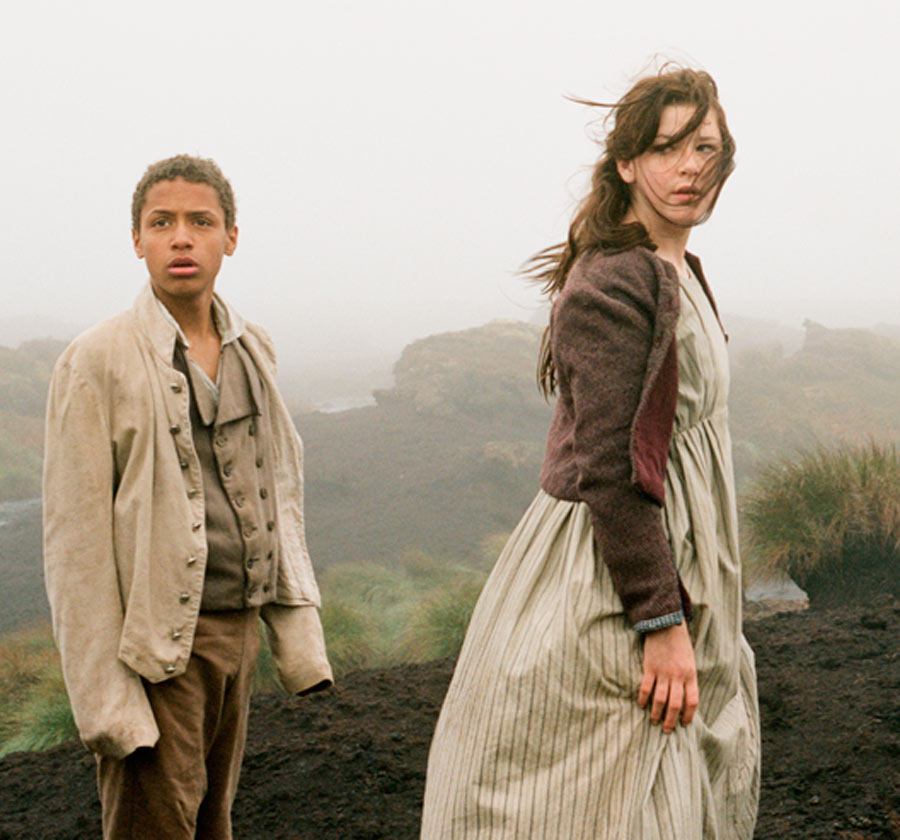
Young love · Solomon Glave (left) and Shannon Beer play young versions of Heathcliff and Catherine in Andrea Arnold’s film, Wuthering Heights. – | Photo by Agatha Nitecka, courtesy of Oscilloscope Laboratories
Arnold’s version is something else entirely. It begins with an angry boy banging his head on a wall and ends with a Mumford & Sons song.
This film is bare bones, using its visuals to encourage impressions and feelings. It focuses more on a seemingly trivial crude painting on a wall or a moment of meditation in nature more so than on the décor of a house or the style of a dress. In fact, Arnold transforms the imposing Gothic edifice of Bronte’s imagination into a dilapidated hilltop farm. It is atmospheric rather than melodramatic, bleaker and more brutal than all previous adaptations in which a swooning heroine and a brooding hero were enough.
“It’s quite mad, doing something like this, but in a way it was very liberating because I couldn’t do anything madder really,” Arnold said of her project. She is the first woman to take on a feature film adaptation of Wuthering Heights, and she takes more artistic risks than any previous director.
Many adaptations don’t stay true to the character’s ages, but Arnold’s decision to remain true to Bronte’s vision was a simple one.
“It makes sense that they’re angry and passionate and slapping each other at 13,” she said.
The younger casting allowed her even more ability to delve into Cathy and Heathcliff’s complex psychology. The film then becomes a coming-of-age story for the two in which Cathy and Heathcliff struggle between the wildness of their childhood and the restrictions of adulthood. In focusing on this balance, the performances of the young actors are the best part of the film.
Arnold sees this struggle as an extension of Bronte’s own anxieties about societal perceptions of femininity in the 19th century.
“There’s Emily and Cathy roaming the moors being free and independent as children and then losing that freedom and independence when they hit puberty and had to be married,” she said.
But though Cathy is certainly less passive and more three-dimensional in this adaptation, she still serves more as a symbol (of Heathcliff’s youthful hopes) rather than a true character.
A subtly mischievous Shannon Beer plays the young Cathy wonderfully. and Kaya Scoledario does an equally good job in a more restrained adult version of the character.
Solomon Glave is particularly suited to the part of the solemn and tormented Heathcliff, and James Howson does well as his more sophisticated older counterpart. Heathcliff becomes less the Byronic hero of old and more a cousin of James Dean from Rebel Without a Cause.
Indeed, Andrea Arnold sees the similarities in the moody young men.
“I started writing a contemporary version. When I was up in the moors, I saw this lad walking down somewhere wearing a hoodie and I thought, ‘Heathcliff! Heathcliff in a hoodie!’ And I started it that way,” she said.
Additionally, Arnold intended and succeeded in attempting to create audience empathy for Heathcliff.
“[In the novel], he’s this mythical, revengeful, brutal, angry character and yet, hang on a minute, didn’t they completely brutalize him as a child?”
One of the ways Arnold intended to highlight Heathcliff’s exclusion was by casting black actors in his role. Though Arnold acknowledges that this representation might not have been Bronte’s intention on the page, the symbolism of Heathcliff being a visually different race from his adopted family was important to her.
“[Bronte] played with him being different, and his difference is important,” said Arnold. “And the fact that he’s different does bring about some of the brutality and I wanted to be very clear about that. … Because I wanted to make it a very visual film, I wanted to make his difference very clear.”
In other aspects as well, the film succeeds at being visual. It is, simply put, beautiful. The camera hovers on thistle and local insects, storm clouds and raindrops.
But the visual emphasis also makes for the film’s downfall.
The supernatural is substituted for the natural and it seems sort of strange to watch Wuthering Heights without spectres and souls. Furthermore, there isn’t much in the way dialogue or transitions, and the narrative suffers for it.
Audience members, then, must have a thorough understanding of the novel to follow the plot. And those who have read the novel might be disappointed in the film’s divergences.
Though the actors can fill in blanks through looks and gestures, too much of the source material is still unfortunately omitted. And though forgoing the second half of the novel should be a good directorial choice, the film seems to end all too abruptly with many questions left unanswered.
But the overall question that Arnold asks us — “Are we born or are we made?” — does receive proper exploration. We see Heathcliff abused and angry from childhood, yet we also see him tender and hopeful with Cathy. The audience gets the sense that this version could have ended much more happily for its protagonists. That realistic exploration alone makes the film worth watching.
“Andrea Arnold’s Wuthering Heights . . . is not Emily Bronte’s Wuthering Heights, nor does it claim to be.”
Nonsense!
It’s claim is all over the film presentation.
Is it not called “Wuthering Heights”?
Isn’t Emily Bronte given credit as a source?
Hasn’t Ms Arnold said clearly that she never thought she would do a book, much less a classic of Ms Bronte’s
caliber?
Arnold should have used her brain instead of her heart.
Yes, “it is entirely different” which is why she should have called it something else and renamed the characters as well. Stop capitalizing on the Bronte name. It is obscene!!!