
Asking For It needs to be mandatory reading at USC
It’s a hot, humid day in October. Synth-pop is leaking out of hidden speakers in the Dubai Mall’s food court, where hundreds of hungry people are drowning out the music with their chattering. A 12-year-old girl is waiting in line at Subway, trying to decide between a meatball marinara and a turkey breast sub when she feels someone press up against her. Whoever it is pushes her against the plastic counter she’s leaning against. Strong arms come up on either side of her, hands pressed against the cool glass of the display case.
In that moment, panic grips her and she freezes. Some small part of her recognizes the man caging her as the one she’d spotted earlier while wandering around, trying to decide what to eat. He’s old enough to be her grandfather. There’s a leer on his face. Her heart is beating wildly. As sirens blare in her head, she experiences the situation as though it is happening to someone else. A few more seconds, the man’s sour breath wafting over her face, and things snap back into motion. She pushes his arm away with adrenaline-fueled force, and runs to where her mother is waiting on the other side of the large food court.
Seven years ago, I was that girl. That is my first clear memory of sexual harassment. In the days following that incident, I would ask myself, “Was it my fault? Was I asking for it?”
Later, I would learn that many people ask themselves the same question after they’re sexually harassed, or worse, raped.
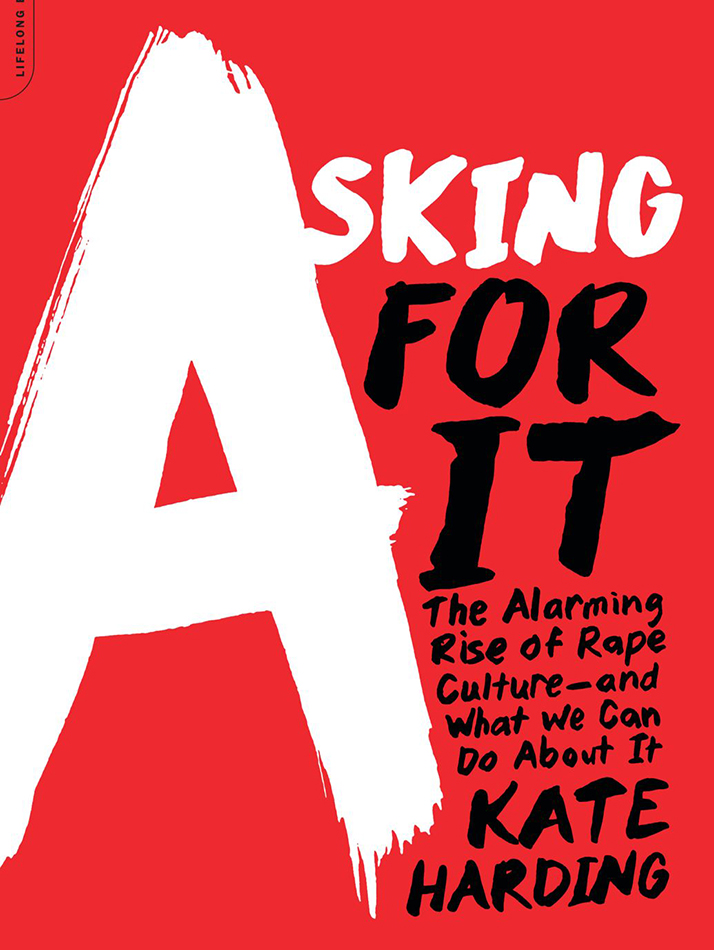
In Asking For It: The Alarming Rise of Rape Culture – And What We Can Do About It, Kate Harding explores the phenomena of rape culture and victim blaming, as well as rape myths and the politics of sexual assault.
“Rape culture? [… ]Isn’t such overblown terminology the kind of thing that makes people call feminists ‘humorless’ and ‘strident,’ and accuse us of holing up in our ivory towers, theorizing about human behavior without ever witnessing much of it?” writes Harding on the first page of her book.
Harding is, of course, correct. The term rape culture evokes violent images, and invites shame to make itself at home in our minds. But is rape culture really a thing? Yes, is the definitive answer, it seems, as Harding explores how rape jokes, the glamorization of sexual violence, and slut shaming have become the norm.
Rape culture is often defined as an environment where rape is prevalent and in which sexual violence against women is normalized and excused by pop culture and the media.
Harding easily and succinctly sums up the very real implications of ubiquitous rape culture: “When it comes to rape, if we’re expected to put ourselves in anyone’s shoes at all, it’s the accused rapist’s. The questions that inevitably come along with ‘What was she wearing?’ and ‘How much did she have to drink?’ are, ‘What if there was no rape at all? What if she’s lying?’”
Harding’s book is not an anthology of sexual assault stories, which would be infinitely morbid, not to mention traumatic for those who have experienced such assault. It is, however, a witty and concise explanation of everything that is wrong with our culture. A recent survey revealed that 29.7 percent of female undergraduate students at USC have experienced some form of sexual assault. More to the point, the USC Department of Public Safety routinely sends out notifications about “butt-grabbing” males assaulting unsuspecting college students across and around campus.
“Not all men!” cry the staunch Men’s Rights Activists and those who believe that feminists hate all males. But while not all men are rapists and sex offenders, every woman and girl has been catcalled, and one in every five women have been sexually harassed and/or assaulted. Being female means growing up with the knowledge that at any moment, you could be attacked, walking alone is never a good idea, you must never leave your drinks unattended, you must take precaution after precaution to shield yourself from the barest possibility of attracting the wrong kind of attention.
“Every seven minutes, someone in America commits a rape,” writes Harding, unraveling the ugly truth.
Feminism, to me, is held to the same standard as the Declaration of Independence (although I am not an American citizen): “We hold these truths to be self-evident.” In this case, those truths are the unalienable rights of every female to live without fear of sexual assault — and I’m certain Harding would agree.
Noorhan Maamoon is a junior majoring in print and digital journalism. Her column, “The Hijabi Monologues,” runs on Thursdays.