
That’s Fashion, Sweetie: The verdict is in: It’s time to be original
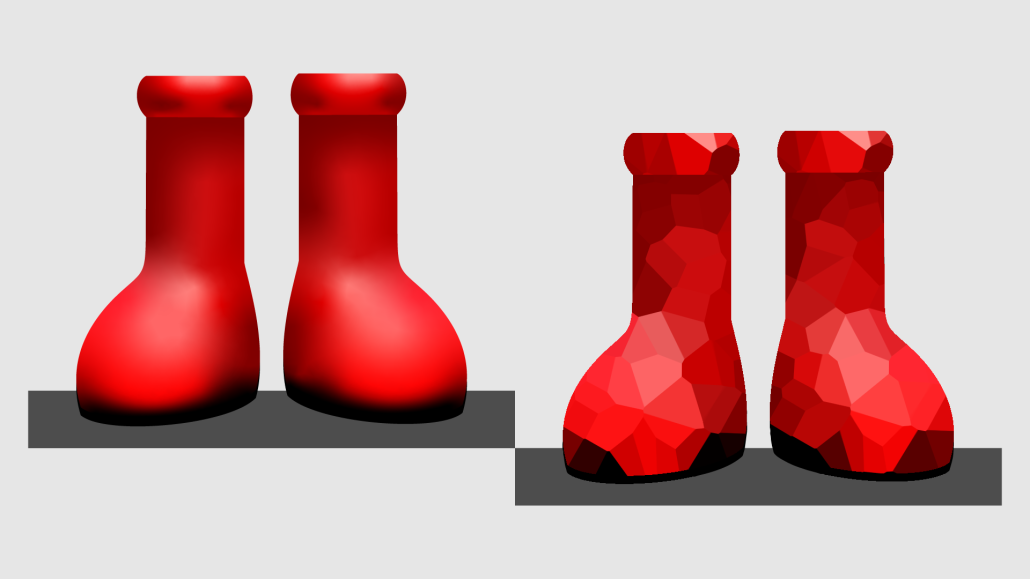

When MSCHF revealed its “Big Red Boots,” it took the internet by storm. Not only was the fashion world gagging over it — in both a good and bad way — but meme culture quickly took over, comparing it to the boots worn by Boots in “Dora the Explorer” and “Astro Boy.”
When contemplating how the boot became so popular to the point that it was sold out within the day, I have to give credit where credit is due: MSCHF teased the shoe at the perfect time.
Giving the internet just over a week before its Feb. 16 launch, MSCHF co-founder Daniel Greenberg knew that the “cartoonish abstraction of a shoe” would quickly go viral. Further implementing marketing tactics by releasing the editorial photos of the shoes being styled, along with various fashion influencers debuting them on their personal feeds, meant that after launch day, the only way to snag a pair is through StockX and pleading with pricey resellers.
I wondered how the boot would be replicated, though — and if it could be at all. Just as fast fashion companies like Shein and retail giants like Urban Outfitters blatantly copy small designers and emerging trends at vastly cheaper prices, shoe companies like Jeffrey Campbell and Steve Madden have had a history and found similar success by following this copy-cat model. Still, though, Campbell and Madden’s shoes were traditional — not massive, clunky, “Super Mario”-tube-portal resembling boots.
I was quickly proven wrong when I was sent Danny Kabouni’s TikTok, where he 3D prints his own pair of MSCHF boots. He scaled another user’s 3D print of the shoe to 700% — since the original creator, bigovereasy, used dimensions for his fingers — and used thermoplastic polyurethane filament instead of polylactic acid to mimic the flexible nature of the actual shoe. The total print time ended up being 12 days per boot, but they were, surprisingly, completely wearable.
Obviously, in the grand scheme of this, it is much cheaper to shell out $350 for the boots or, rather, $500 and upward for the current resale value, than it is to buy a 3D printer and printing material. But, for people who have access to a 3D printer, what does this mean for the future of fashion and everyday items in general?
Most likely, the end of large supply and retail giants. But, as humans, we can be lazy. That’s part of the appeal of shopping — the fact that it’s already there, fully assembled for us. But, then, if we all just saved money to purchase 3D printers and printing supplies instead of buying a new shirt or sneakers, what’s stopping us from creating our own products, and even selling them? The first is that we can’t 3D print everything. Plastic and filaments are not ample nor viable substitutions for cotton, satin and metal. But a second, more technical answer, is the law.
While under the umbrella of intellectual property and IP theft, did you know fashion lawyers exist? It’s even a program at Fordham University.
In fact, fashion lawsuits constantly happen right under our noses, they’re just not as closely followed, except by people who are invested in the industry as some sort of stakeholder or just really care about fashion. While it’s understandable, as these lawsuits don’t affect our lives the way that the overturning of Roe v. Wade or Brown v. Board of Education did, they’re still fascinating to look at.
One of the recent major cases was Adidas v. Thom Browne, in which Adidas attempted to sue Thom Browne for $8 million in damages after claiming that Browne’s use of stripes and high prices would confuse and deter customers away from Adidas. On Jan. 12, the court ruled in favor of Browne. Adidas then filed an appeal Feb. 9 to try and get the verdict reversed, with its spokesperson telling Forbes that the company “will continue to ‘vigilantly enforce’ its ‘intellectual property.’”
Another major case: Hermès v. Mason Rothschild’s MetaBirkins, in which the jury ruled in favor of Hermès, awarding the company $133,000 in damages. Claiming that the NFTs were diluting the “luxury brand’s trademark” and status that came with the elusive Birkin, the jury actually decided based on the NFTs failing a test that determines whether or not they could be considered art.
But why do we even bother with filing lawsuits if we’re living in an age of increased repetition, such as in 3D rendering and IP theft?
Part of this stems from the purpose of trademarks, patents and copyrights. All serve to protect, but do so in different ways and serve different purposes. Trademarks are reserved for a word, phrase or design, or a combination, that distinguishes a company’s good or service from others to avoid customer confusion to further brand reputation and name-brand associations. Patents are for new and useful compositions that are highly unique or vastly improve an already existing product — but, they can’t be utilitarian (generic). Copyrights protect intellectually created works that are original and exist in a tangible medium but serve to protect against copying.
It is up to companies to take the correct course of action to secure their name, idea or product, and to do so in an appropriate manner. While expiration dates and renewals may need to occur before the product or brand becomes big, early action may prevent being steamrolled by corporate giants.
But by enforcing this legal system — and truly, in having a legal system at all — we can continue to attempt to enforce a life of peace, respect, empathy, and nurturing for creativity and humankind.
It is impossible to expect people to live on a purely honor-based system, and it would be naive to believe an entire nation could do so — even though we all have that one friend who is genuinely too pure for the world.
I believe that while rules are meant to guide and redirect rather than restrict and scare, sometimes it’s good to know the limitations — whether this means throwing your pet bottles in the correct bin or thinking of a product and finding it already exists upon further research. It forces you to think differently and pivot, which are skills we need to continue to hone as we grow older and challenges feel grander in scale.
The world doesn’t require a majority of the population to create change. It can always start with one thought or one idea, so why not make it one that’s original?
Hadyn Phillips is a sophomore writing about fashion in the 21st century, specifically spotlighting new trends and popular controversy. Her column, “That’s Fashion, Sweetie,” runs every Tuesday.