TECH TALK
USC should ban devices in classrooms
Devices in classes can be distracting and unproductive, and the no-electronics policy some USC professors enforce has proven more productive and beneficial.

By LILY BLANKENHORN
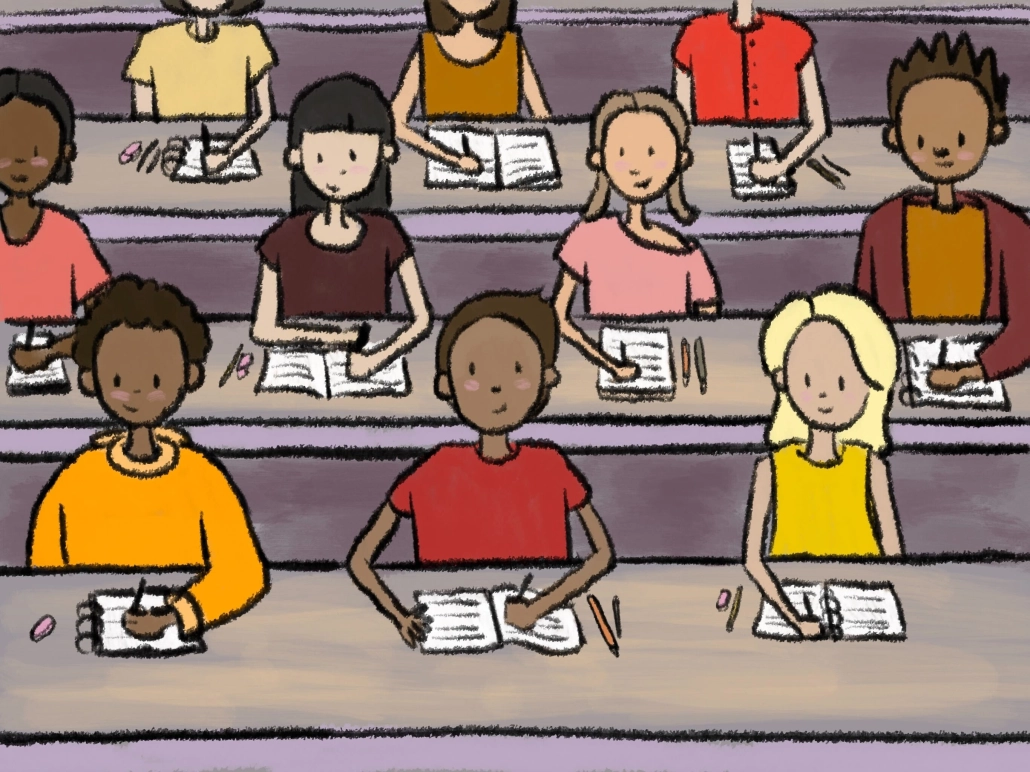

Devices in classes can be distracting and unproductive, and the no-electronics policy some USC professors enforce has proven more productive and beneficial.
Do you ever feel the urge to check your phone during class? Sometimes, I will be fully engaged in an intriguing class discussion when a student in front of me whips out their phone, and I lose my train of thought completely. While glancing at my fellow students in the classroom, I am not the only one with this problem. I’d say that about one-third of students in my classes spend class glued to their phone or computer, completely tuned out of the lessons happening 10 feet ahead of them.
Technology has efficient qualities that are helpful in classrooms, but ultimately, they are a barrier to the education that we pay great money for.
To work around our technology addictions and promote better education, I believe that lectures should acquire the no-electronics policy that some of my USC professors have utilized individually. This strategy requires that students take notes strictly in notebooks or any other non-device material, banning all electronic use.
Classes that prohibit electronic devices produce more engaging learning environments according to USC professor Michael Thom, save us from counterproductive habits caused by multitasking on our devices, and enhance study habits and learning skills — ultimately improving the overall educational experience.
Everyone has experienced a class that they absolutely dread going to. You despise this class because it is quiet, awkward and everyone seems disinterested. Due to the gloomy environment, your interest in the course decreases — as does your motivation to learn or participate. When students are tuning out, they turn on their computers or phones to counteract the boredom.
Using devices in classrooms comes with the threat of multitasking. When taking notes on my laptop, I can’t stop myself from checking my texts, emails and Instagram feed. As a result, I don’t grasp the taught concepts in such detail compared to handwriting because I am focused on multiple things simultaneously.
According to research by the late Clifford Nass, who was a professor at Stanford University, “The top 25% of Stanford students are using four or more media at one time whenever they’re using [electronics]. So when they’re writing a paper, they’re also Facebooking, listening to music, texting, [and] Twittering.”
Multitasking is not only unproductive, but it also produces unproductive habits. Nass told NPR that “people who multitask all the time can’t filter out irrelevancy. They can’t manage a working memory. They’re chronically distracted.” Their studies additionally show that your brain works more efficiently when focused on one task at a time. Class should be our primary focus, and without electronics, it undoubtedly will be.
My journalism professor, Geoffrey Cowan, bans devices in his lectures because of students’ tendency to disrupt the learning environment with their devices. In Vox’s article “Why you should take notes by hand — not on a laptop,” research on undergraduate and law students has shown that “Those who use laptops have something unrelated to class up on their screens around 40 percent of the time. Ultimately, they perform more poorly in classes and rate themselves as less satisfied with their college educations.”
Associate Professor Michael Thom utilizes the non-electronics policy and deems it very effective. When asked why he implemented the procedure, he wrote in an email to the Daily Trojan, “I noticed that students were frequently distracted by their own devices. I also saw a secondhand effect: students would be distracted by other students’ devices.”
On whether he saw a difference in student engagement without the presence of technology, he wrote, “Absolutely. Overall participation is higher and I rarely have to repeat myself anymore.” Technology in the classroom provides unnecessary distractions that can be solved by limiting their presence. With fewer distractions, the learning environment will be more productive and enjoyable for both teachers and students.
I know that handwriting notes is deemed old-fashioned and time-consuming by most, but handwriting helps you cement knowledge in your brain more efficiently than typing does. In fact, the act of taking notes on a computer “actually seems to interfere with the ability to remember information.”
I know most people will be opposed to the technology ban in classrooms. I even favored Google Docs to a notebook any day before this school year. However, after comparing my classes with the non-electronic policy to the ones where devices are permitted, I realized the disposition of the classrooms was drastically different.
Without electronics, students intently listen and an overall joyful mood is often evident. Studies have shown time and time again that devices in classrooms hinder the learning experience and that handwriting notes have many educational benefits. I also understand some students will need to use technology due to academic accommodations, which I believe we could certainly work around. I think it is time that the university considers a non-electronic policy to combat these issues to better classrooms for professors and students.
Lily Blankenhorn is a freshman writing about the affects of modern technology on society. Her column, “Tech Talk,” runs every other Thursday.