Gould School of Law welcomes most selective class
Gould’s class of 2026 also breaks records for diversity in the school.
By TALIA WEXLER
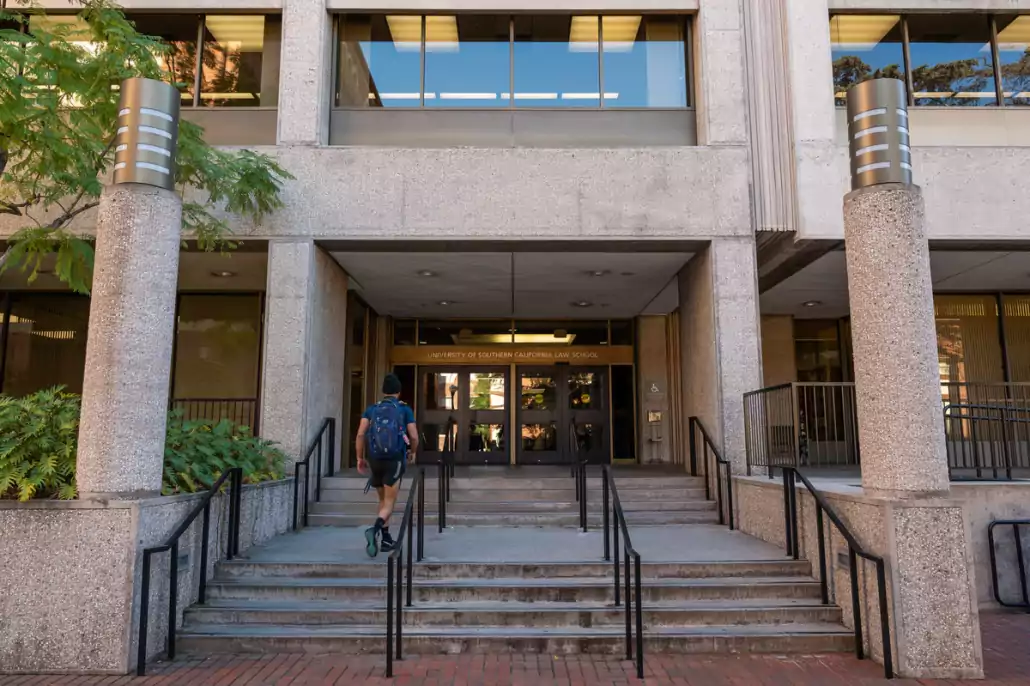

Gould’s class of 2026 also breaks records for diversity in the school.
The Gould School of Law’s Juris Doctor class of 2026 is the most accomplished to date, according to Associate Dean of Admissions and Financial Aid David Kirschner. Fifty-three percent of students reported they come from a historically underrepresented group. Kirschner said Gould’s increasing diversity and selectiveness is continuing off of a trend that began in 2016.
Kirschner said during these seven years, it has become increasingly more difficult to gain acceptance to Gould and the school’s yield rate has increased progressively. For the class of 2019, the median LSAT score was 165, the median undergraduate GPA was 3.76 and the yield rate was 17%. The class of 2026 has a median LSAT score of 169, median GPA of 3.88 and yield rate of 31%.
Kirschner said, from a statistical perspective, it will be difficult to continue the school’s trend of increasing selectivity, yield and diversity with each incoming class.
“This [class] has set a number of records,” Kirschner said. “It certainly makes my job harder moving forward. I don’t know how one, at least as far as numbers go, tops a class like this.”
Kirschner said he is particularly proud of Gould’s commitment to supporting first generation students through its endowed First Generation Professionals Program, which launched in 2015. The program provides a variety of services to students, including peer and alumni mentorship opportunities.
This year, 38% of first year JD students at Gould are first generation college students or the first in their families to pursue a graduate degree. Kirschner said this diversity contributes to the quality of Gould education.
“Lawyers serve diverse communities, in particular lawyers in California,” Kirschner said. “I think there’s a lot to be said for training lawyers in a setting that’s reflective of what they are going to be practicing in.”
Coming from a diverse set of backgrounds, students in the class of 2026 have a variety of aspirations for how they will use their degree from Gould.
Jasmine Kerber is a retired American individual rhythmic gymnast and a first year JD student at Gould. After earning her master’s degree in communications from Stanford University, she volunteered with USA Gymnastics to help develop rules and policies for the sport. She also served as a panelist with the U.S. Center for SafeSport, a nonprofit that works to end abuse in sports.
This legal-adjacent work was a significant part of what inspired Kerber to attend law school. Although she is not certain of how she will use her Gould degree, she said she is interested in pursuing law that allows her to remain close to sports.
“I really like the idea of trying to help athletes in some way, especially young female athletes,” she said.
Another member of the class of 2026, Nathaniel Park, joined Gould with a background in environmental studies. Before law school, he worked as a mission operations coordinator in the science operations division of the Pacific Islands Fisheries Science Center. In his former role, Park navigated legal policies surrounding federally protected wildlife and fisheries, which he said inspired him to pursue a JD.
“[My work] was a large factor in me going to law school, I’m interested in the policy and legal issues that surround environmental conservation and climate change issues,” Park said.
For Park, USC’s location, faculty support and networking opportunities were key factors in choosing to attend Gould, while Kerber said she was enticed by the welcoming environment of the school.
The Gould class of 2026 also includes a Peace Corps volunteer, students with backgrounds in entrepreneurship and at least two Fulbright Scholars.
This group of first year JD students will be in the most diverse classroom environments in Gould history, allowing them to learn from a variety of backgrounds and ideas.