‘Frida: The Last Night Show’ introduces students to Korean theater
Korean theater company EMK performed for students at Bing Theatre Friday night.
By DAVID RENDON
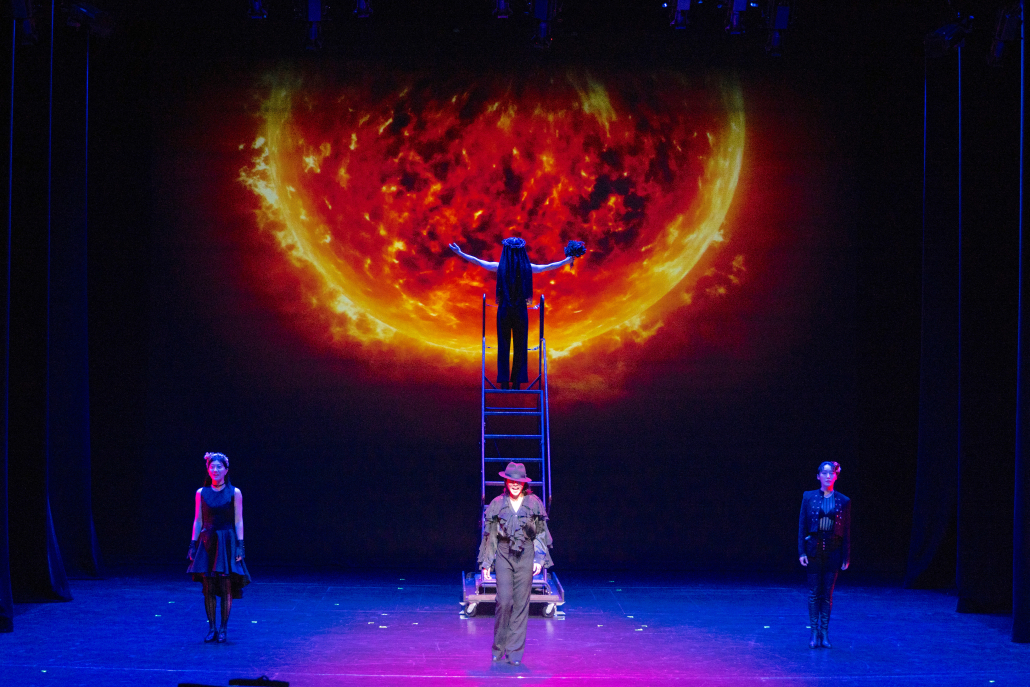

Korean theater company EMK performed for students at Bing Theatre Friday night.
“Frida: The Last Night Show” had its United States debut in a packed Bing Theatre, two years after it opened in South Korea. EMK — one of Korea’s leading musical companies — along with the School of Dramatic Arts, the Korean Cultural Center, Los Angeles and USC Visions and Voices put on the show.
The show presents Frida Kahlo’s story in a new light, framing the performance as her retelling her own life on a late-night show. The musical was almost entirely in Korean with accompanying supertitles for the audience to follow along and was followed by a panel with the show’s producer, writer and star all in conversation, alongside USC faculty including English and American studies and ethnicity professor David Román and School of Dramatic Arts professors Esther Chae and Luis Alfaro.
The cast is composed of four women, but this wasn’t the case initially, said producer Sophy Jiwon Kim in a translated interview with the Daily Trojan and Annenberg Media. Originally, the cast was going to be larger and include men.
“When changing to four only female cast members, achieving commercial success in [South] Korea can be challenging,” Kim said. “Having a popular male figure cast member in a show means a lot.”
But “Frida: The Last Night Show” didn’t need these tactics to become a commercial success, as in its first season the show was able to sell out completely, Kim said.
The theater company is known for their large theatrical productions, but the version they brought to the U.S. was much simpler and much smaller, Kim said. USC had initially wanted a different, larger production, but Kim felt it was not economically viable to do so.
“EMK is well recognized as a company that makes high quality and large scale productions,” Kim said. “Those types of productions are difficult to bring to the global scale … we want to have the EMK identity in it, but at the same time have a small scale, and that brings us to the Frida performance.”
There were very few props in the show, with the most complicated being a ladder and different backgrounds. The show utilized a screen to create ambiance and showcase different pieces of art by Kahlo.
Although this simplistic take on the production is outside their norm, it was received well by audiences.
“It was a really powerful performance,” said Brooklyn Cooper, a junior majoring in business administration who is also in the business taxation master’s program. “The fact that there were basically no props at all, and it was just focused solely on the actresses themselves, I thought it really highlighted what they were actually trying to portray.”
Kahlo’s ability to suffer through so much but still find the beauty and joy in life was one of the key inspirations for the show, said writer and director Jung Hwa Choo.
“I got a lot of passion and a lot of inspiration, specifically of the watermelon and the blood that says ‘viva la vida,’” Choo said. “Her life was so difficult and yet, how could she create such a powerful message with ‘viva la vida?’”
The idea of having the musical be presented as a late-night show was in part because Choo wanted to gift Kahlo high heels, something she likely never got to wear due to the condition of her legs. It gave Kahlo the opportunity to dance as much as she wanted.
“I wanted to give this message to as many people as possible, even though pain may be stalking you and harassing you, open a bottle of champagne,” Choo said.
Having EMK perform on campus in collaboration with KCCLA provided an opportunity for USC to reach out to the community, moderator Luis Alfaro said.
“This signals a very important moment at our school to acknowledge the Korean American community, its course but also the role that it’s taken to shaping Los Angeles not only here but through into our future,” Alfaro said. “I’m thrilled that we’re able to have this moment. Ten years ago, we wouldn’t have had this moment.”
The event included special seating for members of KCCLA, including its director, Sangwon Jung. This involvement between USC and organizations outside its walls came together to gift the University community with an unforgettable experience.
“I’m really happy that USC can host some events with the outside community,” said Freida Lin, a fourth-year architecture student. “I thought it would be good, we have more opportunities to see shows like this. USC is trying to bring some outside resources back to the campus.”
Despite Kahlo being Mexican, Kim said it was never the goal to try to focus on Mexican culture or be representative, but for future performances, they are considering Mexican musical styles for the show.
“Rather than just focusing only on Mexican culture, we wanted to create a story that resonated globally,” Kim said.
Kim acknowledged that it’s difficult for people who do not live in South Korea to see Korean musicals, given that they run in seasons and it can be easy to miss a show. She hopes that this performance of “Frida: The Last Night Show” helps popularize Korean theater.
“Recently, there is a lot of interest in Korean culture: K-pop, K-drama, K-movies, K-food,” Kim said. “It’s challenging to bring Korean musicals that are produced in [South] Korea to go abroad, compared to Korean movies or Korean dramas, because those dramas or movies are just filmed there. They can be distributed to the internet, but bringing musicals to different countries will take a lot of staff members and it takes the whole cast to move to different countries.”
For many students, this was their first exposure to Korean musical theater, and it served as a way of introducing them to a whole new world of art.
“I have not seen any shows in Korean before,” Cooper said. “It’s good to highlight different sorts of culture as well, especially since it’s free, so it’s easily accessible for students. There’s no barriers to actually getting to see different types of culture and representation.”