Candidates clash on AI, campus access at debate
Four presidential and vice presidential tickets as well as 13 senators took the stage Tuesday.
By SEAN CAMPBELL, NICHOLAS CORRAL & ASIANA GUANG
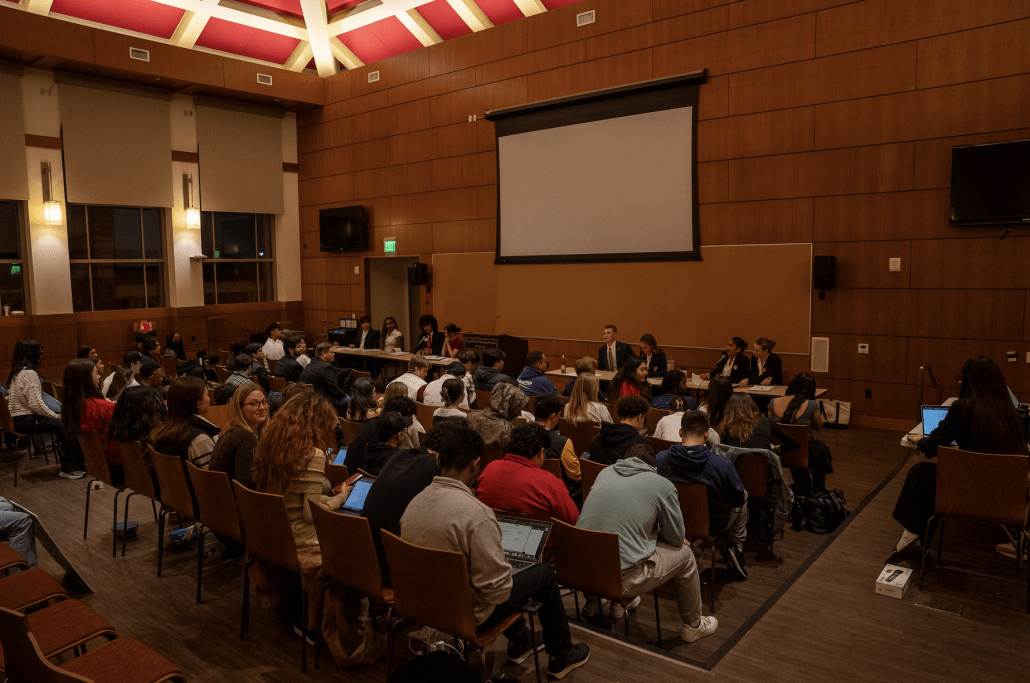

Four presidential and vice presidential tickets as well as 13 senators took the stage Tuesday.
On Tuesday night, the four tickets vying for Undergraduate Student Government president and vice president went toe-to-toe in a nearly two-hour debate in the Forum at Tutor Campus Center.
Candidates repeatedly returned to a theme of transparency between USG and students, and between the USC administration and students.
Vice presidential candidate Gwen O’Beacain — running alongside senator John Breitfelder — said she never knew what was going on as someone who’s never been a member of USG, and emphasized the need for more transparency. Chair of the committee on academic affairs and vice presidential candidate Emma Fallon — running with senator Mikaela Bautista — also said that the administration should have a clear line of transparency so students feel more supported.
Meanwhile, the ticket of senator Ali Bhatti and Chichi Makasi repeatedly mentioned their focus on implementing surveys and questionnaires to include more student perspectives. Senator Heydy Vasquez and speaker of the senate Elija Barnes said having data would be the most powerful way to justify a proposal in their administration.
Moderators asked the candidates whether they supported the current campus gates and, if not, what steps they would take to try to remove the gates.
Bhatti and Makasi spoke primarily about the internal fences around Alumni Park; their platform calls for removal. The other candidates were measured in their responses on campus gates. O’Beacain said the external campus gates made her feel safer, but the Breitfelder-O’Beacain ticket noted that, while changes to external barriers were unlikely, they expected changes to internal barriers.
Bautista and Fallon said they wanted to continue conversations with USC administration about the removal of the perimeters, while Vasquez and Barnes said they wanted to balance safety and student desires.
When moderators asked which other ticket candidates would vote for, Vasquez and Barnes said they would vote for Bautista and Fallon, emphasizing the importance of USG experience for the role. Bautista and Fallon reciprocated the vote.
In response, O’Beacain said the focus on experience promotes “exclusivity,” and Breitfelder said the lack of experience was good because he thinks USG “needs change.”
All four tickets include at least one current USG senator. Two tickets have current USG members as both candidates: Vasquez and Barnes, and Bautista and Fallon. Both Makasi and O’Beacain hold leadership roles in Panhellenic sororities — Alpha Phi and Delta Gamma, respectively.
Fallon and Bautista also received support from the other two tickets. Bhatti said the other two tickets are “not what the culture of USG needs,” and O’Beacain said Fallon and Bautista welcomed her when she began her campaign as an outsider to USG.
Vasquez said the presidential and vice presidential roles are administrative rather than project-based, and said other tickets should “reflect that.” Their ticket emphasized goals like advocating for extended library hours during finals week and utilizing excess funds from previous years.
Breitfelder and O’Beacain repeatedly described themselves as “scrappy” and focused on their goal of reforming USG with an “outside perspective” to the organization. They said they would bring an entrepreneurial spirit to the office, which will allow them to adjust their goals and projects when they encounter hurdles.
Food access was another major topic of the debate. O’Beacain and Breitfelder aim to bring In-N-Out Burger to campus during finals and remove seed oils from the dining halls to promote healthier food options and “make our dining halls great.”
Their proposal to implement EBT for businesses at Tutor Campus Center attracted questions from Bhatti and Makasi about the feasibility of their proposal, claiming that EBT is not usable for hot, prepared food from restaurants.
Among other contested topics, candidates sparred on plans to provide students with access to ChatGPT products. Bautista and Fallon have proposed providing access to ChatGPT Plus, while Bhatti and Makasi have proposed ChatGPT Edu.
Prior to the debate, 13 candidates for senate shared their platforms during three-minute presentations followed by audience questions. 12 of the 13 candidates will be elected.
Among the candidates are two current senators, Jeremiah Boisrond and Jad Kilani. The slate of candidates includes just one woman.
Voting will begin at 10 a.m. Tuesday, Feb. 18, with voting continuing until 11:59 p.m. Feb. 21. Results will be announced at the Feb. 25 senate meeting.
Disclaimer: Heydy Vasquez was previously a columnist for Opinion. Editor in Chief Stefano Fendrich was among the moderators on Tuesday. Fendrich was not involved in coverage of the debates and Vasquez is no longer affiliated with this paper.