‘Topdog/Underdog’ picks the winning card
The SDA professor directed show gives a deep insight into the two brothers’ lives.
4
By HENRY KOFMAN
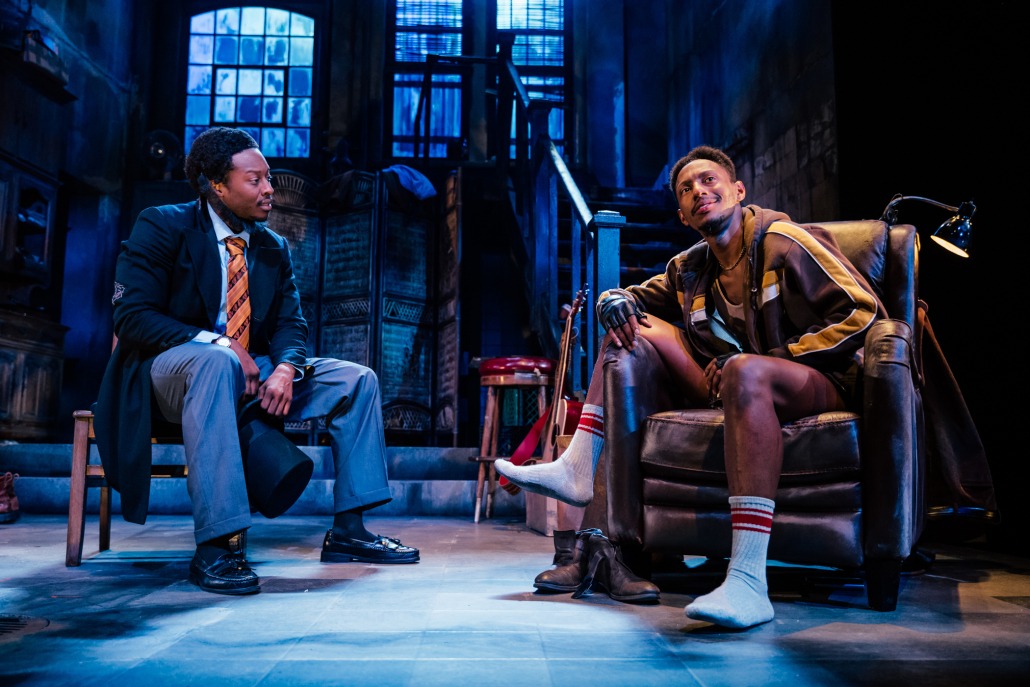

The SDA professor directed show gives a deep insight into the two brothers’ lives.
4
“Watch me close, watch me close now,” says Booth (Brandon Gill) as he shuffles the ever-so-slightly bent three cards under the draping of an overhead stage light; the action is such that the sold out audience might not realize he is actually talking to them. In the Pasadena Playhouse’s production of Suzan-Lori Parks’ Tony Award-winning play, “Topdog/Underdog,” you must watch closely and then you will see a dramatic and powerful tale of sincere human character.
“Topdog/Underdog” tells the story of two brothers, Booth and Lincoln (Brandon Micheal Hall) — names given as their father’s idea of a joke — entirely in the basement room that Booth calls home. The brothers struggle to form a bond between themselves, among a tumultuous past and present, while the show explores themes of the American Dream and personal agency. Parks’ brilliant writing creates an authentic, well-paced and executed relationship between the historically-named brothers.
This production is masterfully directed by Gregg T. Daniel, a theatre professor at the School of Dramatic Arts. The way Daniel approached the show only further integrated the brothers’ relationship and maintained the balance of drama and comedy that Parks’ wholly unique script brings to the table.
The choice to set the show in a basement single room apartment — as opposed to a standard apartment, which has been done in the past — is both well designed and deeply meaningful. As Lincoln leaves to go to work — as an Abraham Lincoln impersonator at the arcade — he walks up the stairs to the street seeking out a traditionally earned living. Under Daniel’s direction, along with Tesshi Nakagawa’s scenic design, there is a physical ascendance towards Lincoln’s idea of the American dream, just like the metaphorical one.
Meanwhile, Booth spends much of his time down in the basement room practicing his hand at the “game” of three-card monte — an act which Lincoln has sworn off. This symbolism — just a small fraction of the greater symbolism in the show — is a perfect example of direction that further supports the writing to make a full theatrical production. By creating this physical and visual upward movement, it gives an understanding of what each of these characters strives for in their aspirations.
With powerful writing that comes to a stunning conclusion, there is much to be appreciated in the show, but at times, it can seem to be going nowhere. In hindsight, the show seems like a well-wrapped gift, but in the moment, some interactions feel useless and there to serve no purpose. In an otherwise well-written and directed show, there are moments — especially in act one — that feel like an awkward and slightly unnatural translation between deep drama and comedy.
In a two-person cast, one weak link can completely crack the show in two, but this is not the case with Gill and Hall’s miraculous and earnest performances. Gill takes to the stage when that first light comes up, drawing the audience into the game of three-card monte that is the show itself. His excitable and energetic performance of Booth’s relationship troubles, family conflict and financial struggles allowed for the audience to connect well with Gill’s embodiment of Booth. His performance is greatly complementary to Hall’s Lincoln.
Hall’s performance, while great from the start, really shines after the intermission and into the next act of the show. His character is deeply motivated and thoughtful when considering the past, and this shines through with Hall’s performance. He seems to feel the weight of every single minute of Lincoln’s past.
These two masterful actors are great to discuss in their own individual performances, but it is truly the collaboration and fluidity of their brotherhood that builds the story through the two-hour duration that keeps the audience engaged.
The show is really a sum of all its parts, all the physical and practical elements led to the strong emotions in the audience. The show plays a harmonious melody of script and production right up until chaos ensues before harmony returns, again and again.
Deep emotion echoes from that basement room even in moments where the characters would be far too afraid to show it. The show would approach a perfect symphony of theater had it not been for the few strange and awkward moments where emotional shifts felt unnatural. In addition, some scene changes felt too long, drawing the audience out of the show. Small moments can also be off-putting, such as when supposedly masterful three-card monte players slip up and drop or flip a card in the shuffle.
Daniel’s directing does a great job overall and the show represents the powerhouse of a theater artist that he is.
As the show comes to a close and audience members walk out into the beautiful courtyard of the Pasadena Playhouse, there is a deep understanding of what family, the American dream, betrayal and connection mean to so many Americans and audience members themselves.
“Topdog/Underdog” runs at the Pasadena Playhouse through March 23.