Museums are dying
Art is disappearing behind the white walls and so are our brains.
By XYLA ABELLA

Art is disappearing behind the white walls and so are our brains.
I never outgrew my childlike dreams of being an artist, so in May, I will graduate with an art degree — even though I am often bored, angry or a blend of both with most of the art and white-walled hypocrisy of today’s museums.
If there is any indicator that our society is spiraling into cultural decline, it is the state of the art world.
In her book “Funny Weather: Art in an Emergency,” Olivia Laing wrote that art “provide[s] material with which to think: new registers, new spaces … It shapes our ethical landscapes.”
Art has always been a vessel to challenge the status quo. At its core, artists do not seek to reproduce the world we live in, but to rethink, challenge and meaningfully redefine it, unafraid of a revolution. They remain steadfast to the act of free expression and free speech.
Historically, artists were an impetus to socio-political resistance, creating a long-standing tradition of anti-establishment activism. I like to believe that most working artists, especially emerging ones, still hold onto these values of advocacy and protest in their practice.
However, as the art world succumbs to neoliberal and market-driven tactics, the grittiness of politically informed, subjectively earnest art is replaced by what I consider to be mind-numbingly neutral works of little substance. With the primary priority of being sellable, artists are more likely to compromise fervid creative pursuits in exchange for commercial success.
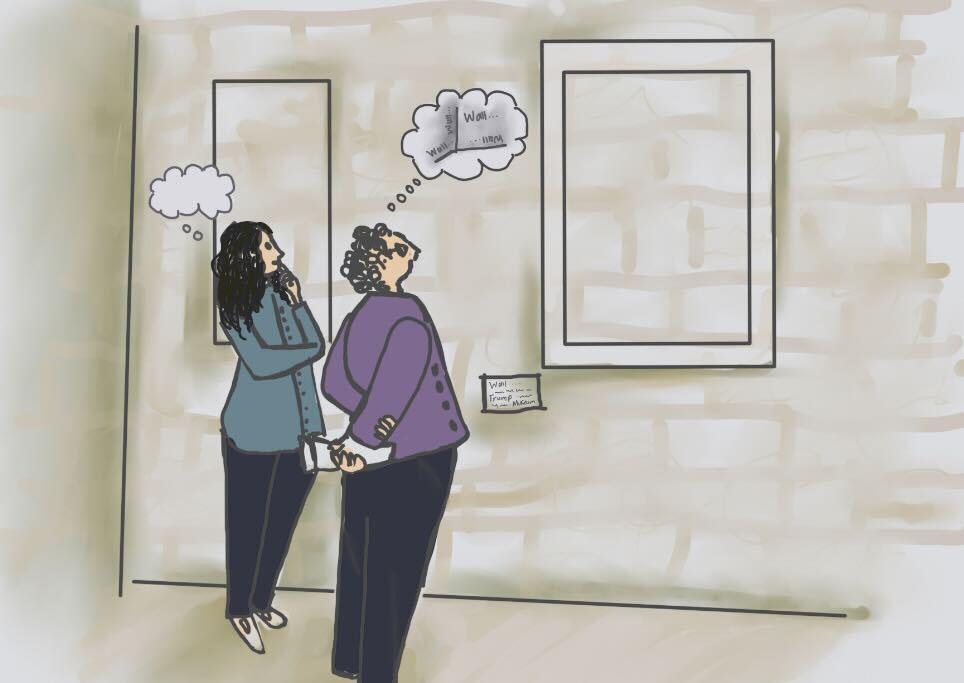
Although questionable market trends within the industry are not something new, they are now further exacerbated by the increased deadening of museum culture in the 21st century as the slippery slope of late-stage capitalism eclipses all cultural institutions. While museums were once a concentrated space, displaying boundary-pushing ideas and the audacious incongruencies of society, today they are no more than glorified panopticons.
I was first introduced to critical museum discourse in Tony Bennett’s book “Exhibitionary Complex” as a first-year student at USC. Now, as a fourth-year, I am returning to the same required reading as I watch the art world turn inward in the face of the current presidential administration and fear funding losses.
In “Exhibitionary Complex,” art theorist Bennett draws parallels from Michel Foucault’s examinations of early prison systems to the functions of the modern museum. According to Bennett, large-scale exhibitions operate under “a set of cultural technologies concerned to organize a voluntarily self-regulating citizenry” with hopes of creating a homogenous body politic.
Sold as culturally enriching hotspots and a safe space for contentious thought, museum spaces have become pawns in the chess game of social order. The neoliberal and market framework ensure that the standard of excellence for museums — and the art they display — is based on the limits of what is revolutionary enough to satisfy a scholastic opinion but not so radical as to disrupt the flow of money and status quo of capitalism.
However, there are strong-willed forces — artists and spaces that are dedicated to disrupting the existing condition and devoted to visual dissent. Art spaces like as-is Gallery in South Central are curating works focused on local Los Angeles history and the investigation of regional culture. Even the architecture of the space is indicative of its humble roots; the layout of the space is reminiscent of homes, further characterized by its weathered red tiles.
In a recent exhibition, as-is Gallery featured L.A.-based artists William Camargo and Jackie Castillo alongside Julie Shafer. I was especially drawn to Castillo’s installation of large, black-and-white photos, depicting realities of Southern California’s housing crisis and the exploitation of immigrant labor in the real estate industry.
We are lucky to live in a city that is committed to maintaining spaces of visual and conceptual richness like as-is Gallery. Nonetheless, the existence of smaller-scale art spaces, especially among for-profit collections, is partially sustained by community interaction and public visitation. They can only be activated by the people.
So, text the group chat, make a day of it, discuss. Art, after all, is meant to be realized closely and shared widely. Remember that art is an opportunity to learn, to feel and to be confused; it does not always seek to answer, but it always seeks to question.