Native American Student Assembly Powwow holds third annual Popup Powwow
The event featured performances including traditional singing and dancing to encourage education and connection with Native American culture.
By BANI CHAUHAN
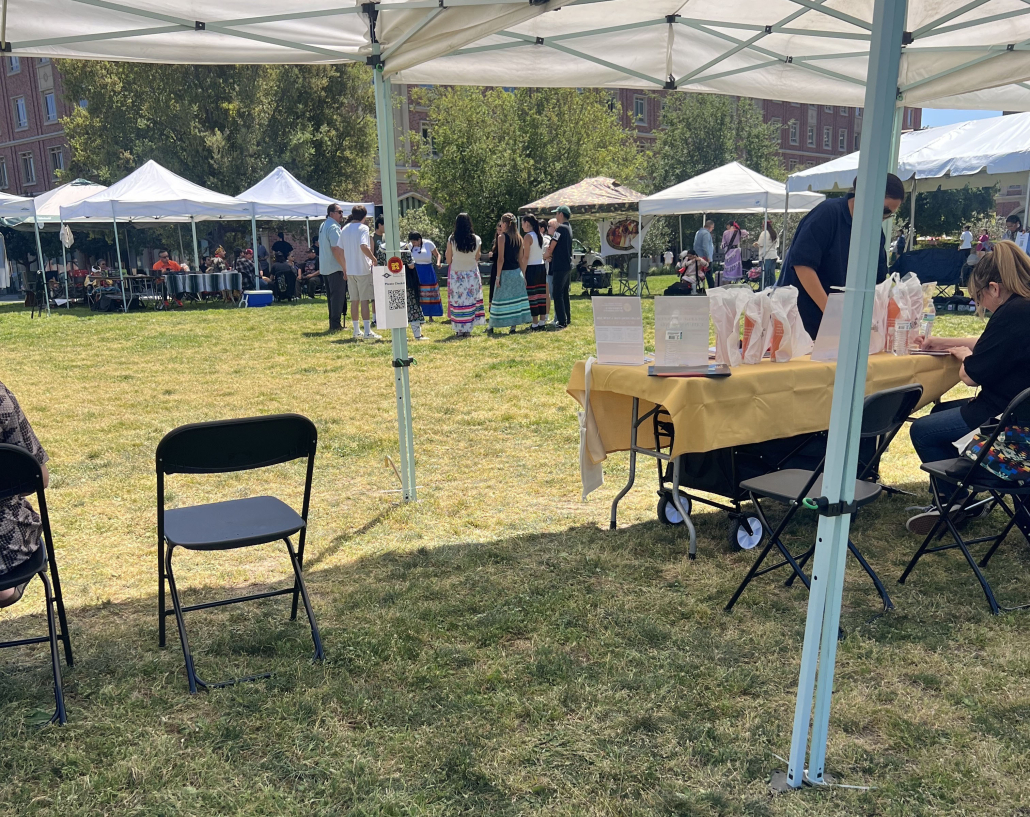

The event featured performances including traditional singing and dancing to encourage education and connection with Native American culture.
The sound of drums, prayer, singing and dancing could be heard at USC’s third annual pop-up powwow event April 5 at USC Village’s Great Lawn which brought together members of the Native American community at USC and the greater Los Angeles area as well as non-Native American attendees.
The Native American Student Assembly organized the performances by reaching out to Native Americans in the Greater Los Angeles community, said Regan Van Stavern, a NASA intern and a junior majoring in industrial and systems engineering.
“The people that are dancing, they actually volunteer, and a lot of people will just show up because of it being a contest [with] a prize,” Van Stavern said.
The powwow began with a prayer and then a grand entrance where all the dancers came out to the grand arena, the center stage for performances. The arena director, Richard DeCrane, decided which group danced next, according to Kaitlin Becenti, the assistant director of NASA and a senior majoring in journalism.
This powwow is just the third event of its kind to be held at USC. The event has grown a lot since its inception. The inaugural powwow featured around six dancers, Van Stavern said.
According to Van Stavern, powwows are ceremonies to honor ancestors and bring the Native American community together.
“It’s very significant because it’s for honoring your ancestors, your elders, just anybody that is a big person to you and your community, and it’s to dance and listen to music,” Van Stavern said. “It’s that kind of connection that you don’t get from just talking; it’s more spiritual.”
Powwows allow different Native American tribes to gather and uplift each other to celebrate culture and heritage, Becenti said.
“It’s a special [event] for a lot of Natives who live in urban areas, like the L.A. area,” Becenti said. “It’s a way for us to all connect again in moments where sometimes we’re not able to. These events are really meaningful to us and a lot of us students are away from home, so this allows us to reconnect and be grounded again.”
Holding the powwow comes with certain challenges, said Dineh Barragan, the director of advocacy at NASA and a sophomore majoring in environmental studies.
As an entirely student-organized event, the powwow faced multiple organizational challenges because of funding issues, Barragan said. Other student clubs and organizations played a role in helping to get the powwow event financially organized.
“Last year we got our funding cut, and that’s been a struggle that we’ve had to deal with in terms of adjusting our budget and ensuring that we have enough funds, so whether that’s getting sponsorships through the Latine Student Assembly or even [Student Assembly for Gender Empowerment] or Visions and Voices who have assisted in hosting this event today,” Barragan said.
According to Barragan, an important function of the event is to provide a space that lets Native American students connect with their community and allow non-Native American students to learn more about Native American culture and community on campus.
“Just knowing that regardless of whether or not they come from an Indigenous background, that NASA is a space for everybody, and we’re always welcome to allies,” Barragan said.
The amount the event has grown over the past three years is a hopeful sign that the event will continue to grow even more, with greater student involvement and food trucks next year, according to Van Stavern.
“I hope this event gets more people to be interested in the culture itself,” Van Stavern said. “Because we are on [Gabrielino-Tongva] land right now, USC is built on this land and it’s important to acknowledge that.”