THE NOT SO GREAT DEBATE
Why portal mania has me worried
The allure of the transfer portal is dangerous for student-athletes.

By HENRY MODE

The allure of the transfer portal is dangerous for student-athletes.
Well. It’s been a minute — including an entire March Madness — since Editor in Chief Stefano Fendrich and I have given our lovely Daily Trojan readers a window into our never-ending quarrels. I, for one, am excited to get back in the ring.
During the break, Fendrich and I made a pit stop in Spokane, Washington, where we took in the Sweet 16 and Elite Eight of the NCAA Tournament — in the end watching USC (31-4, 17-1 Big Ten) fall to eventual-national champions UConn (37-3, 18-0 Big East).
But even without superstar sophomore guard JuJu Watkins, the Trojans came far closer than any other team to taking down the Huskies — trailing by just five points entering the fourth quarter. So I’m ready to take yet another victory lap over Fendrich, this time on my contention that the Trojans (with Watkins) were the rightful pre-tourney national title favorites.
It’s safe to say that if not for the consensus National Player of the Year’s devastating right ACL injury, there’s a very good chance the Trojans would have been cutting down the nets in Tampa on Sunday.
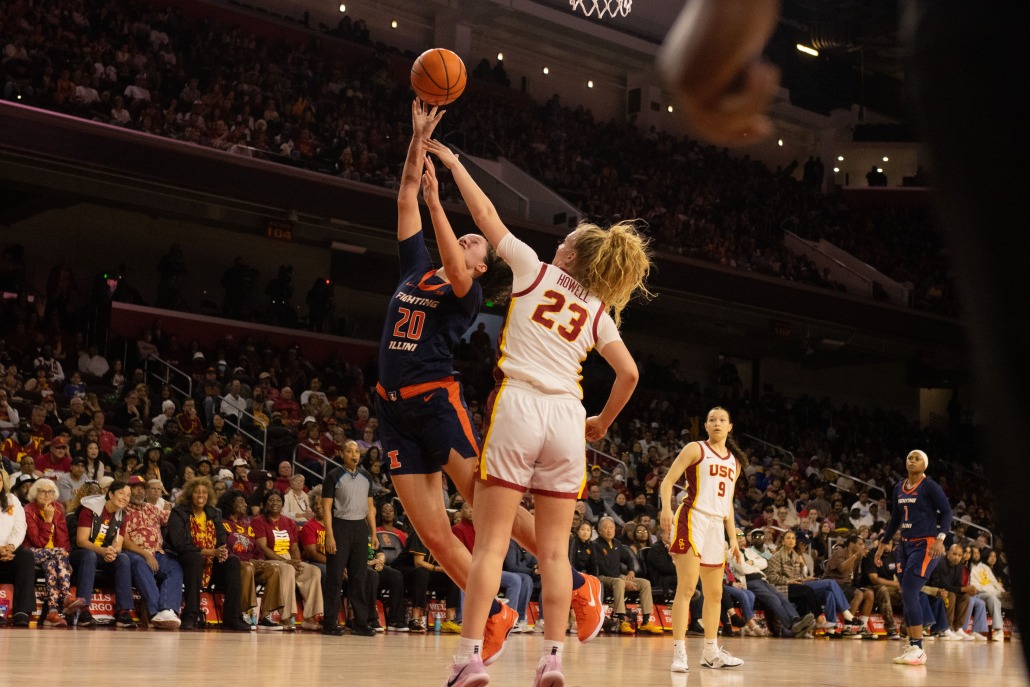
But we’re not here to talk about the tournament or what could have been. Fendrich has rapidly shifted focus from the Big Dance to the transfer portal — and Head Coach Lindsay Gottlieb has been forced to do just the same. Four Trojans entered their names in the portal in the days following the end of USC’s campaign last week, including standout freshmen guards Avery Howell and Kayleigh Heckel.
Howell and Heckel are two of 1,226 women’s college basketball players to enter their names in the portal, as of Monday morning. On the men’s side, that number passed 1,800 over the weekend, and both are sure to continue rising until the portal closes on April 22.
This has become an extremely controversial topic, and I agree with Fendrich that there’s a lot of ridiculous takes flying around. He’s right that there is no reason to attack players for trying to get paid, or to hold student-athletes to a different standard than coaches hopping from school to school.
I’m not even particularly interested in the grandstanding about the talent fleeing from mid-majors to Power Four programs, and how it may have led to the lack of upsets in this year’s NCAA Tournament. Cinderellas are fun for a bit, but I’ve always been partial to how things usually play out on the women’s side — where the top seeds may cruise early but there is usually a guarantee of competitive battles between the best of the best when the business end of the tournament comes around.
Where my concern with NIL and the transfer portal comes is with the student-athletes themselves. It is undoubtedly a good thing for players to be compensated, but as it’s currently playing out, I don’t think the system is ultimately working to the benefit of their development — either on the court or off of it.
Let’s start with their development as athletes. Ultimately, high-level prospects play Division I sports with the primary goal of improving their skills and, as a result, their chances of a long, successful career at the next level.
Adversity is perhaps the most important part of this developmental process, and the portal teaches young athletes to run away from it at every step. Hard coaching? Portal. Minutes down? Portal. Don’t like your role? Portal.
Fendrich says this is natural. If you’re used to being the top dog in high school and get to college just to see others from your recruiting class playing more minutes and having more early success, wouldn’t you transfer too? Sure, I probably would. And guess what — there’s a reason why I’m not a Division I athlete.
Learning to play in different kinds of systems and take on new roles is crucial for young athletes, but the portal is a tempting and ever-present offer to just skip the hard part.
Fendrich says NIL gives athletes an “opportunity to seek greener pastures,” but I think we all know the adage about that one. Very often players will ditch their programs just to see even less playing time and struggle even more in their new environment.
Fendrich also says sports are changing and we rarely see players on one team their whole career, and he’s right, sort of. We are in the player empowerment era, but that only applies to a very select few.
A tiny percentage of college basketball players, for example, will even get two-way contracts in the NBA. And to those that do, good luck with your trade request when you’re sitting on the end of the bench. Even lottery picks have basically no power. They’re under team control for five years, and even after that must sacrifice a lot of money if they want to switch teams.
The transfer portal may seem attractive now, but in most cases, it’s not helping these players in the long term. It worries me especially in a sport like women’s basketball, in which professional roster spots are so hard to come by.
Expansion is on the way eventually, but there are elite players who can’t even come close to getting a contract to play for one of the 13 WNBA teams. Student-athletes will need to be ready to compete extraordinarily hard in training camp — if they can even get there — to earn a spot, and the resilience required to do that is best built by sticking it out with one program.
Now for the student bit, which Fendrich conveniently neglected to touch upon. Just 1.1% of men’s college basketball players go on to play in a major professional organization. That dips to 0.9% for women’s college basketball, and rises ever-so-slightly to 1.5% for collegiate football players.
So for the overwhelming majority of student-athletes, their college life outside of sports is far more important for their future. Many smartly leverage their talent to get an affordable education at a prestigious school, never playing their sport again after they graduate.
For those that are lucky enough to play professionally, the future is unpredictable. Whether it’s due to untimely injuries or just the fact that you can’t compete at the highest level forever, it’s crucial for athletes to make the most of the education and resources available to them at college.
That’s simply not going to happen when they are at a new school every year. Rather than familiar environments and long-term relationships with professors and classmates, transferring means everything is new, and often scary. Many student-athletes have talked about the strain transferring has placed on their mental health. An athlete would never say publicly that moving schools affected their education, but I think it’s fair to assume that’s the case for many.
When money-hungry agents are pushing their clients to take $300,000 to transfer from Washington to Baylor, I don’t think they have the best interests of the athletes at heart. NIL may have been a necessary change, but there were always going to be some pretty nasty side effects of turning college sports into a capitalist free-for-all.
I see why the portal appeals to so many student-athletes, but for the majority, the pastures will not be greener. The portal is still new, and perhaps the allure will wear off, but if not, the NCAA may need to seriously consider implementing restrictions for the benefit of the student-athletes and their futures.
Henry Mode is a sophomore opposing the takes offered in Editor in Chief Stefano Fendrich’s column “The Great Debate.” Mode’s column, “The Not So Great Debate,” typically runs every other Monday, and he is a sports editor at the Daily Trojan.