Political extremity is fueled by stubbornness
Our refusal to listen to and discuss opposing political opinions is dividing citizens.
By SHRUTHI NADATHUR
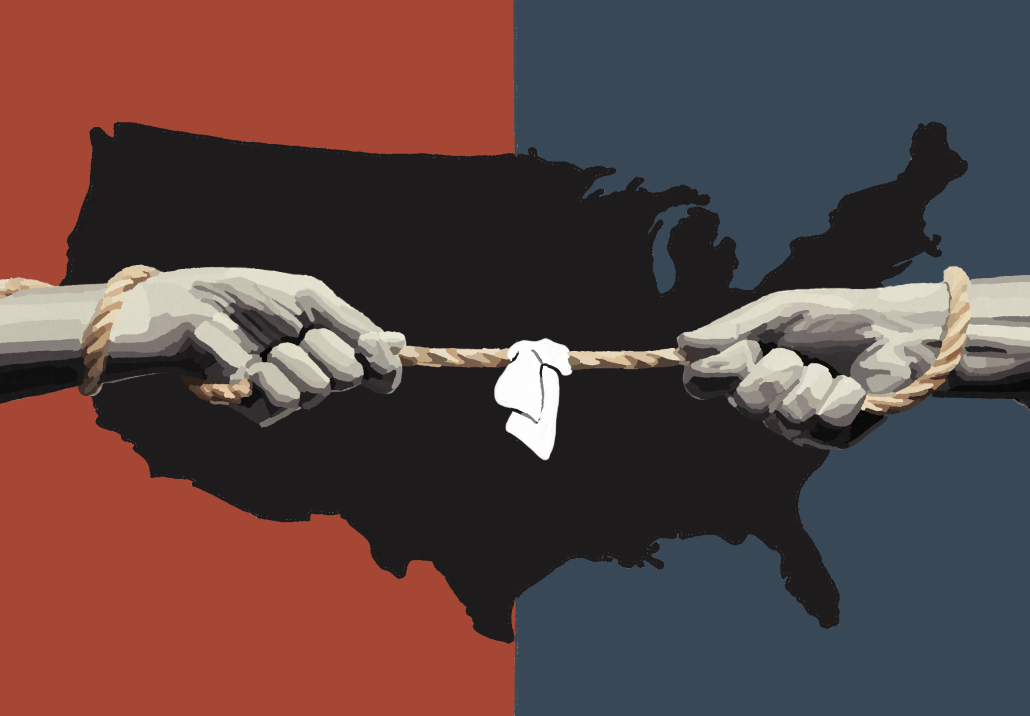

Our refusal to listen to and discuss opposing political opinions is dividing citizens.
In a nation intrinsically defined by its political divisions, we’ve reached a critical point where the art of listening across party lines has become a rarity. As a lifelong Democrat who grew up in a conservative city in Texas, I was continuously exposed to the opposing viewpoints of my peers and neighbors. Yet, these differences in political views never disrupted my day-to-day relationships. When I was growing up, civil discussions were the norm, but now, our world is evolving away from this practice.
Our nation is profoundly polarized; there’s no clearer way to put it. Many blame our current polarization on divisive political figures, but this simplification overrides a complex problem. This rift started before figures like President Donald Trump — who has consistently used targeted rhetoric to bolster party divisions — took control of the White House. The origin stems from a growing refusal from both parties to listen to each other and find compromises. Thus, stubbornness is appointed to propel this polarization further. Yet, if each party truly listened to the other, prevalent similarities would be acknowledged.
The whole foundation of conservatism relies on upholding traditional values and avoiding significant change — abiding by the vision of the United States that the Founding Fathers established. Yet, modern-day liberalism inherently mirrors these principles. Since there is no emphasis on engaging with opposing perspectives, there is no evolution in critical values; thus, liberalism follows the same avoidance of change that conservatism holds. This conclusion has never been made evident since the Democratic and Republican parties rarely strive to find common ground.
Now, research on political issues has been rendered irrelevant. Rather, pure party-oriented beliefs or news media rhetoric have become the primary outlet that has fueled this increasing polarization. For instance, during the 2024 presidential debate, contrasting news sources such as CNN and Fox News utilized distinctive political rhetoric. Fox News host Greg Gutfeld stated how “[y]ou need to make war to bring peace” to depict a civil war that would ensue from the 2024 presidential election. This rhetoric is unfortunately only fueling further polarization, and representatives from these respective media are unable to maintain neutrality.
With this lack of communication and extensively divisive political rhetoric, all we have instead is an inability to recognize that modern-day politics is transforming everything into a political issue. According to the Brookings Institution, climate change has been associated with the Democratic Party since the 1990s, showing how even issues with significant scientific evidence like environmental sustainability are now seen as partisan. Thus, instead of focusing on progression, we are just creating opposition to whatever the opposing party says.
But ideological differences have never resulted in disrespect towards opposing parties until recently. Back in 2008, with the infamous John McCain speech, his audience criticized former President Barack Obama for his birthplace. Rather than critiquing this occurrence, McCain told his audience that Obama is a “decent family man” that he has “disagreements with on fundamental issues, and that’s what this campaign is all about.”At this time in U.S. politics, respect overtook all political views. Individuals from varying parties were able to be civil with their opponents and have meaningful discussions.
In recent campaigns, however, politicians such as President Donald Trump have used rhetoric such as how former Vice President Kamala Harris must be “impeached and prosecuted.” The contrast in this terminology signifies how political campaigns utilize individual criticism, overriding respect for opposing opinions.
We cannot progress as a society without overcoming these differences and finding ways to be more receptive. Rather than dismissing a peer because their political views don’t align with yours, focus on questioning why these judgements are formulated. What experiences sparked the development of these beliefs? What medium ground can be found between opposing views?
We are on the verge of an extreme political crisis, and without overlooking individual stubbornness and listening to contrary opinions, our society is condemned to stagnancy.