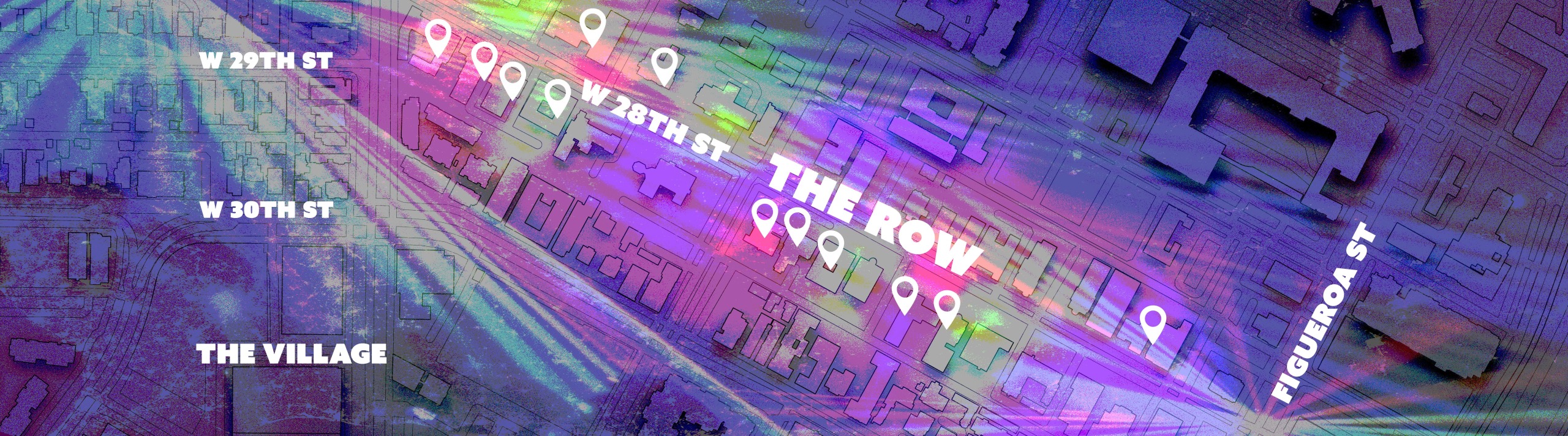
The Row echoed echoed March 8 with muffled music as I left my Lyft and joined the line into Jurassic Pike, a playful twist on fraternity Pi Kappa Alpha’s nickname. Members sporting dinosaur onesies and black streaks on their cheeks asked for my USC ID before letting me pass. I entered a dim tunnel covered in a curtain of mesh green to mimic vegetation, partly illuminated by verdant lights. It meandered to the left and opened up to the event made for everyone’s enjoyment.
Flooded with girls and Pike members alike, the space pulsated from EDM curated by a DJ stand from above until the initial distinctive notes of “We Found Love” by Calvin Harris and Rihanna elicited an excited cry from the audience — but not as excited as when confetti and smoke flooded the air at its beat drop. It was a lesson in fanfare. The bass turned up and people started to move their bodies to the beat in earnest, though all limited their moves to swaying, head bops and frat flicks.
This event was the most curated one I had ever attended at USC. Elevated platforms surrounded a screen of flashing graphics. Monstera deliciosa plants branched from corners of painted panels. Frat guys tried their darndest to satiate their guests in a cave of a bar thick with fog from smoke machines. Beyond the vibrations of the base, an undercurrent of energy connected every single partygoer there, made possible by the convergence of people and individual aesthetic choices.
Exclamations of recognition inspired fervent chatter, embraces, jumping and yelling. This energy passed along from person to person. The commonality between attendees was the pulsating environment separate from reality.
“Parties are only fun if you’re with the right people. You could go to the most fun parties and if you’re not with the right people, you’re not gonna have fun,” said Chris Araujo, a senior majoring in business administration and an inactive member of Tau Kappa Epsilon.
Beyond fraternal enjoyment, moments of passion came to fruition. Uninhibited make-outs constantly spiked and dissipated like atoms bonding and breaking in moments of chemistry.
It was a progression that seemed as natural as breathing, but the atomic makeup of this air was engineered. Fraternities tend to let in men only when they have a personal connection with active members, which indicates that a major point of these events is Pike’s connection with girls.
Araujo explained that this policy is to keep girls safe.
“We don’t want an issue to arise … because some random guys [could sneak]snuck in and then we get the blame for it,” Araujo said. “We make sure to keep our house safe and make sure the girls feel safe and have a good time.”
Whatever the reason, gendered structure defines the reputation of frats themselves, creating their hierarchy. Unofficial yet frequent frat rankings, many of which appear on Sidechat, are based on whose parties attract the most girls. But Araujo believes rankings to be superfluous.
“If you’re worried about rankings, I think you should figure out your life,” Araujo said. “There’s more important things in the world.”
However, there is no denying that girls are the necessary component that keeps frat parties, and therefore frat culture, alive.
…
Last semester wasn’t a good one. I felt unlike myself, practically only taking general education classes due to a mental back-and-forth between two very similar majors. I wasn’t a part of any organizations, my self-tape audition submissions were going nowhere and the screenplay I was working on only got more complicated the more I tried to find solutions. But the film fraternity Delta Kappa Alpha’s Halloween party was an interesting change of pace.
I was messy. Cranberry juice staining my white dress, I bumbled about, babbling to strangers. I took on “Project: Get my roommate a guy” in full stride and precariously reeled my friend into a bed of aloe vera, then crouched in the dark corner of the garage. But it was nice to just talk to people, some of whom I knew, many of whom I didn’t.
As the crowd thinned, the liquor depleted and the hours turned late, I got into this weird little huddle with three different Carmys from “The Bear.” There wasn’t really much to it. When a DKA member told the partygoers to disperse, they let me stay until my roommate declared it was time to leave with the Rocky I helped him secure. The whole thing was so silly, but I was grateful; it was a brief glimmer of connectedness during a period of isolation.
I only raised an eyebrow the next afternoon when I got a follow request from him on Instagram. I didn’t remember his name at all, but he seemed to remember mine.
…
The USC Snow Club’s marine-themed party was the equivalent of a rambunctious, swaying sardine can, mostly made up of men. It was a disaster.
The theme wasn’t so much executed as vaguely suggested; the only signs of it were Snow Club members in mariner’s hats and the occasional girl in a vaguely nautical outfit. A small smoke machine carried the aesthetic legwork. The electricity cut out twice. It was basically a bunch of college kids standing around shouting and drinking with hyper-energetic EDM blasting by the garage. But the incohesion was endearing. The jumbo pink teddy bear that was inexplicably being passed around confirmed this theory.
Luc Mainvielle, a sophomore majoring in electrical engineering, and Kevin Xu, a sophomore majoring in business administration, both get a kick out of this kind of insanity. They go to parties like these every week.
When I asked them if they liked Snow Club, Mainvielle said that it was the “best club in the world.”
“They bring the vibes,” Xu said.
Mollie Cleary, a freshman majoring in economics, joined a part of the Snow Club crew who were slinging boxes of beers onto the deck. She was already integrated into the club’s cultural practices despite being in the middle of joining.
“It’s a difficult one,” Cleary said about the process. “[Snow Club] is exclusive because you want to have fun, but it’s pretty chill..”
The relaxed, convivial function seemed to be an authentic translation of the club’s culture. This lies in contrast to Cleary’s experience with rushing a sorority.
“It’s fun to be with the people in Greek life, but it’s hard to meet new people,” Cleary said. “Parties like [Snow Club] are so much more open to different types of people, which makes them so much more fun and inclusive.”
USC’s raucous party culture can be quite the culture shock. This was the case for MJ Simmons, a freshman majoring in psychology as well as creative writing. She lived in a quaint town last year, so this was a real change of pace.
“It’s a big change from my hometown, but I love it. I love every minute of them,” Simmons said. “I honestly feel like every party that I go to at USC, I meet a lot of really nice people.”
That’s the lingering power of a party: to strengthen existing bonds, sure, but to also create new ones.
“Usually, I love to dance, but you gotta read the vibe sometimes,” Simmons said of the lack of dancing. “Most people are just talking … but if somebody wants to dance, I’m always gonna dance with them.”
That chance soon arose. At the sound of the beginning notes of “We Found Love,” our fellow sardines roared in recognition and started flopping around, promptly devolving into moshing, abutting the speakers so our eardrums could be permanently damaged in about 20 years.
…
2025 was going to be a new start. No more isolation. I stacked my schedule with classes I was passionate about and plotted extracurricular activities. Part of my multi-tiered initiative was rushing DKA, inspired by that helter-skelter Halloween night. Sidechat was aflutter with sorority rankings the week before spring semester, and I got nervous that I had missed my window to rush.
So I pulled up that Instagram contact that found me on the first of November and sent a DM. He obliged. He pitched to talk about it further over coffee, which prompted a second eyebrow raise. But I’m not one to jump to conclusions. I agreed to meet up at Cafe Dulce in a week and a half’s time.
A simple DKA rundown turned into a four-hour-long conversation about religion, first-pressed records, the film industry and our past histories. I was glad to be able to indulge before classes became real, especially with someone so interesting.
But time marches onward. He was already late to a rehearsal for a concert on his rooftop that was to happen the following night, a celebration of his friend’s new single. He left, but not before sending me the details and noting that I should take a friend or two.
I did. We arrived on time, which was early, so we hovered around to giggle and gab. Finally, he arrived immediately before starting the set. I admired his immersion while playing, the enjoyment, the ease of the drumsticks in his hands. He was nowhere beyond that very moment.
I had two of my closest friends by my side, the ones who made me happy. Finally, after so much time, I too was nowhere beyond that very moment.
…
I was marked with a heart on my hand as I entered FemFest’s Valentine’s-themed house show “Lovers Rock.” All I could see was corduroy, leather and vintage-looking graphic tees as Ponytrick checked sound under a string of lights. More heart-marked attendees percolated into the lot until the band finally played “we fell in love in october” by girl in red, starting off an indie-rock night with a certified indie classic.
As their set list progressed from “Kingston” by Faye Webster to “touch tank” by quinnie, I couldn’t help but admire lead singer Sarah Hyun, a freshman majoring in music industry. The notes painted her face with serenity.
Joints were passed. Red Solos were sipped. Wine bottles were savored. But the main event was the live music. An artful sax solo elicited cheers while swaying and singing along. We saw notes being created in real time and felt them reverberate in our bones, moved by a shared sonic force.
Sofia Gomez, a sophomore majoring in popular music performance, enlivened audience members with covers like “Waterloo” by ABBA and “Kiwi” by Harry Styles, and her singles “Voodoo Doll” and the upcoming “All Yours” alike in her curated pop-rock set made special for this FemFest event.
The music overtook her as she hit high notes with a soulful rasp and moved with an excited familiarity. It was obvious that the stage was her home, a home she began to make for herself in her early childhood years. Gomez later told me that she’d trade moshing for shows like these any day.
“Instead of going clubbing or going to frats, we would do a house show,” Gomez said. “We’d rather listen to music.”
This “we” is what Gomez identifies as her community, this group of corduroyed and leathered “artsy kids” that come together for shows like “Lovers Rock,” the music and theater gang. It’s an opportunity to do what she loves and connect with her people. It’s personal.
“[With] a house show, or a show at a venue, or something where you’re headlining or an opening act, it’s a much more intimate connection,” Gomez said. “Especially with house shows, most of these people are your friends — or friends of friends — that you’ve seen somewhere on campus. So I feel like there’s more of a connection with the artists in the audience.”
…
My friend told me that I should ask the drummer to hang out in the days after, but I completely disagreed. I had spent so much of my college experience pining after men who wouldn’t do the same for me, so I conscientiously left it to chance.
There was a DKA “Wicked-” (2024)- themed (2024) party happening the next Friday that my friends and I were going to anyway. If he was going to be there, he would, and if he wasn’t, he wasn’t. He’d later tell me that he had no intention of doing so until the very last minute, but I somehow knew he would.
Running into each other turned into getting drinks, which led to holding each other, which led to a kiss to the backtrack of Lemonade Mouth, which led to us listening to a Billy Joel record at his place, which led to us falling asleep together and nothing more.
I ended up getting an impressive three hours of sleep before walking home at 7-something a.m. in the prairie skirt I wore the night before. I never wake up in a place other than my bed after a party, and I never would again. But I made an exception just this once, because it seemed right.
…
I rushed into Bovard Auditorium right as the lights focused on MC Alizé Stone announcing the commencement of the Queer and Ally Student Assembly’s 15th Annual Drag Show. The crowd clapped, snapped and squealed in a shared diverse celebration of queerness that only grew louder as the night unfolded.
Willconique stunned in her red tassel dress as she jumped into splits, pedaled the air and grinded the floor to Lady Gaga’s “Bad Romance.” This impressive athleticism and skill carried into the performances of Digaysia, Kalypso and Rae Oblivion in a sea of leather, feathers and sparkle.
Cheeky sexual innuendos brought about bursts of laughter. The Angel did a heady rendition of Sabrina Carpenter’s “Juno” that the Polly Pocket-sized pop star would be proud of.
But Ella Mayo won the salaciousness category. She sensually slathered bread with her namesake as memes, Heinz condiments and plastic surgery-related images flashed on screen behind her at lightning speed. Boys held beefy sandwiches by their crotches and got on their knees to take passionate bites.
Ella Mayo’s memes were complemented by a performance inspired by the baseball scene in “Twilight” (2008). Drag king Count Ejacula choreographed an erotic fight with a fox and ripped off his jersey to reveal his shimmering, silver skin — the skin of a killer.
Although we oftentimes think of meme culture as superficial, these artifacts that percolate social media are a mode of communication and culture that unifies us. This was evident in the laughter elicited by Rihanna’s “all gender appropriations and the pronouns” quote and in the crowd roaring with recognition when Count Ejacula entered the stage. Our collective consciousness connected performers and audience members alike.
There were also more thought-provoking beats. Pestilence read from the “The Secret History of the Court of Justinian” by Procopius before flying onstage in a swan costume, its white neck protruding from their crotch as a third, lengthy appendage.
After flying and pecking their pecker to pick up seed, Pestilence analyzed the historical climate of the previous passage and compared it to its current perception. Coupled with Dacity’s activist piece, the audience was left with much to consider.
The eclectic event ended in a drag battle. Rae Oblivion and Digaysia competed in the final to Charli xcx’s “Von dutch,” both of them going into the aisles to showcase splits and high kicks, blurring the lines between audience and performer to create a unifying exuberance. The crowd stood and screamed their heads in elation.
This boundary-breaking is a part of what Willconique finds so special about drag. The co-director of the show is also known as Will Yeaman, a junior majoring in theatre.
“[Drag] is so interpersonal. And I would say it’s definitely less refined than maybe theater or film,” Yeaman said. “It’s that instant connection with the audience.”
Yeaman discovered the drag community at USC after a high school experience isolated from queer culture. After only being able to participate in drag culture through “RuPaul’s Drag Race” and being a “bedroom queen,” he was enthused at the opportunity to audition for the QuASA’s drag show in his freshman year.
“It changed my life, for sure,” Yeaman said. “I met a lot of people at USC, and some of them I’m still quite close with.”
For Yeaman, and so many others like him, drag is more than performance: Iit’s family, especially for those not as close to their biological ones.
“Queer people form their own families … and a lot of that has stemmed into the drag scene, where there will be house moms, and they will have drag daughters, and it establishes a family relationship and connection between queer people, between drag performers,” Yeaman said.
In this vein, one of Yeaman’s goals in throwing the drag show is to introduce drag to both novice performers and audience members who have never seen it before, giving it credibility as a transcendent art form centered around connection and culture.
“I’ve made connections with people at parties, and discussed drag with people at parties, and people recognize me. I think more people know Willconique than Will,” Yeaman said. “Most of my involvement with USC has been through drag, and it sparks conversations with people about drag. They realize that I’m just a person like them.”
…
DKA didn’t stick, but he did. Since that 7-something a.m. walk home, we stole time from sleep to spend it with each other until we finally found enough space in the day to break our nocturnal tendencies. We share our lives, both in recitation and shared experience. We especially enjoy reflecting upon the hectic beginning of our relationship, made up of cheeky carelessness and fate in a series of USC-centric events.
Now that I have taken this anthropological role upon myself, I can’t help but be even more grateful for USC’s flourishing nightlife: the way it connects strangers and friends, the way it makes and reflects a myriad of colorful cultures that are all somehow a part of this school.
Disclaimer: Dacity served as digital managing editor at the Daily Trojan in Spring 2023. They are no longer associated with the paper.