Daily Trojan Magazine
USC fountains vs. green space: The balance of sustainability
Students and faculty acknowledge the campus’ efforts towards sustainability and green spaces, but believe there is more to be done.
By MELISSA GRIMALDO


Students and faculty acknowledge the campus’ efforts towards sustainability and green spaces, but believe there is more to be done.
When I first got to USC, one of the first things I noticed was the number of fountains on campus. It felt like everywhere I went, I could hear the sound of water splashing nearby, bringing a sort of familiarity to the University.
Because of this, it’s become a habit of mine to stop by a fountain whenever I’m feeling overwhelmed by something or just on a walk, and with my luck the ample amount of fountains makes it never get old.
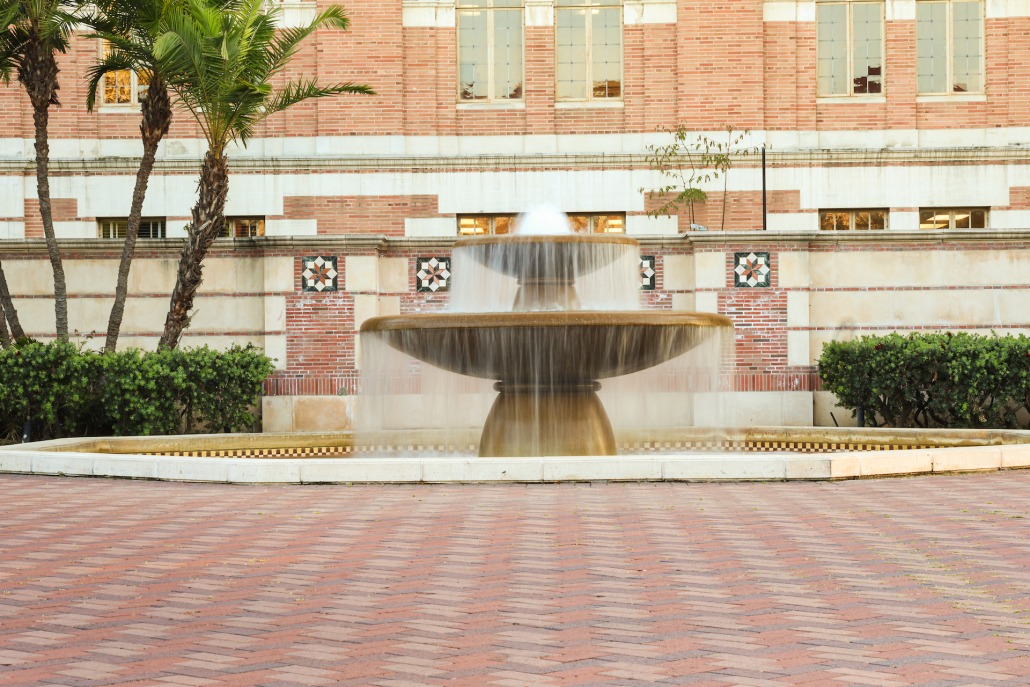
Including the three on the Health Sciences Campus in addition to the dozens spread across the University Park Campus, USC has a total of 41 fountains across its space, but some are more well-known than others.
Inside USC’s most notable fountains
Whether it’s on their way to the Tutor Campus Center or passing by to get to Doheny Memorial Library, a student is more than likely to see the Shumway Fountain located in Hahn Plaza.
The Shumway Fountain, gifted to the University by Patsy and Forrest Shumway, was originally a spout of water coming from the floor with concrete benches surrounding it when it was first built. It was in the summer of 2012 that the fountain was upgraded as part of a larger project to improve the landscaping along Childs Way. The renovation included elevating the fountain onto a rounded platform with multiple spouts coming out of a bowl-shaped figure and potted plants next to the available seating.
In front of Doheny Memorial Library, students can find Youth Triumphant. Presented to USC in 1935 by the Carman-Ryles family, they installed the fountain in Alumni Park in memory of their son, Edward L. Prentiss.
Taking inspiration from The “Four Cornerstones of American Democracy” in San Diego, the fountain is a replica with four kneeling woman figures at the base, each representing different democratic cornerstones: school, home, community and church. Atop the four kneeling female figures is a bronze figure representing youth that holds a pose as water splashes at its feet. The fountain was reinstalled in 1979 after being damaged by falling trees in 1976.
Even if you’ve never had a class in Mudd Hall of Philosophy, you’ve probably taken your LinkedIn profile photo outside in the courtyard and heard the fountain from a distance.
The Mudd Hall courtyard fountain was designed by architect Ralph Carlin Flewelling, son of USC philosophy professor Ralph Tyler Flewelling, who had begun the process of creating Hoose Library of Philosophy in the mid-1920s. The fountain is in the center of the courtyard, a decorated central column in the middle with the inscription, “O stream of life run you slow or fast, all streams reach the sea at last,” around the base of the fountain.
Despite some of these fountains having seating areas and greenery nearby, it begs the question: Is it enough to make students interact and feel connected to the environment around them?
What has USC done for the environment?
Joon-Ho Choi, associate professor of building science and director of the USC Center for Wellness in the Built Environment, told USC Today that interacting with a natural element like water has been proven to reduce stress and improve mood.
The USC Today article states that the 41 fountains account for approximately 2% of all water usage at the University. In order to maintain efficiency, the University has each fountain running on a schedule that is adjusted seasonally and for special events, including a school-wide shutdown over winter recess.
The fountains are also using recirculated water in order to reduce the need to refill them regularly, with several fountains also having a wind sensor to shut them down under windy conditions in order to avoid water blowing out.
Scott Uriu, an adjunct associate professor at the School of Architecture, said that USC could be doing more in regard to sustainability, as they are in the “perfect position” for it.
Within USC’s design elements, Uriu said that although the new elements in recent architecture projects are “pretty good,” it is a matter of focusing on sustainable elements within these designs.
“Designing things for what I call long life, loose fit,” Uriu said. “So if it’s a parking garage now, maybe in the future it could be converted to something else.”
In regard to the fountains, Uriu feels it would be best to design them with more features that allow you to sit down and have a conversation, making it more of a destination. Uriu said that it would “be amazing” if USC took advantage of those in the landscape architecture department who know the environment and sustainability internally to plan these features.
“I’m happy that they are — at least on paper — even addressing sustainability, which some campuses are not, so it’s a foot in the right direction — but it’s not necessarily a 1000-yard walk or anything,” Uriu said.
Yesenia Hernandez, a master’s student studying architecture, said that the University should enhance the water features we already have so people can go and enjoy them.
Hernandez is currently doing volunteer work in Altadena — which suffered from wildfires in January — where she is trying to revitalize the area by adding plants, aquaponics and ponds, and by doing so, creating a sustainable environment.
“I believe [the fountains need] more landscaping, more seating, like the terrace seating needs improvement,” Hernandez said.
Hernandez said that by using the correct systems, the fountains could add freshness to the campus, and by putting more landscaping around the existing areas, there would be a better sustainable environment.
“Make sure that the fountain is clean, put more [landscaping], put more seating, put more trees and people will go there,” Hernandez said. “People are attracted to activities around those fountains… but if you don’t give that to the users, how are they gonna go?” Hernandez said.
Aside from the water systems, USC has a “Sustainability Map” available to the public that locates USC environmental resources, sustainability services and green points of interest at both the UPC and HSC campuses.
Elizabeth Fong, a sophomore majoring in environmental engineering, said that to her, sustainability means being able to look at how humans are operating in the world and making changes that move towards reusing things and reducing waste.
Growing up gardening with her father, Fong found her way to the SC Garden Club, where she feels it has given her time to reground herself at the end of the week, using it as a sort of reset for her weekend.
Currently holding the position of co-vice president at the club, Fong said the garden adds vegetation in a “very concrete place.”
“By adding this vegetation, we’re helping to recycle the carbon dioxide that’s in the air and help suck up some of the emissions from traffic and everything,” Fong said.
The garden is located behind Parkside Arts and Humanities Residential College, and Fong mentioned that the USC community can grab the produce straight from the garden rather than a market, which uses emissions to transport the produce to select locations. Outside of the garden, Fong said her connection to plants has allowed her to destress, and she now takes the time to put herself outside within nature.
“Even just on the [USC] Village lawn, and even though it’s still very much a city around you, it helps me feel so much better,” Fong said. “Just having the sun shining on you and being able to touch the grass and look at all the plants around you.”
With USC’s sustainability efforts, Fong said she hopes they will continue to educate people on the topic, as not everyone grows up doing composting and recycling.
“If you never really learned how to do it, how are we supposed to expect you to do it on your own?” Fong said.
Esther Jeon, a senior majoring in neuroscience, said joining the SC Garden Club has been “world-opening.” Despite her lack of gardening experience, she soon realized how accessible urban gardening could be.
“For me, what tipped the scales was actually taking an environmental class,” Jeon said. “I didn’t really plan on taking that class but after seeing so many of the smaller sustainability efforts and also just what our garden does, it did make me more interested in environmental science.”
Before coming to USC, Jeon said she didn’t have experience with composting or recycling her daily trash, and having the centralized bins around her has been helpful to her.
Along with other changes the campus has made, Jeon said she feels it helps people to change small habits while also noticing the changes around them, and eventually be more aware that sustainability is something that you can integrate without being “super painful.”
Sharing a similar sentiment to her fellow club member, Jeon mentioned that having a green space around her helps her be more grounded, as she realizes the world “doesn’t revolve around humans.”
“I think being in nature and actually touching grass and soil and working with it kind of makes you realize, ‘The world is much bigger than I am,’” Jeon said. “There is a grounding sensation to that but also, ‘I have a responsibility that’s bigger than just humans.’”
USC green spaces: A deeper dive
Despite USC having a sustainable water system in place for their fountains, they are inevitably taking up space that would have added an additional green space to the campus. While many studies prove that access to green spaces is beneficial to the well-being of society, green spaces and sustainability are multifaceted, tackling multiple issues inside and outside the walls of a university to benefit those around them.
Ellie Bridges Greenfield, a senior studying environmental studies, said she believes sustainability is about longevity and being able to consume at an amount and rate that can guarantee society won’t run out of a particular item. While she continues to work on how to participate in sustainability in her daily life, Greenfield said that she believes sustainability is both actions-based and a mindset.
“I want to sustain my passion for environmentalism — I want to make sure that I’m not pushing myself so far to where it isn’t even enjoyable and I can’t keep up with making these decisions and I get to the point where it’s like, ‘Is it even worth it?’” Greenfield said.
Greenfield, who originally attended Tulane University in New Orleans, Louisiana, said she would love to see more green spaces at USC, but doesn’t know if it is realistic considering how much space the campus has.
In terms of incorporating green spaces within existing fountains on campus, Greenfield said that there are areas that could be turned into a green space, incorporating things such as pollinator beds, a habitat garden with native plants that help support the lifecycle of pollinators year-round.
“If I can limit having to drive forty minutes to an hour just to get some fresh air — like, true fresh air — I’d love that,” Greenfield said.
As an organization, Greenfield said she hopes the University works on the passion and drive behind the sustainability of its buildings. While acknowledging that it would be hard to do, Greenfield wants to see intention for sustainability put into the new building projects USC is doing.
While an environmentalist, Greenfield acknowledged that although she doesn’t want to ostracize people into making them feel like they need to “uproot” how they do their life, while also recognizing that it has come to the point where there isn’t much of a choice.
“I want there to be the balance of knowing maybe this entire university will not be sustainable, [and] it’s never going to be 100% sustainable,” Greenfield said. “But we could do little things and find that balance, and I feel like balance is key.”
David Rios Palomares, a sophomore majoring in urban studies and planning, said that along with being conscious about his red meat intake, he has also found it important to have conversations with those around him regarding sustainability.
“I know sometimes that’s what can make the most impact,” Rios Palomares said. “Talking about sustainability with friends and family and kind of meeting where they’re at and talking about why this issue matters, I feel like that can go a long way.”
Similar to Greenfield, Rios Palomares is originally from out of state, normally residing in Charlotte, North Carolina. Rios Palomares said that being in Los Angeles makes it difficult to find green spaces, especially near USC, making it hard to have that connection with the nature around him.
While acknowledging that there are some green spaces on campus, Rios Palomares sees potential for more on the outside of campus. Having seen spaces where more people walk by, like at USC Village, gave Rios Palomares the idea to plant more trees in those surrounding areas.
“Just to provide more shade for the people that are walking, for the people that are waiting for the bus,” Rios Palomares said. “Just finding those areas that are populated that people already go to.”
With USC being so close to downtown L.A., Rios Palomares said the security gates have made it hard for L.A. residents who are not students to use the campus and walk through it as they once did. Because of this, Rios Palomares said the conversation of having green spaces be added in the surrounding areas, along with inside campus, so L.A. residents are able to take advantage of these spaces, is an important one to have.
While continuing to protect the environment, Rios Palomares said USC needs to approach sustainability from various angles, thinking about the issues surrounding L.A. in regard to environmental justice and environmental hazards near campus.
“The conversation of sustainability is not just about conservation, but it’s also about social equity and thinking about the people that are [most] affected by climate change,” Rios Palomares said. “If there could be more of an emphasis on justice, I think that would be a good way for USC to focus sustainability through a more intersectional approach.”