LITTLE THINGS
Another cavewoman vindicated
At the Masters, around 90,000 phoneless people had themselves a time.

By LEILA MACKENZIE
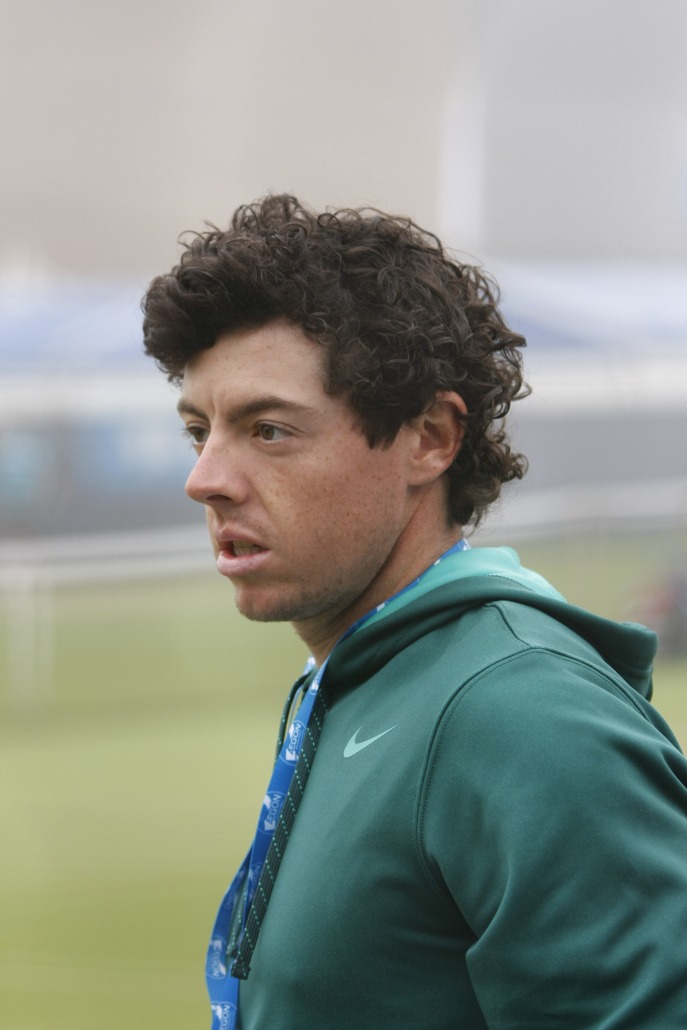

At the Masters, around 90,000 phoneless people had themselves a time.
Rory McIlroy finally pulled it off. In unfamiliar fashion, Wee-Mac’s major pain train rumbled through the Augusta National Golf Club and ground to a halt Sunday — he disembarked, suited in Masters green.
McIlroy’s Masters championship makes him the sixth man with a career Grand Slam and the first since Tiger Woods in 2000. But it took an apocalyptic series of major meltdowns for McIlroy to don that elusive Pantone 342.
By age 25, he’d already won four majors. Suddenly, the dynasty dude became choker-in-chief. Winning his last major title in 2014, McIlroy has swung between brilliance and breakdown for the past 11 years (more than half my life).
He first came close at Augusta in 2011, fumbling a four-shot final round lead for a 15th-place finish. Then in 2018, he stunk up the final pairing, ultimately slipping outside the chase box.
He failed so much that it became systemic. Back in 2012, after his first Masters collapse, I figured McIlory’s redemption was imminent. Every year in my elementary school’s Masters “sweepstakes” contest, we each selected a titleist, and the best bettor won a golf ball or maybe a whole box. I wouldn’t know. I always picked Mister McIlroy. And he always lost.
Until Sunday. One hundred thirty-six moon spins later, I have been vindicated.
Only just. McIlroy couldn’t help but bend his irons into a roller coaster ride that teetered on more catastrophe.
On the final day, it took a whopping two holes for McIlroy to lose his two-shot lead. Then, on the back nine, he impressively blew a four-shot cushion in three holes. Only a little deterred, McIlory delivered two clutch shots on 15 and 17, sending him to the 18th with a one-shot lead.
Of course, that wouldn’t do it. He shoved a wedge into the bunker and missed a 5-foot par putt to summon the first Masters playoff in eight years.
McIlroy’s sudden death stroke landed him four feet from the pin, and with one scrupulous dink, he had his masterpiece.
The ball vanished into the green, cueing McIlroy to clasp his head. His arms levitated like a conductor driving the crowd’s crescendo, and when the roars reached their climax, he dropped to his knees, shaking in disbelief, or relief, or something only perceptible to a career Grand Slam winner.
He clenched his fists and yelled in ecstasy — at the grass, at the sky, with his caddie and with his family. As the crowd chanted “Rory” relentlessly, there was more fist-pumping, more hair-grabbing. I must note: McIlroy’s hair appeared to gray by a shade each round.
Freezing each moment of McIlroy’s celebration would’ve yielded an emotional spectrum of reaction memes. But spectators could not — and would not — do that. Phones are banned at Augusta National.
Rather than watching through a device lens while recording the moment, Masters patrons are living in it, present and unplugged. Magnolia Lane — the entrance to Augusta National — accepts none but professional golfers, fans, media and families.
“The no-phone policy just makes everyone so present and so into what we’re doing out there on the golf course,” McIlory said in the championship ceremony.
Golfers are not the only ones who reap the positive effects of a phone-free event.
“I honestly would probably put [the Masters] No. 1 … There’s really just nothing like this, and I think honestly the aspect of like not having your phone is so unique,” said Caitlin Clark in an interview on Under the Umbrellas. “You can tell everybody is so invested and they’re really just there to watch the greatness of the athletes … You’re really just living in the moment.”
The deadzone cultivates a refreshing connection between the sport, spectators and landscape that’s seldom replicated in any environment, let alone in sports. It encourages serendipitous relationships among those who clearly share an interest. And incites streams of observations: “What a janky jab,” “Caddie thinks he’s slick” and “That polo is goofy.”
I’m an unlikely advocate for golf. I’ve never played. Though, I’ve done the putt-putt, and I am disastrously impatient. I typically make it to the second hole before threatening to frolic in the dirty streams. By hole five, I have certainly taken a plunge and have lost my stick-pole-thing.
Yet, this sport, as brain-smushing as it is, may be the most beautiful one to watch live, simply because it is devoid of devices. So imagine if the Masters’ seemingly idealist and elitist policy extended to sporting events with reliable scintillation.
From hockey to tennis, young fans would likely become better athletes, as they’d pay attention to professional technique. Casuals would know more than five basketball players. There would be more table smashing at football games. Baseball nerds would be better at catching foul balls. And most importantly, poolside cabanas, like those at EverBank, would become the norm across the NFL.
Do people have phones in Jacksonville? Perhaps not.
Duuuval! Let’s make all sports more like golf — it’s time for a digital detox. Ditch the device at the detector and stop turning viewership into a documentarian competition. Whether it be a decision by the cultural collective or venue governance, attendees need to be active, engaged and willfully impacting competition.
Leila MacKenzie is a junior writing about minor details in sports in her column, “Little Things,” which runs every other Wednesday. She is also the data editor at the Daily Trojan.