Truth is political propaganda’s enemy
We need to stay informed despite Trump’s attacks on “divisive” information.
By DOR PERETZ

We need to stay informed despite Trump’s attacks on “divisive” information.
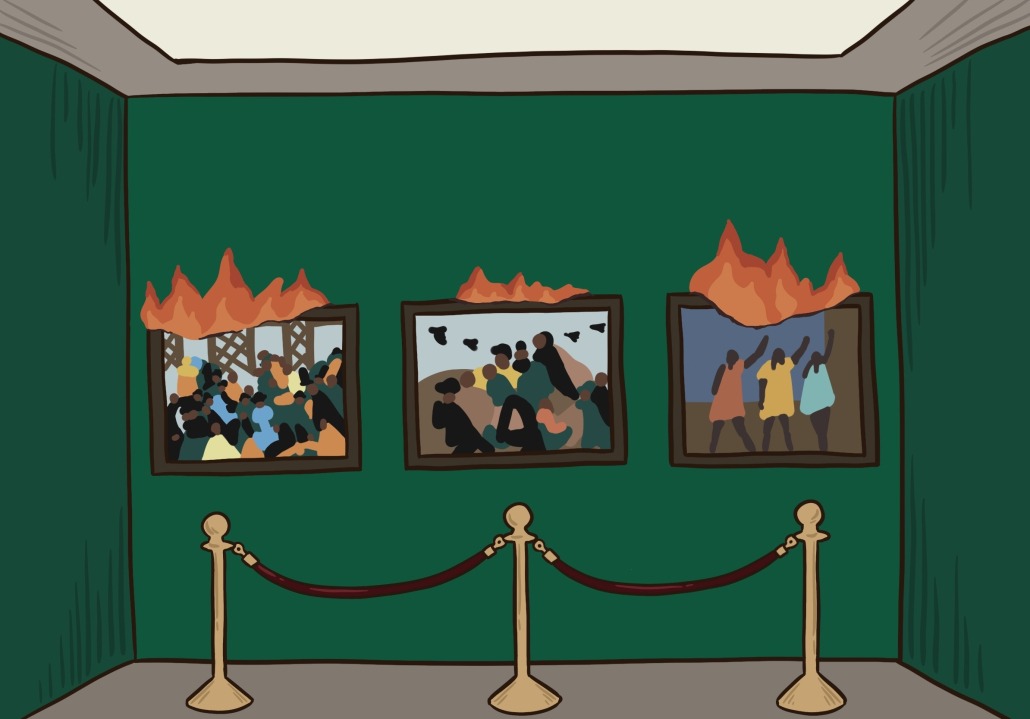
In yet another executive order, President Donald Trump has targeted the Smithsonian Institution for indoctrinating people with “a divisive, race-centered ideology.”
Trump criticized exhibitions in the Smithsonian American Art Museum, the National Museum of African American History and Culture, and the Smithsonian American Women’s History Museum for betraying the United States by portraying it as a less-than-perfect nation.
“Under this historical revision, our Nation’s unparalleled legacy of advancing liberty, individual rights, and human happiness is reconstructed as inherently racist, sexist, oppressive, or otherwise irredeemably flawed,” the order read.
According to Trump, the Smithsonian Institution must rid itself of such “divisive” and indoctrinating narratives.
However, the Trump administration’s demand of the Smithsonian is indicative of a much bigger and problematic pattern: Trump wants to suppress all types of information sources that might weaken the power of his administration.
Trump’s censorship efforts have upended scientific research, the freedom of the press, diversity, equity and inclusion initiatives in colleges including USC, and now — through this executive order — threaten the realms of history and art as well.
By enforcing these policies, Trump leads with a political strategy taken straight from totalitarian regimes.
Perhaps the most known example of censorship used to eliminate political opposition is the Nazi Party’s rule during World War II. Led by Adolf Hitler, the party banned all information which went against his ideals or the Nazi way of life, including films, radio and newspapers.
Prominent aspects of the Nazi party’s censorship tactics were art looting and book burning. Nazis confiscated about one-fifth of all European art and more than 5 million cultural objects that they deemed degenerate, as well as making university students burn over 25,000 books — some estimates even say 90,000 — that were blacklisted for defying Nazi ideology.
In a video from the United States Holocaust Memorial Museum about Nazi book burnings, author Azar Nafisi emphasizes that “the first thing every totalitarian regime does … is confiscation of history and confiscation of culture.”
Restrictions on information were also key markers in the Cambodian and Armenian genocides.
In Cambodia, Pol Pot, leader of the Khmer Rouge, established a “Year Zero” to realign the nation with communist ideals and demolish any evidence of previous Western influence. From 1975 to 1979, the Khmer Rouge killed anyone suspected of being an intellectual — even those who simply wore glasses or spoke a language other than Khmer — as yet another effort to limit the spread of information.
Similarly, from 1915 to 1916, Turkish officials behind the Armenian Genocide arrested 250 intellectuals and killed most of them due to concerns about their loyalty.
Although less extreme than these examples, Trump’s policies restricting the flow of information, intellectual works and cultural expressions are still eerily similar to the censorship undertakings of these past genocidal regimes.
It is no surprise why Trump wants to limit information in this way; it is much easier to convince people one’s rhetoric is true when evidence to contradict it is less accessible.
It might be easier to convince people that immigrants deserve to be treated as inferior if they lack information on how immigrants contribute to our nation. It might be easier to persuade people that climate change isn’t a concern now that the Trump administration has removed data on environmental issues from its federal websites.
The irony of all this is that despite how Trump claims that the issue with the Smithsonian’s museums is that they have rewritten history, Trump is the one doing the rewriting. He is forcing educational, scientific and cultural institutions to abandon truths about how our nation has made mistakes in favor of aligning with his own political agenda.
But art, history and science are not meant to conform. They are meant to make us question our knowledge, our beliefs and our values. To take away their “divisive” nature is to leave such studies as only shells of themselves, ultimately meaningless.
As students, our core duties are to learn, to seek out truth and to analyze what we come across from a variety of perspectives. Despite the barriers that Trump is creating to information, we must continue to look beyond curated portrayals of the U.S. as perfect, ask ourselves what progress really means to us and hold our government accountable if it fails our standards.
When ignorance can cost us our democracy, it isn’t bliss — it leaves our future bleak. Only by committing to the pursuit of knowledge can we fight back against Trump’s unjust policies.