When a Trousdale chat shakes your faith in God
Accepting a Bible study offer can have a profound impact on students’ spiritual lives.
By NATHAN ELIAS
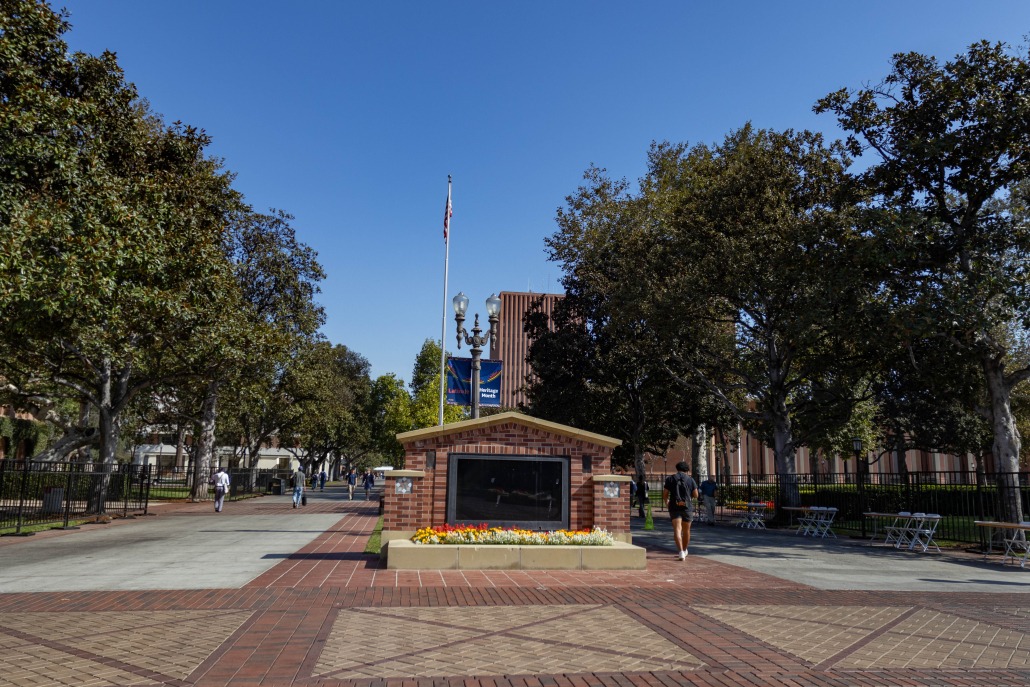

Accepting a Bible study offer can have a profound impact on students’ spiritual lives.
When Brandon Avelar sat down for another one of his Bible studies with The Harvest, the member he was studying with placed a water bottle in front of him, splitting the table in half. The member pointed: On one side was the devil, and on the other side was God. He asked, if Avelar were to die right now, which side would he be on?
Prior to attending USC, Avelar said he had been through a dark time before encountering a Bible verse that saved his life and led him to pursue Christianity. He made a promise at that moment to deepen his faith and spread it to others, and in Spring 2025, his first semester at the University, he began attending Bible studies with The Harvest after being invited during a conversation on Trousdale Parkway. He told the member he was with God.
He said Avelar was wrong.
The answer came as a shock, but he isn’t the only one to hear it. Although USC has more than 80 recognized student religious groups spanning a variety of faith traditions, the campus is also often a venue for what the University’s Office of Religious and Spiritual Life describes as “high-pressure religious groups,” including The Harvest, which are not officially recognized or supported by the University. The Harvest now goes by The Rooted Campus Ministry and previously used the name D.R.E.A.M. Campus Ministry @ USC.
The ORSL claims that the groups use aggressive recruitment tactics and demand high commitment to bring people into their worldview. This can make students — particularly those new to campus — frequent targets. Spending time in high-pressure religious groups can leave lasting impacts on their ability to trust or engage with faith communities.
In early February, Avelar, then a freshman majoring in astronautical engineering, was walking down Trousdale Parkway when a student stopped him and asked about his sweater, which had a cross on it. The student later asked if he wanted to attend a Bible study, and they exchanged numbers.
During their first meeting, Avelar sat down with the student he had met as well as another Harvest member. They shared stories on how they had come to Christianity — Avelar had found himself struggling to find direction, and the student, Ranier Velasco, had felt similarly at one point. In an interview with the Daily Trojan in Spring 2024, Velasco said he had initially wanted to join the military when he first came to USC, but he later became disillusioned with the career and felt dissatisfied with the advice he had found in books he read. Everything changed when he explored Christianity and when he joined The Harvest.
The studies proceeded twice per week. Avelar would sit down with a few Harvest members as they would open their Bibles and dissect the passages, including a verse with a message from God: “Search for Me with all your heart.”
“That’s something that really stuck with me,” Avelar said. “Seek God with all your heart.”
The group is an affiliate of Restored Church Worldwide, a nondenominational Christian organization of churches with the mission to help people become “disciples” through active recruitment, according to its website. RCW is a group of churches that split off from the International Christian Church, another nondenominational Christian organization, around October 2024.
Olayinka Oredola, a leader with The Harvest, told the Daily Trojan in a Spring 2024 interview that this recruitment style and other practices of the group were critical to their faith. In fact, several members the Daily Trojan interviewed joined the group after being approached on campus and were grateful for the opportunity.
Members described their practices as mirroring what they have read in the Bible to be the actions of the first-century Christians spreading the religion. But to the ORSL, these behaviors meet their characteristics of a high-pressure religious group: manipulative recruitment, a high level of commitment and claims of having an “exclusive understanding of the truth.”
After their initial meetings with The Harvest, several students said in interviews that the studies became more aggressive and demanding, leading them to quit the meetings. Avelar said the Harvest members would constantly ask him when to schedule their next Bible study, urging daily sessions.
“They were like, ‘Hey, man, that’s part of seeking God with all your heart,'” Avelar said. “‘If you really love God, you’re gonna do this.’ I was doing, obviously, classes and everything, academics in the back of my mind, too. But I was explaining to them, ‘Just because I don’t meet with you guys, doesn’t mean I’m not seeking God with all my heart, because I can be reading the Bible as well [by] myself, and I do.’ … And they would seem a little ticked off.”
The lessons continued according to a precise lesson plan; more members of The Harvest joined meetings; and what had started as a relationship between two people discussing their faith on Trousdale soon became lopsided, he said. After nearly 10 Bible studies and several long theological arguments that seemed to go nowhere, Avelar decided to quit.
Vanessa Gomez Brake, associate dean of religious life at USC, estimates that at least six students have come to her in the past two years to seek counseling after having experiences with high-pressure religious groups.
“I’m dealing with what you would expect is a trauma, a break in one’s own relationship with God, because it’s been put into question by these high-pressure groups,” Gomez Brake said.
Gomez Brake said high-pressure groups typically target vulnerable people, whether it be a new student away from their friends for the first time, or an older student going through a rough patch. If a high-pressure group member spots one of these students, they arrive and “love-bomb,” promising to bring the student into their supportive environment, she said.
Another student, who declined to share his name for fear of retaliation for speaking about his experience, also began meeting with The Harvest during his first semester at USC. He had already started to explore Christianity in high school, though it had been through converting from his family’s religion.
After talking about searching for a Christian community with a Harvest member during class in August 2023, he began his first Bible study with the group on the following day. He continued attending studies while keeping it a secret from his family until the Harvest members pressured him to tell them. The student’s family did not take it well, and the fallout from that conversation followed him for at least another year, he said.
Through a combination of that experience, warnings from other students and a conversation with a pastor he had met in high school, the student decided to quit. He texted the Harvest members, explaining that the decision came after struggles with his family and disagreements with their approach. A Harvest member replied expressing sympathy, and that he should come back when he was worthy of salvation.
When a student comes to her, Gomez Brake said their conversations involve “benchmarking” and “reality-checking,” discussing what should be normal within friendships or group environments.
“There’s this idea that because you’re at a secular institution, or you’re in the [United States], that perhaps you can’t talk about religion,” Gomez Brake said. “Our society has done that to us. It’s like, ‘Don’t talk about politics and don’t talk about religion, because those are personal things.’ And yet I’m on the other side of that.”
Although The Harvest had been an uncomfortable experience, Avelar said he found more opportunities to have theological discussions at Christian Challenge at USC, a university-recognized religious organization. He also found several other people who had previous experience with The Harvest and similar stories.
As someone who also aspires to spread his faith, Avelar said he admired the “zeal” of The Harvest, feeling challenged to defend his faith and dive deeper in a way he hadn’t before. But he also said there was harm in their aggressive approach and their inability to see his point of view.