‘Object to Binary’ examines gender roles belied by routines
The Roski student exhibit investigates gender via texture and color.
By KIRA MANELSKI

The Roski student exhibit investigates gender via texture and color.
Under the dimmed lights of the Helen Lindhurst Fine Arts Gallery, the five works of “Object to Binary” tell a story of attrition beneath the guise of the ordinary. On the Aug. 27 opening of her exhibit, Carlee Nixon, a junior majoring in art as well as communication, spoke of the collection’s genesis.
“When I was first doing this exhibition, I felt like I was a little bit crazy,” Nixon said. “Because it’s basically about how there’s subtle gender constructions within everyday objects, and while they don’t seem noticeable, they can creep in in a very structural way and less of a personal way.”
“Object to Binary,” Nixon’s exhibit, features mundane scenes charged with symbolism and translated with undeniable technical skill. A pair of her compositions focus on innocuous objects themselves: creased, just-got-out-of-bed sheets; chargers neatly plugged into sockets, accompanied by an inconspicuous toy truck; a porcelain cat, staring into the distance.
The work invites viewers to think more deeply about the sentiments we assign to easily overlooked objects. Rendered in black-and-white, the diptych “Home in People” presents almost like an X-Ray, encouraging the viewer to look beneath the obvious.
Though these inanimate objects are seemingly harmless, questions arise when considering the emotional weight behind the scenes. Why do people gender a porcelain cat as a female-coded object while a toy truck is associated with rowdy young boys? An upturned pair of glasses reflects the shining surface they’ve been laid to rest upon. But are those “boys’ glasses” or “girls’ glasses?”
A blurred background, contrasting with the focused, rigorous object-studies, asks viewers to widen their perspectives, going beyond the comfort of routine scenes. The vignettes force viewers to question the whys and hows of their daily realities and how they navigate the gender binary on a day-to-day basis.
“Honestly, I was quite struck by the meticulous nature of every single piece,” said Alex Madrazo, a sophomore majoring in design at Roski School of Art and Design. “Just so beautifully crafted and filled with so much care, I feel like that was the thing that stood out to me the most, as someone who goes through life very aware of the gender binary and how I fit into it, or don’t.”
Those familiar with Nixon’s work likely aren’t surprised that “Object to Binary” investigates the hidden emotional truths behind everyday scenes. Her work seeks the romantic in the prosaic, what’s interesting and topical in the ordinary. But “Object to Binary” is demonstrative of her broadening artistic gaze, asking questions about how society influences the intimate and everyday lives she often portrays.
“Object to Binary” draws directly from Nixon’s personal experiences, sourcing her inspiration from a seemingly benign moment with her sister while moving her grandparents’ couches.
“And [my sister] was like, ‘Okay, so which one do you want, the boy or the girl?’ And I was like, ‘Wait, why did we just gender these couches? This is so weird!’,” Nixon said. “After that, I started to see it just a little bit differently … it’s very subtle, it’s very hidden, but there.”
The pieces oscillate between acknowledging Nixon’s palpable feeling of deep nostalgia for her youth and confronting the more sinister gender roles and social constructs at play.
Shea Noland, a senior majoring in fine arts at Roski, spoke about the delicacy with which Nixon handled her work’s discussion of gender roles.
“I think especially when talking about gender, it’s one of those topics that can get very on the nose if you don’t do it right,” Noland said. “And it can be a sensitive topic sometimes, but I thought it was handled subtly, in a really profound way.”
Twin paintings of girlhood scenes, “Carlee’s Window” and “Chloe’s Room,” are depicted in the bright, idealized colors of a childhood perspective. The figures are painted with the hazy quality of a scene remembered, transporting onlookers into the vivid world of youth.
The colors of skin and shadow are vibrant and unencumbered, a child’s view of the parents she idolizes. It’s as if Nixon is bringing viewers along her own line of questioning, her journey of learning gender roles, starting at the beginning: her childhood.
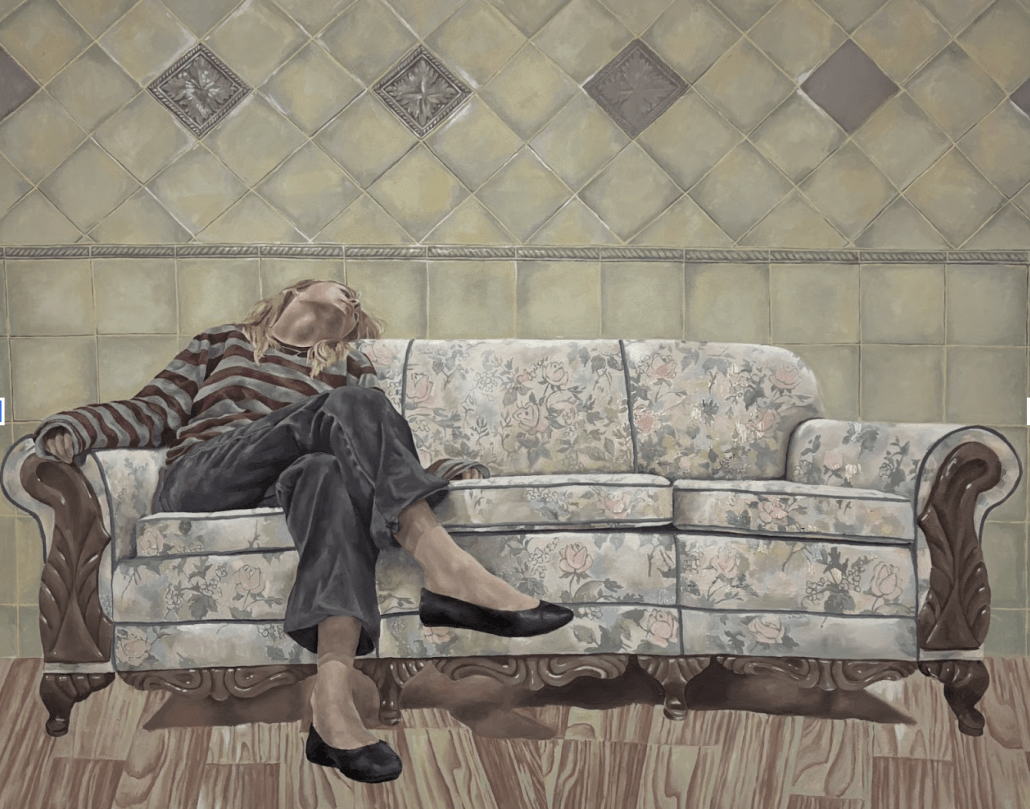
The exhibition culminates in Nixon’s largest piece, a portrait of a young woman lying haphazardly on the floral couch that inspired the collection. Unlike the aforementioned pieces, the color scheme of this painting is muted, infusing the scene with a distinct sense of malaise.
The piece, “Grammy’s Couch,” like the other works in “Object to Binary,” is texture-laden, the eye immediately catching on the folds of the figure’s clothing and the recognizable coldness of the tiles that line the background. The primness of the old couch and the deterioration of the figure appear in stark contrast to one another.
While the couch — a visual reminder of enduring gender roles of the past — is prim and neat, the girl, languorous and empty-eyed, gazes to the left, her clothes crumpled, her legs folded. Despite the beauty of childhood, the gendered expectations learned during that time — and the fetishization of even the inanimate in order to reinforce those gendered expectations — ultimately confuse people. Creative impulses atrophy and self-expression turtles.
In a world where romance languages contain gendered articles, where there are debates about who can use certain bathrooms and where pink is still called a “girl’s color,” it is easy to wonder if there could ever truly be a world in which the performance of gender doesn’t define all people, at least to some extent.
But progress begins with questioning, and in “Object to Binary,” Nixon begins that examination, shining light on the gendered constructions of day-to-day living.
“Object to Binary” will run at the Lindhurst Fine Arts Gallery until Sept. 17.
Disclaimer: Shea Noland formerly served as an art & design editor at the Daily Trojan in Summer 2025. Noland is not currently affiliated with this paper.