‘IDIOT GENIUS’ examines dystopian society
The exhibit uses creatures, humor and monumentality as a societal critique.
By PABLO RODRIGUEZ

The exhibit uses creatures, humor and monumentality as a societal critique.
Humor and dystopia rarely tend to come together; they’re almost opposites. However, to senior fine arts student Casey Ho (stylized as KC HO), this contradictory nature provides an opportunity to explore the complexities of living in a world that can itself often feel conflicting and hopeless in his exhibit, “IDIOT GENIUS.”
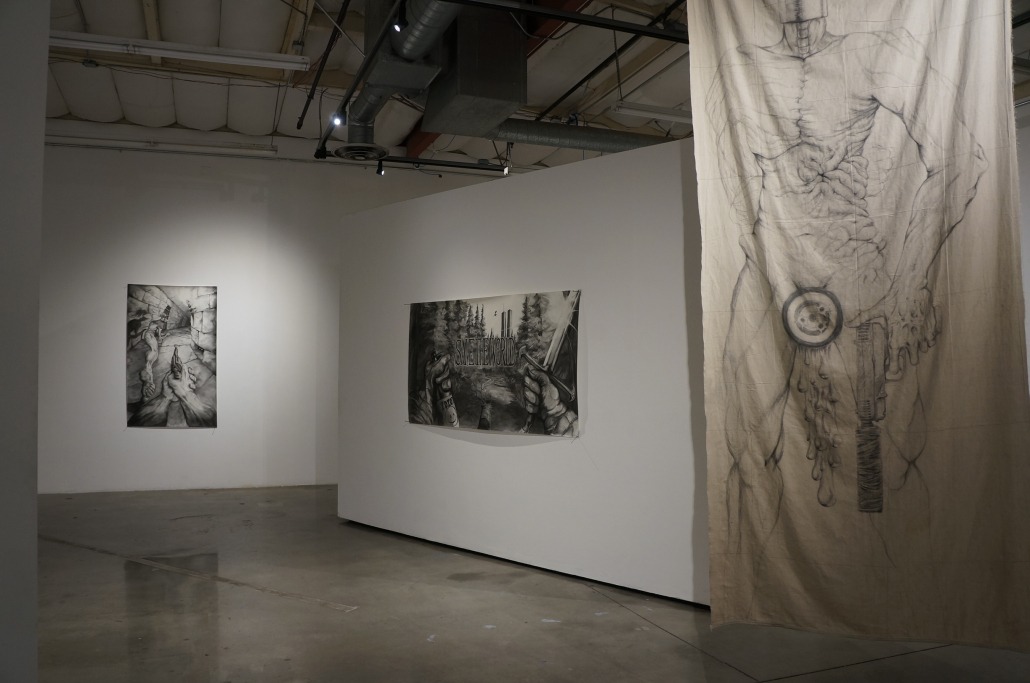
The exhibit featured detailed works, mainly charcoal illustrations on canvases ranging from medium sized works hung on walls to large tapestries hanging from the ceiling. Ho included some ceramics as well, featuring smaller creatures that can comfortably fit within two hands and a large one that stares at viewers from many angles with its multitude of heads.
Details and creatures transcend mediums, hopping in and out of 2D and 3D works, keeping the viewer on their toes. Much of Ho’s work deals with the idea of ordinary people wanting to be heroes, often by using perspective and imagery common in video games. The most obvious of these is by using the first-person point of view, putting the viewer into the character’s perspective, similar to classic first-person shooters like the DOOM and Wolfenstein franchises.
“So many people of any generation, whether you’re a gamer or not, could relate to the ideas of wanting to be a hero,” said Keith Mayerson, a professor of art at the Roski School of Art and Design. “In a world of anti-heroes, wanting to save the world — it feels futile.”
This feeling of futility made its way through many of the exhibit’s works, as seen in Ho’s use of a cigarette as a motif representing the weakness of human nature and the glorification of human vices.
“Smoking is dumb, and it’s stupid, and I’m an idiot for doing it, and [smoking is] kind of like a declaration: ‘I am defeated, and I lost this one, which sucks,’” Ho said. “I’m not proud of it, but God, they’re just so yummy.”
There is a massive sense of scale to Ho’s work: Some of his pieces include large, beautifully illustrated charcoal drawings on canvases that hang from the ceiling. The creatures drawn are equal parts eerie and colossal as they tower over onlookers. In one, a disfigured man looks like he’s melting in some parts of his body while holding a gun.
Even the smaller works in the exhibit manage to play on this sense of scale. Using perspective, some works make the viewer feel small and the drawn creatures feel large.
“All of my work has a monumentality to it,” Ho said. “You look at the things that mankind has built; it’s inarguably impressive. … But then you also think about ‘what did it cost?’”
Fantasy imagery, alongside the video game references, is another common motif in several of the exhibit’s drawings. One of Ho’s pieces takes a first-person video game point of view with the Twin Towers present in the background. He uses this mix of fantasy and real-world events to describe what 9/11 invokes in much of Generation Z.
“For our generation, [9/11] really is more of a myth than anything. It has this mythological presence,” Ho said.
The same piece also has giant text in the center, reading “Save the World,” coupled with fantasy elements such as a medieval sword and flying dragon. The text invites the viewer to imagine a world in which 9/11 never happened, or rather, if it happened in a fictional world.
The serious themes and dystopian worlds that Ho presents in his exhibit through towering beings and structures could easily leave viewers feeling hopeless. However, he blends these elements with humor and absurdity, bringing brevity to the pieces.
“He was obviously showing this dystopian version of our world, but also, he made it very clear to me that he wanted people to come in and see his exhibit and find a bit of humor in it, a bit of hope,” Mayerson said. “I think that’s really incredible.”
Though charcoal-on-canvas drawings made up most of the exhibit, Ho also included some ceramic sculptures as three-dimensional translations of his drawing skills.
“You draw people or characters long enough, and then you want to [bring them to life]; I’ve got this Geppetto instinct, like from ‘Pinocchio,’” Ho said. “I want to make little freaks and bring them into the real world.”
Ho’s art style is visibly unique, using charcoal drawings, ceramics and more to provide a bittersweet look into the intersection between cynicism and hope.
“I’ve never met someone who [is using] the styles that [Ho is] practicing right now,” said Kayla Jang, a senior majoring in fine arts. “His artistic practice is very refreshing from the traditional things that we’re used to in my major … It’s very stationed in our generation. It may seem pessimistic, but it’s very refreshing.”
The origin of the title “IDIOT GENIUS” perfectly encapsulates the exhibit. Ho said he got the title from Kurt Vonnegut, Jr.’s book “Slapstick,” a dystopian novel characterized by its comedic and irreverent prose.
“It’s the main character describing himself,” Ho said. “He’s the last president of the United States: idiot, genius, ape man, et cetera.”
Comedy and desolation are dissimilar concepts, yet in Ho’s eyes, they come together to form an exhibit that dissects society. In the same vein, “idiot,” coupled with “genius,” are rarely used to describe someone or something simultaneously.
“I think everybody’s an idiot and a genius in different moments and ways,” Ho said. “I think both of those titles are equally useless, but it feels great to say.”