SILVER SPOON
Petit Trois brings French formality to Sherman Oaks
The bistro trades speed and customization for tradition, offering Angelenos a taste of France’s deliberate dining culture.

By DEON BOTSHEKAN

The bistro trades speed and customization for tradition, offering Angelenos a taste of France’s deliberate dining culture.
In France, meals move at their own pace. Customers don’t send back steaks for being “undercooked,” servers don’t deliver dishes all at once and coffee comes only at the very end — signifying closure to a meal rather than an accompaniment.
Food isn’t treated like a customizable design. It’s part of its own ordered logic, following a distinct pacing with respect for tradition. None of this is an attempt to scold or meant to feel elitist; it’s just the rhythm of French dining.
In the United States, the rules flip. Meals are built to personal preference, tailored like playlists. A side of fries can become a kale salad, sauces get pushed to the side and entrees often cohabitate the table with appetizers even before the first bite. “No substitutions” is an unrealistic standard in American dining and is virtually an insult. The meal is less about tradition and more about choice.
Petit Trois Le Valley, located in Sherman Oaks, balances the two cultures. The restaurant doesn’t scold you for what you order, but it also doesn’t bend itself into the endless have-it-your-way American mindset. Instead, it feels authentically French in how it presents its food: slowly, one course at a time, with a sense of sequence that is completely foreign in Los Angeles.
The bistro is hard to miss; its facade is painted a deep teal green that pops against the palm tree-lined street. Parking — like the rest of L.A. — is less picturesque. Without a parking lot along a traffic-filled stretch of Ventura Boulevard, by some miracle, I managed to grab a metered spot out front.
The inside is decorated with shiny, black and white marble flooring that leads into a room of hardwood tables topped with crisp, white linens. The large glass windows allow the warm Southern Californian sun to fill the space. The dining room itself hums with an energy that feels distinctly bistro — not loud, but alive. Conversation bounces lightly between tables, never loud enough that you can’t hear the person across from you.
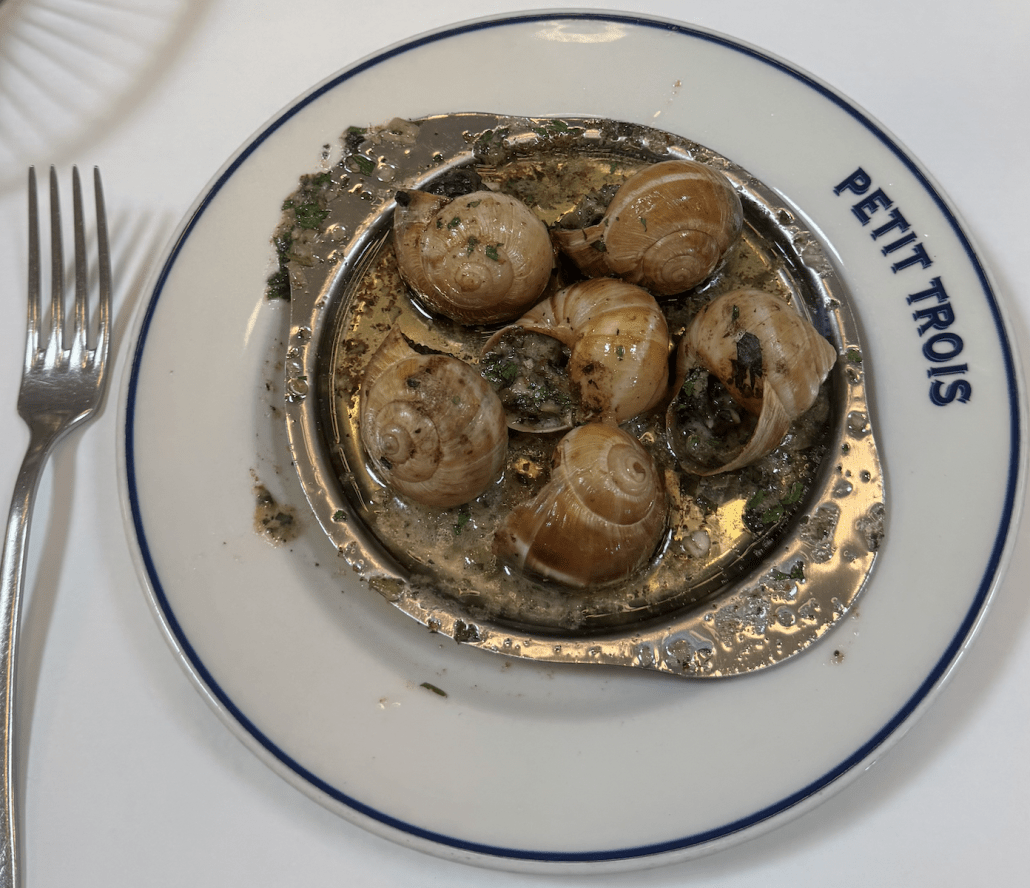
For starters, the Burgundy escargot was priced at $28, featuring snails swimming in a perfect garlic and parsley butter, served in a traditional escargot dish with little pockets holding each shell. The flavors were familiar, but the price forced me to pause. In France, escargot is accessible; in the U.S., it feels more like a luxury. Still, tearing bread to mop up the last bits of sauce was satisfying in a way that justified the moment, if not the price tag.
The steak frites leaned more classic: a 6-ounce Wagyu cooked perfectly rare — the correct way — with béarnaise butter for $41. The steak was tender and seasoned simply enough to let the meat stand out. The fries, while golden and crisp, were not remarkable, though that didn’t make them any less enjoyable. The plate worked perfectly, just as steak frites should: balanced and straightforward.
The Big Mec — which literally means big boy in French — was the star dish of the evening. At $38, it isn’t just another burger — it refuses to be eaten with your hands. Stacked high with two patties, bordelaise and special sauce, it demands a fork and knife.
Each bite is heavy and layered with the sauces soaking into the meat without overpowering its flavor. Unlike most burgers, which vanish in mere minutes, the Big Mec slows you down. You can’t rush through it, and truthfully, you don’t want to.
The service was as memorable as the food. Courses never overlapped: The escargot was cleared before the burger arrived, and when the baguettes left behind crumbs, a server brushed the table clean. Nobody hovered, and nobody was rushed. Time was allowed to stretch naturally.
Petit Trois isn’t cheap, and it’s not meant to be. What it offers isn’t just food, but time: time to sit at a table without rushing to the next venture, time to savor each dish as it arrives, time to let dinner feel like an event. For the chaos outside that was Ventura Boulevard, the restaurant creates a pocket of calm that feels closer to the French countryside than sprawling San Fernando Valley.
As I think back to the evening, it isn’t the traffic or the long drive over the Hollywood Hills I remember; it’s the teal facade and the rare feeling of being allowed to linger.
That’s why Petit Trois is worth the splurge. It doesn’t reinvent French cuisine or bend it to American habits. Instead, it reminds you that eating can be deliberate and slow. And in a city where everything moves quickly, that reminder might be the real luxury.
Deon Botshekan is a senior writing about special occasion dining and restaurants worth the splurge in his column, “Silver Spoon,” which runs every other Wednesday.