Not everyone can afford a real designer bag
Forget the cost of tuition; Let’s uncover the true cost of community on campus.
By EDWARD ZHANG
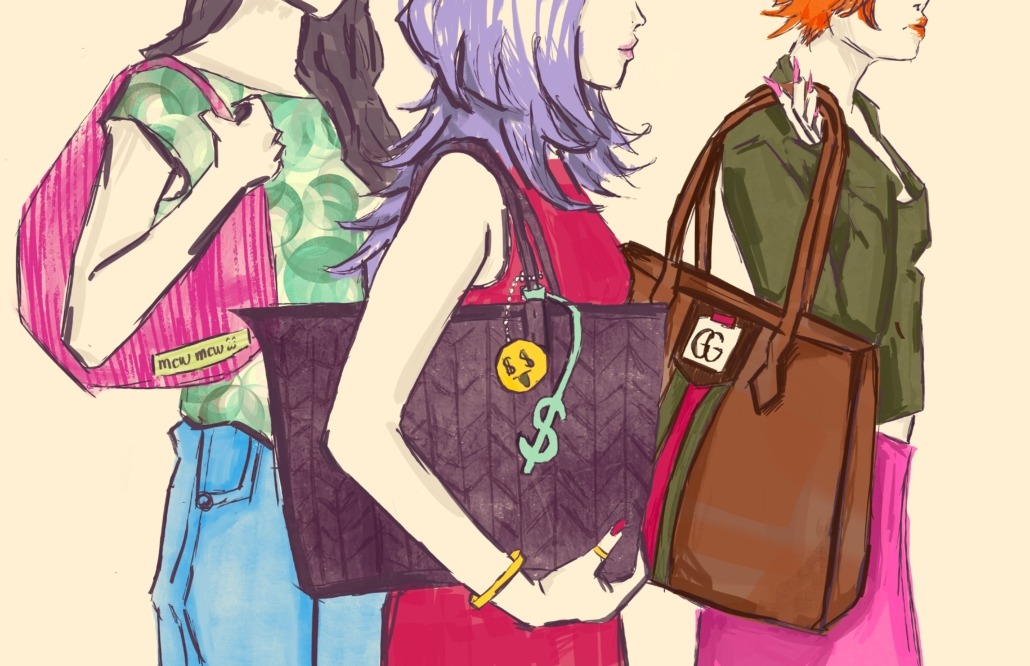

Forget the cost of tuition; Let’s uncover the true cost of community on campus.
Whether or not you agree with the “rich kid” stereotypes that often fall upon USC students, it’s easy to see where such stigmas might come from. After all, outward aesthetics are the primary way people generalize populations, and a brief walk around campus will yield a snapshot that is littered with Miu Miu sunglasses, Stüssy shirts and — most prominently — the Goyard tote.
However, just as stereotypes might not always ring true, the luxury bag culture at University Park Campus hides a darker underside. For students who aren’t able to truly participate, the constant physical reminder of their otherness can contribute to impostor syndrome and social pressure in an environment that may already be intimidating. This feeling of being left out might be felt by the nearly 21% low-income students receiving financial aid.
It’s no secret: Fashion lovers — and frankly, our generation as a whole — are suckers for creating community on the basis of having something that others can’t. If you own the new item that everyone wants, you’re in the cool kids’s club. If you don’t, you’re an outsider. Much like the actual clubs here at USC, the harder the group is to get into, the more desirable it becomes.
Not only is the average brand new Goyard tote priced at $2,000, Goyard — as almost all other luxury brands do — practices artificial scarcity as part of its marketing strategy. The leather goods dealer does not offer online shopping options, meaning the only option for prospective buyers is to visit one of Goyard’s 35 physical boutiques, with only six in the United States.
And yet, couture logos appear to be everywhere on campus. A recent post-lecture conversation I had with a classmate revealed why: When I pointed to her Gucci bag and offered some dry quip about the number of designer bags I saw that day, she exclaimed that hers was “fake as hell!”
The presence of “fakes” in the ecosystem of luxury items on campus presents a new set of problems and perspectives. First, the idea of students buying fake luxury items is proof that there is a group of young people at USC who desire to fit in by possessing expensive products, but cannot afford or justify the actual price point. A false statement of class.
A study conducted by Aaesha Abdalla at the University of Warwick explores the connection between being low-income and impostor syndrome. She notes impostor syndrome affects predominantly those of minority backgrounds, putting an emphasis on how “social context plays a significant role in shaping feelings of self-efficacy and belonging.”
It’s important to understand that the abundance of luxury items on campus only presents a social problem for students of lower socioeconomic backgrounds. After all, if you can simply go out and get a designer bag, the homogeneous culture only acts as a social safety blanket.
Not only this, many of USC’s social communities can be difficult to access for low-income students. Clubs and Greek organizations are often pointed to as ways to find community for new students. However, almost all clubs and organizations, especially larger ones that hold frequent events, require members to pay dues that can range from $30 to thousands of dollars.
As such, the social context that exists at USC is deeply unfriendly to low-income students, further facilitating the development of impostor syndrome and, in this case, the probability of one seeking a fake bag as a way to escape such feelings.
After purchasing a fake item, however, imagine how a student is then essentially forced to lie — at the very least to themselves — throughout every day of their lives. Every time they receive a compliment on their bag, they’ll be reminded of how they’re an “impostor.”
Finally, the existence of these fake products only perpetuates the effect that pressures students to buy them in the first place. When students feel like they need to buy luxury bags to fit in but can’t afford them, they’ll resort to buying a fake. As these fakes flood campus and the perceived frequency of luxury goods increases, the students left out will feel that they are a part of an ever-increasing minority.
As a result, these students will want to either stretch their financial capabilities to buy the authentic product or decide to buy a fake, thus triggering the cycle once again.
All of this begs the question, when the “rich kid” stereotype becomes the aspiration, how many students are pressured into shouldering a representation of the class culture that USC can be infamous for? How many carry with them a reminder that although they look like they fit in, they never truly will?
The aforementioned bag culture is just one example of the many costs that do not show up on the tuition bill. When some shoulder the cost effortlessly while others struggle to survive, the divide can be overwhelming, and its residue is everywhere.