Seniors, prepare for a fall of job hunting
As the semester advances, the question of postgrad aspirations is resurfacing.
By HEYDY VASQUEZ

As the semester advances, the question of postgrad aspirations is resurfacing.
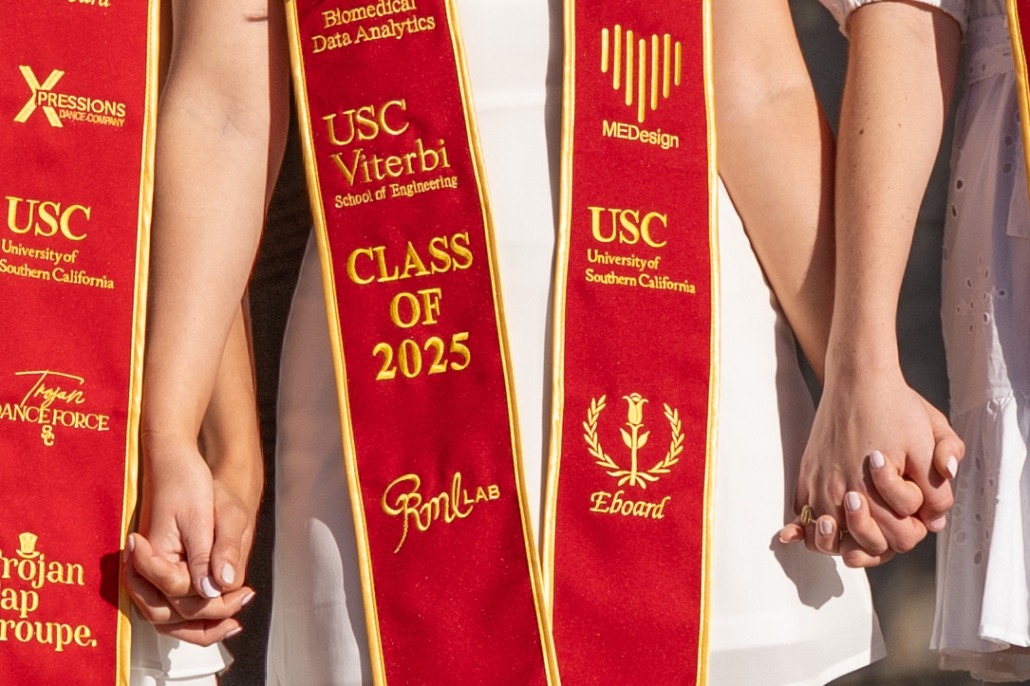
Since beginning college, I have periodically logged into Pride Sash to design my graduation stole. I can’t wait to see the Gould School of Law and the Daily Trojan’s logos stitched into the right of the sash, and “Magna Cum Laude” embroidered on the left with the Mexican flag below.
It’s finally Fall 2025; I’m a senior — time is ticking on my stole’s final design.
This fall, though, I’m not just facing colder weather. In every conversation, the same questions are parroted: Are you applying for law school? What are your postgrad plans?
During the summer, students spend their time interning and building their resume for this very moment. The pressure to take the next step into adulthood has intensified, and so have my anxieties.
Graduation is an accomplishment — even after walking at commencement, you’ll never forget the late nights spent at Leavey Library, dinners in the dining hall or evening runs to Trader Joe’s. But now, it’s all about scheduling your senior portrait or checking in with the Career Center.
The pressure to find a job after college is one this generation dreads, and it won’t dissipate any time soon. With budget cuts slashing funding across a variety of sectors, students are unable to even interview for an entry-level position.
Additionally, with the advent of artificial intelligence, some tech companies no longer have a need for novice employees — the AI performs entry-level duties just fine, and it’s less costly too. With limited beginner-level jobs, fewer and fewer positions accommodate each individual’s career aspirations.
Despite the achievement of earning a degree, this graduation season already seems to have a precarious edge — more days are spent with resume uploads to Handshake and walks through career fairs than meeting new people in general education courses.
Confronted with rising numbers of unemployment and the vanishing possibility of working in their field of study, seniors are preparing themselves for a grim future. One can dream of making six figures after college, but there are limited positions open, especially for those fresh out.
A decade ago, only a fifth of long-term unemployed people were college educated; today, the number has grown to include a third of college graduates, according to government data compiled by Matthew Notowidigdo and Jingzhou Huang at the University of Chicago.
So, how do we remain hopeful?
The solution is different for each individual. There are millions of career opportunities with limited open doors. I used to respond to the postgraduation question, “One gap year and then I’ll nail the Law School Admission Test.” As sweeping layoffs continue to leech into the job market and our economy, I have since lost my assurance about my life post graduation.
As economic uncertainty grows, many revised postgraduate employment plans in favor of applying to graduate school: In 2025, law school applications surged 20% from the previous year.
The last time there was such a dramatic surge in law school applications was during President Donald Trump’s first term. Anna Ivey, a law school admissions consultant, coined this trend the “Trump bump.” Law school applications are mixed with already eager pre-law students and motivated individuals witnessing changes in law. With this, law school admissions have become much more challenging.
Furthermore, application numbers for the top 200 law schools have increased up to 20.5% from last year, as reported by The Wall Street Journal in March. The same article announced that Georgetown University Law Center had 650 open seats and received an estimated 14,000 applicants. Meanwhile, the University of Michigan Law School received a record-high number of applications in its 166-year history.
Instead of preparing for the workforce, many students are opting to continue their education, and not by choice. Though many students want to pursue a career related to their undergraduate area of study, they have limited opportunities to do so. According to a 2024 Lumina Foundation article, less than a third of college graduates’ careers relate to their undergraduate studies.
This fall, seniors are bittersweetly preparing for the next stage of their lives, and in the spring, lines will wrap around Tommy Trojan for graduation pictures. While this was not the senior year of college we were promised, especially after pandemic-induced school shutdowns, many of us cling to the hope of fulfilling our dreams after college.
The anxiety of what to do after graduation is felt on campuses across the U.S., and it is okay to not know what to do given this political and economic turmoil. The transition to fall and spring will be filled with resume building, job hunting and lots of rejections, but don’t let that stop you from exploring other areas you might have never considered.
Although this isn’t the most desirable situation, seniors should not shy away from pursuing interests, no matter how trivial, that intersect with their academic pursuits. True passion is hard to come by these days, but it’ll still set you apart from AI.
Yes, some plans may not work out; however, it’s important to remember that even those you admire had to begin at the bottom before succeeding. While we have the rest of our lives to succeed, we will successfully land our dream jobs and lives, one way or another.