Thornton Edge pushes the limits of music
From repertoire classics to hot-off-the-press commissions, the ensemble thrives on new music.
By KATHERINE KANG
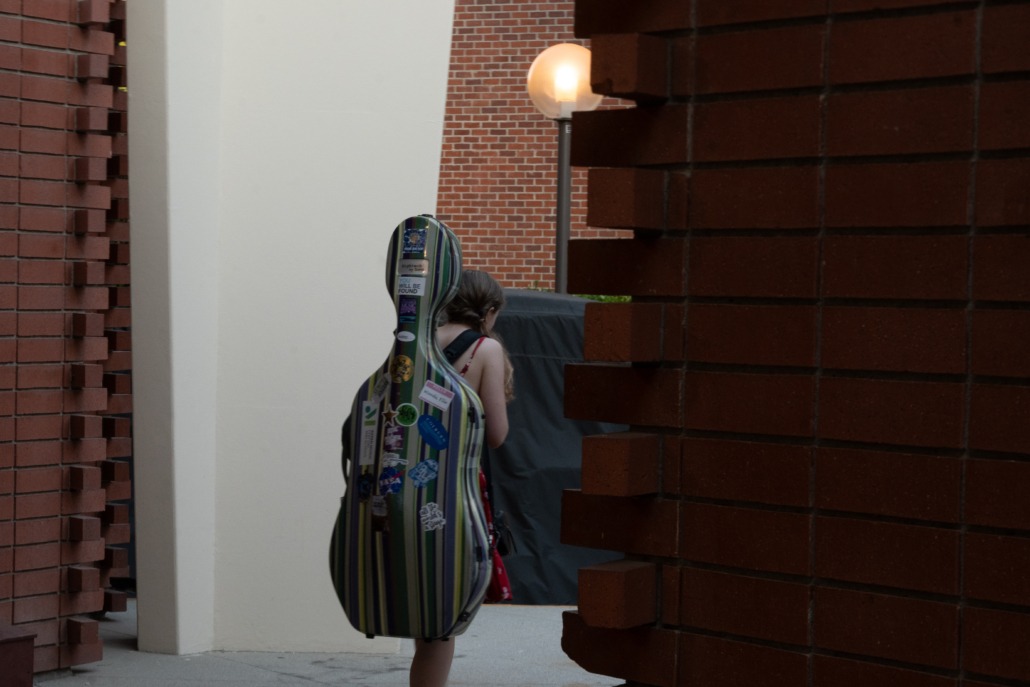

From repertoire classics to hot-off-the-press commissions, the ensemble thrives on new music.
When a former Thornton dean requested that the word “contemporary” not be used because it was often associated with pop music, students stepped in to rename the Contemporary Music Ensemble to Thornton Edge. The name formally stuck, and for the last 10 to 15 years, it has captured the ensemble’s forward-looking energy. Today, Edge is known for acoustic music that is “hot off the press,” often premiering brand-new works.
Thornton Edge, USC’s ensemble for new music, has been a home for contemporary classical music for nearly five decades. Robert Wojciak founded the ensemble in 1976, though the group shifted under the leadership of Donald Crockett, professor of composition and chair of the composition department, in 1984.
The first Edge concert of the season will take place Oct. 7 in Newman Recital Hall and will present the world premiere of Ariel Sol’s “Strum!” harp concerto, alongside Witold Lutoslawski’s “Chain I,” originally written for the London Sinfonietta.
Edge’s range spans everything from works written in 1980 to pieces completed just months before their premiere.
“You can come to an Edge concert and be pretty sure you won’t have heard the pieces before,” Crockett said.
Each season blends music by faculty, Edge alumni and current Thornton students, as well as composers from Los Angeles and around the world. Past composers include Witold Lutoslawski, Ariel Sol, Nina Shekhar and Crockett himself.
“We have a lot of composer-performers in the ensemble,” Crockett said. “They are composition majors who also play their instruments very well.”
This mix allows Edge to serve as both a training ground for young composers and a laboratory for modern performance. For students, the ensemble also offers a rare chance to perform in a space where innovation is the norm. Gibson Mahnke, a senior majoring in composition, joined Edge to fulfill his degree requirement while maintaining his oboe skills but quickly found deeper value. He said the group gave him insight into the practical side of composing, showing how musicians respond to and interpret new works.
“By being a performer and playing new music on a consistent basis, you see what works. You see what doesn’t work,” Mahnke said. “You see how you can write as a composer, write music that performers actually enjoy playing and not just the music that you want to write.”
That practical perspective of balancing the push of a performer and the pull of a composer sets Edge apart from more traditional ensembles. Trevor Zavac, a second-year master’s student in composition, said he specifically sought out graduate programs where he could play horn in a new music ensemble when applying.
“It’s cool, as a performer, to be able to contribute to that change that I want to see in the appreciation of new music throughout our classical music culture,” Zavac said.
In Edge’s relatively small group, each musician has autonomy, resulting in a dynamic rehearsal process. The ensemble meets twice weekly, with four to five weeks of rehearsal devoted to each concert program. That collaborative spirit defines the ensemble’s culture.
“We’re doing one of my favorite things in the whole world, which is we’re making this music sound in acoustic space for the first time,” Crockett said.
Edge’s programming thrives on flexibility, unlike many classical presenters that plan years in advance. Crockett designs seasons only months ahead, allowing room for timely works and fresh commissions. He collaborates closely with his graduate teaching assistant, Ben Beckman, a second-year master’s student studying composition, and gathers input from students.
“One of the important things to refine in rehearsal is the intonation, because the music is not necessarily, obviously in the kind of harmonic language that, say, Beethoven might be in,” Crockett said. “The ensemble of about 15 musicians are asked to do unusual things with their instruments, like blow through the instrument without making a pitch, or doing key clicks on the instruments, or bowing the string instrument in unusual places.”
Mahnke pointed out that ensembles like Edge challenge traditional expectations of beauty in classical music. By leaning into extended techniques and unconventional sounds, the value of a piece lies not in its conventional aesthetic appeal but in its ability to stir emotion.
“There is a misconception that all classical music, the good classical music, has to be beautiful or pretty,” Mahnke said. “In my opinion, good classical music evokes an emotion, whether that emotion be one of happiness, one of sadness, one that’s an unpleasant emotion, something that you don’t want to feel.”
In performing pieces with varied instrumentation and a roster composed almost entirely of volunteers eager to participate, Crockett sees Edge as a creative space fueled by passionate artists.
Yet for Beckman, who is responsible for recruiting personnel, each cycle presents the demanding challenge of finding the necessary musicians who want to volunteer their time to play new music. For Zavac, as a student, the greatest obstacle isn’t logistics but perception.
“The majority of the classical music idiom, I think, has at least some biases to new music,” Zavac said.
Despite the hurdles, the ensemble has built a legacy of nurturing talent that extends far beyond USC. Beckman said the group has several notable alumni, including Vicki Ray, Sarah Gibson and Thomas Kotcheff, who had successful performance and composition careers after graduating from Thornton.
The ensemble’s alumni network underscores its influence in shaping future leaders of contemporary music. Looking ahead to its 50th anniversary next season, Edge shows no signs of slowing down.
“My interest is in … continuing a trend that we’ve been actively pursuing in the last decade, which is to very much diversify the kind of composer and the kind of music that’s presented in Edge,” Crockett said.
That means expanding opportunities for young USC composers to break into orchestral writing, regardless of biases against new music, he said.
“If we want art to exist in the future, we need to make art now,” Beckman added. “If we want to create a body of work that exists well into the future, we have to explore the breadth of music that is available to us now.”