The ethics of filming without consent
Filming in public is far too normalized, and what used to be basic courtesy is gone.
By KENIA PENA
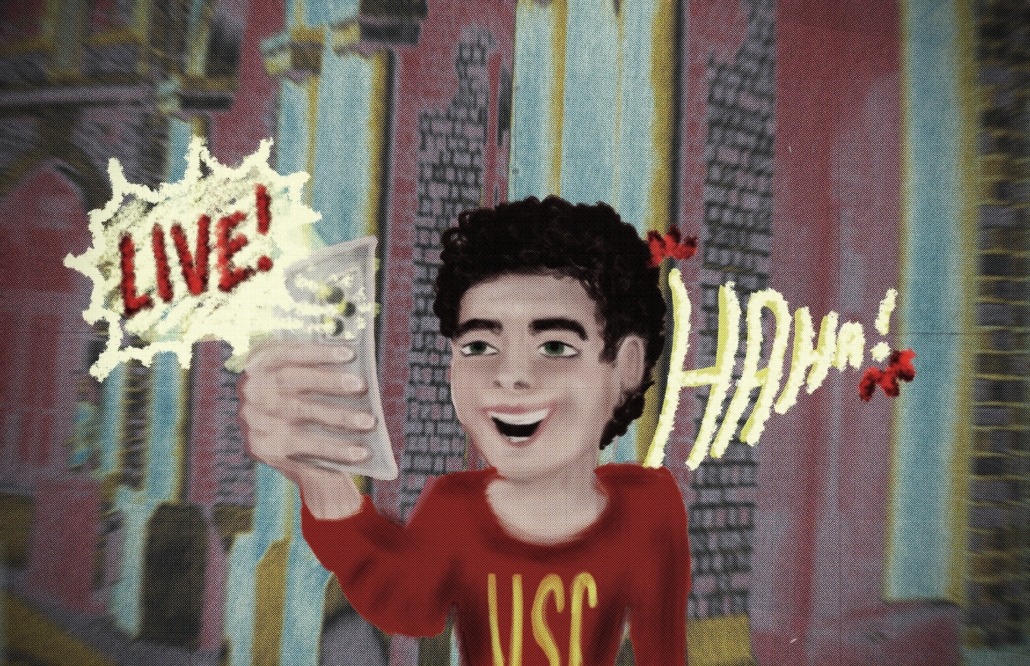

Filming in public is far too normalized, and what used to be basic courtesy is gone.
Every night, during your inevitable doomscroll through TikTok, you’ve probably encountered a hilarious video that makes you pause: The background is our campus, whether it’s a lecture hall where you’ve sat, a restaurant at USC Village or the elevator of your residence hall.
These TikToks may be filmed in a private building, such as a residential college, or an academic building, while others may just be filmed around the city. However, it’s inappropriate for students to film around campus, subjecting nonconsenting students to online judgment.
Filming strangers for the sake of creating content isn’t a new or recently emergent occurrence, but it has become more prevalent than ever. On campus, it’s common to see unfiltered interviews, unsolicited room tours, dance videos at Leavey Library or humiliating stunts in front of others in public elevators.
The content is endless. Not all video content is harmful — a “day in my life” vlog that keeps others out of frame is relatively harmless. However, much of this trend leans on exploiting peers as props.
So, what makes some public filming acceptable and others invasive? Students know it is unrealistic to expect absolute privacy outside their dorm rooms. That being said, no one wants to find themselves in the background of a TikTok that’s been viewed millions of times, while they might not look their best. As technology advances, the basic courtesy of not invading others’ boundaries falls away.
In the state of California, privacy laws are particularly strong. The public and the press are legally allowed to film in public under the First Amendment. Legally, with the consent of the individual, content creators are allowed to share the image of a person in public. But, California does have laws restricting the posting of conversations.
When filming on private property, rules do get more rigid. Specifically, individuals usually must seek permission from the private property owners. While this is not solely restricted to commercial use, USC specifically states, “We recommend social media influencers interested in filming on campus do the same” on its USC Today website.
While it is legal to capture students’ shocked reactions and appearance in the background of a TikTok video, it should still not come at the expense of someone else’s comfort.
The issue worsens when considering the ever-growing number of student influencers with thousands of followers at USC, who film videos that often feature other students in the background. When influencers of this scale post content, their platforms have the power to share unconsenting aspects of students.
Take TikTok personality Aegyo Alan — whose real name is Alan Cho — a senior majoring in economics, whose “man-on-the-street” interviews often catch students off guard in campus common spaces such as Leavey Library. His videos sometimes rack up millions of views, with strangers’ reactions or discomfort preserved indefinitely online.
Whether it is an embarrassing reaction or something as simple as eating and walking, that moment can live on indefinitely. The difference lies in scale: a private video shared with friends fades quickly, but an influencer broadcasting to thousands creates a power imbalance — one where the influencer controls the narrative and the unconsenting student does not. That imbalance makes consent all the more critical.
Just because something is legal does not mean it is ethical, especially in a private setting like our University. Here, students are in the comfort of their space and feel safe to be themselves, learn and act without the threat of public exposure.
Students can take matters into their own hands: ask for consent when filming in public, even if you legally do not need it. Avoid filming in spaces like libraries or dorms where people expect more privacy. If someone asks to be removed from a video, even after it’s posted, respect that request. Remember that behind every clip of a video is a person, and every person deserves respect.