Thornton Symphony Orchestra plays musical chairs
The winds section brought a breath of fresh air to Bovard Auditorium on Friday.
By HANNAH ALBRECHT
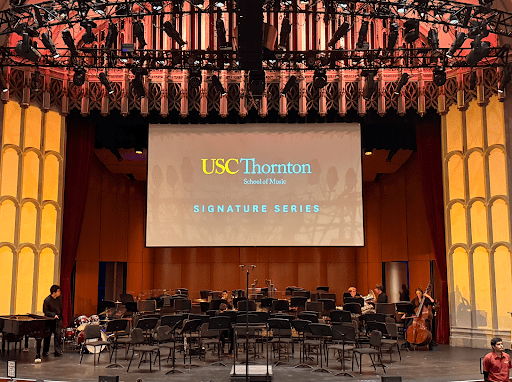

The winds section brought a breath of fresh air to Bovard Auditorium on Friday.
Musicians took practiced breaths over their jazz-like warmups as the audience trickled into USC Thornton Winds’ performance Friday night under the warm lights of Bovard Auditorium.
Musical chaos quieted into a silence eventually broken by “Variations on ‘America,’” a piece recognizable in its melody and yet richly diverse as it raced between a cabinet battle of jovial, seductive and aggressive tones. Quickly after the piece ended, the stage crew rushed in to rearrange the chairs and begin the first of four different rearrangements of the night.
The next song was well worth the wait, as ten student musicians played alongside the iconic Lina Bahn. A globally-hailed, award-winning and studio-recorded master of her craft, Bahn grasped the stage with a prickling sound that came not just from her instrument but her entire physicality.
“I just couldn’t keep my eyes off her,” said Sophie Molitz, a senior majoring in psychology. “All of the instruments were communicating with one another … like a call and response,” Molitz said, referring to the musical conversation between Bahn and graduate student Caroline Weiss, principal clarinet on Michael Daugherty’s “Ladder to the Moon.”
String and wind sang together to create a hauntingly beautiful melody of both promise and threat, and the audience didn’t allow Bahn to leave the stage without a bouquet of flowers.
The musical tempo escalated after the next rearrangement, introducing a larger ensemble to perform “Afrospire” by Bakhari Nokuri, a junior majoring in composition. His second piece to be performed by a Thornton ensemble and the first with the wind ensemble, “Afrospire” was bounding and adventurous, as well as unique in its inclusion of a drum set.
“I’m a drummer, so a really big part of composing for me is rhythm and harmony,” Nokuri said.
The composer explained the Thornton wind ensemble’s impressive grasp on the piece in its inclusion of jazz, R&B and woodwinds, sitting artfully in the “pocket of jazz” that is often so desired.
Nokuri explained to the audience that he drew inspiration for this piece from his experiences growing up as an African American man in the predominantly white spaces of Maryland. Always returning to his identity for clarity while growing up, he drew from his African American roots to create a fierce composition inspired by the words of artists such as Kevin Day and Omar Thomas.
Joseph Schwantner’s “…And the Mountains Rising Nowhere,” featuring internationally-acclaimed Kevin Fitz-Gerald on the piano, quickly grasped the audience once again. Ensemblists began the piece with a circular ring of sound as they ran their fingers over wine glasses filled with water.
The piece quickly became a pounding heartbeat, with drums echoing across the room. Fitz-Gerald displayed the control of a master as he pounded the keys of the piano alongside the drums to create focused chaos.
“It was very suspenseful. I feel like it could be in a scary film,” said Ari Matthews, a sophomore majoring in electrical and computer engineering.
To conclude the performance, the entire ensemble trickled onto the stage to perform the compositions of Frank Ticheli, described by conductor Sharon Lavery as the most prolific composer of wind ensembles in the world. In attendance himself, the former USC professor of 32 years addressed the audience to introduce his piece “Rest.”
Ticheli described “Rest” as a piece originally arranged for chorus. Premiered by the Pacific Chorale, “Rest” was written for his dear friend who lost his eighteen-month-old son in a tragic accident. The audience sat in pensive silence as the melancholic piece began, telling a story of loss, hope and ultimately peace. Although haunting in their meaning, the soft harmonies were reverent as they sang a child off to rest.
Thornton Winds wrapped up the performance with “Blue Shades,” another composition by Ticheli. The polar opposite of its sister composition, this piece rolled back and forth between the sections under the cardinal and gold shades of the auditorium.
Not fully classical but also not jazz, the piece featured a solo by principal clarinet graduate student Jane Pankhurst that gripped every tapping foot in the room.
The Thornton ensemble struck again with an impressive show of talent — and a masterful selection of compositions. A musical chairs-style rearrangement of orchestra chairs is a worthwhile investment when it is accompanied by music that ties the audience to their seats.
“I was so amazed by how good our students were,” Matthews said. “Now I just keep going whenever I can.”