Immigrants, we can no longer get the job done
The H-1B visa fee increase will create problems for all US residents.
By PIRIL ZADIL
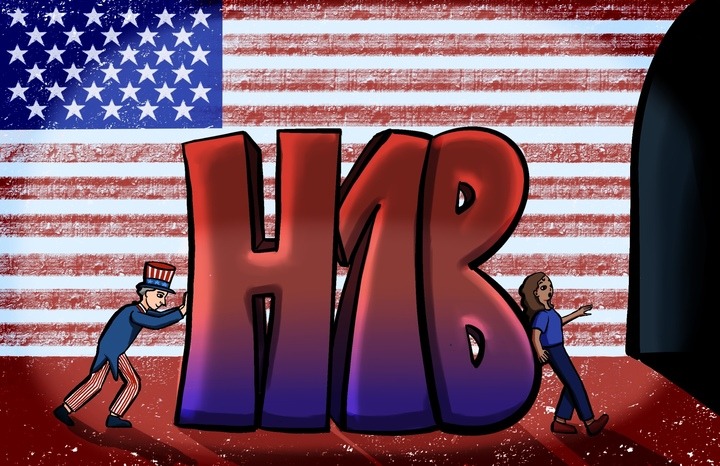

The H-1B visa fee increase will create problems for all US residents.
On Sept. 19, President Donald Trump signed an executive order raising the H-1B visa application fee to $100,000, at least a 20-fold increase from its former amount of between $2,000 and $5,000 per petition, effective Sept. 21.
According to the Trump administration, this recent change is intended to incentivize United States employers, who are responsible for paying the fee, to hire U.S. citizens instead of sponsoring foreign workers.
Many current domestic workers welcomed the announcement, arguing that international workers have been taking jobs away from Americans for some time. A common contention is that, since the bulk of H-1B workers are entry-level employees under 30 years old, they do not require the same wages or healthcare costs as older American workers.
The idea that H-1B workers provide U.S. employers “cheap labor” is a myth — it’s more expensive for companies to hire foreign workers. There are laws that prevent employers from underpaying H-1B workers, as well as significant costs associated with recruitment, visa processing and compliance. Moreover, the median wage of an H-1B worker is more than double that of U.S. workers in general: $108,000 compared to $45,760.
The truth is that most jobs occupied by H-1B visa holders cannot be sustained by Americans alone, which is why U.S. employers are willing to pay higher wages.
In particular, the healthcare industry hires externally to address labor shortages resulting from an aging population, burnout and increasing demand. According to an X post from Nicholas Mark, a respiratory doctor, international medical graduates comprise roughly 30% of U.S. medical residents.
Without the contribution of skilled international workers, who many healthcare professionals believe are the solution to these shortages, American healthcare, especially in rural areas, will suffer.
H-1B workers not only assist in maintaining U.S. resources, but they also contribute to their improvement. These workers drive innovation in several industries, from tech, where they drive developments in AI, robotics, and security, to research and other fields.
International workers are not a replacement for American workers but rather a necessary addition to them. They also benefit the U.S. economy overall by spending and investing their wages in the U.S., which increases consumer demand and creates more job opportunities for native-born workers.
The real reason why the majority of H-1B visa holders are “entry-level” workers under 30 years of age is that 54% of H-1B visa holders are change-of-status applications, with 71.2% being students studying in the U.S. with an F-1 visa.
Fortunately for us international students, the new fee does not apply to those who wish to change an F-1 to an H-1B visa. In truth, international students are at an advantage as the immigrant group that still has a path to work in the U.S. without a six-figure fee.
Some international students may rightfully feel a sense of relief at this, as good news is rare within our community. However, as German pastor Martin Niemöller, an anti-Nazi activist, states in the famous quotation that originated in his 1946 lectures: “Then they came for the Jews, and I did not speak out, because I was not a Jew. Then they came for me, and there was no one left to speak out for me.”
Our favorable position should not be a reason to overlook the detriment to foreigners who wish to work in the U.S. As intended, companies will become far less likely to apply for H-1B visas on behalf of foreign workers, as covering the $100,000 cost per applicant will become too substantial.
It is unrealistic to believe that international students will not be systematically targeted. Given our favorable position, international student numbers may rise, potentially leading to a cap on admissions that will ultimately decrease the number of international students admitted every year.
The loss of international students will be a cost universities must bear. Most international students pay full tuition due to their ineligibility for federal or state aid and are rarely presented with the option to apply need-blind.
Without the tuition contributions of international students, who made up 26.1% of the student body at USC in the Fall 2025 semester, the University will continue to implement budget cuts.
For USC, the Trump administration’s actions will be especially detrimental: If the University were to hire the same number of H-1B faculty as it did between 2017 and the first three quarters of the 2025 fiscal year, it would have to incur an annual expense of between $10 million and $20 million.
To elaborate, during this period, the University filed 1,610 visa applications. Aside from an ongoing hiring freeze, the increased cost would likely cause USC to reduce its hiring of H-1B visa applicants, resulting in setbacks in University research and specialized education that will impact the quality of education for all USC students.
The presence of international students and workers in this country is beneficial, if not essential, to the perseverance and development of the American population. Change is imperative; the world’s resources and societal well-being cannot be sustained if we ignore the necessity of embracing people who are different from us.