Pasadena Playhouse finds humor in disorder with ‘Eureka Day’
Pasadena Playhouse production of Eureka Day turns a trivial disagreement into a riotous mirror of human folly.
3.5
By HALIA LINDAUER

Pasadena Playhouse production of Eureka Day turns a trivial disagreement into a riotous mirror of human folly.
3.5
The trouble with consensus is that it only lasts until the first fundamental disagreement — in theory, agreement should make things simple, yet in practice, it rarely does. Jonathan Spector’s “Eureka Day,”, currently running at Pasadena Playhouse under the direction of Teddy Bergman, explores just how fragile unity can be.
The plot centers on a seemingly progressive, parent-led private school board in Berkeley, California, that prides itself on inclusivity and empathy. That is, until a mumps outbreak forces all five characters to debate the ethos and pathos of vaccination policy.
The polite, well-mannered intro to the play devolves into a satirical cyclone of clashing values, digital chaos and raw human fragility. The play allows itself to be a mirror not only to modern American discourse but also to the audience, begging them to ask themselves, “Am I doing the right thing?”
“Eureka Day” is a sharp, witty exploration of how seemingly straightforward ideals collide with reality. The play interrogates inclusivity and personal freedom, contrasting them against the unruly nature of modern discourse by using the board’s vaccination debates as a critique of larger societal tensions.
Though the piece was written and set in 2018, the post-COVID-19 viewing context makes the discussions around the morality and necessity of vaccines feel immediate and relevant, with the humor of the script ensuring these weighty issues are anything but heavy-handed.
The audience is invited and almost instructed to recognize a little bit of themselves in the chaos of the plot, reflecting on how easily good intentions can go awry when human stubbornness and ideology collide.
Bergman’s direction keeps the characters and audience on their toes, with a keen sense of rhythm, allowing the circumstantial irony to land without losing sight of the characters’ humanity.
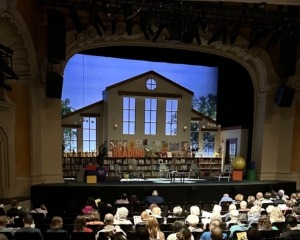
The scenic design by Wilson Chin is the most striking aspect of the creative direction, bringing the audience immediately upon arrival to access a vision of their youth. The comfort and naivete of the spaces’ curation is brilliantly contrasted with the chaos about to unfold, highlighting how quickly idealism can unravel.
The production also makes clever use of multimedia and projections to represent a town hall video chat, turning the ever-present digital chaos into a visual element that heightens both the humor and tension.
The funniest moments of the play come from these digital chat sequences, which exude relatability, as the audience repeatedly erupted in laughter that drowned out the actor’s witty comments and exclamations. The energy on stage and in the audience was immaculate, with the audience feeding off the frustration and hilarity of the moment and the actors playing with action and subtext.
That said, some directorial choices, especially in staging and constructing chemistry among the characters, often felt rigid or forced, particularly in transitions between quippy banter and quieter, reflective beats. While some of this awkwardness stemmed from blocking, it was primarily evident in moments between the characters, Camille Chen (Meiko) and Nate Corddry (Eli), whose relationship required a deeper emotional connection than was being portrayed by their performers.
The struggle to unlock the weight of this relationship undercut the impact of the otherwise emotionally in-depth script. In a production as firmly ensemble-driven as this, with no singular lead carrying the narrative, it becomes imperative that each actor remain fully engaged with every performer carrying equal weight in sustaining the story’s momentum. It felt as though some actors were left to pick up the slack on their own in driving the play forward.
Nevertheless, Bergman’s pacing largely ensures that the escalating conflict of the parent-led board felt inevitable and clever.
The ensemble cast of “Eureka Day” worked tirelessly to sell both the absurdity and humanity of the story, with School of Dramatic Arts faculty member Mia Barron (Suzanne) being a standout in the show. She effortlessly navigated Suzanne’s well-meaning but fraught attempts at diplomacy, managing the play’s razor-sharp, chaotic dialogue alongside the empathy of its most emotionally demanding scenes.
Cherise Boothe (Carina), Chen as Meiko, Rick Holmes (Don) and Corddry as Eli round out the rest of the board, each finding moments of humor and tension that, while at times feel performative, still offer a lived-in and honest portrayal of their given circumstances.
When the lights rise in the theater, “Eureka Day” compels the audience to consider what it means to be “right,” whether it’s possible to empathize with the multiple perspectives of the characters and what that reveals about themselves. It invites deep reflection on the similarities between audience members and the parents of Eureka Day School, and whether those similarities are virtuous, flawed or somewhere nestled in between.
The result is a production that challenges American complacency, offering disquieting insights through humor amid the ever-present tension of the 21st century’s pursuit of progress, and sparking continued dialogue long after the curtain falls.