Gen Z everywhere is fighting back, except in the US
With frequent moral lapses and political disasters, young Americans should not stay on the sidelines.
By LUISA LUO
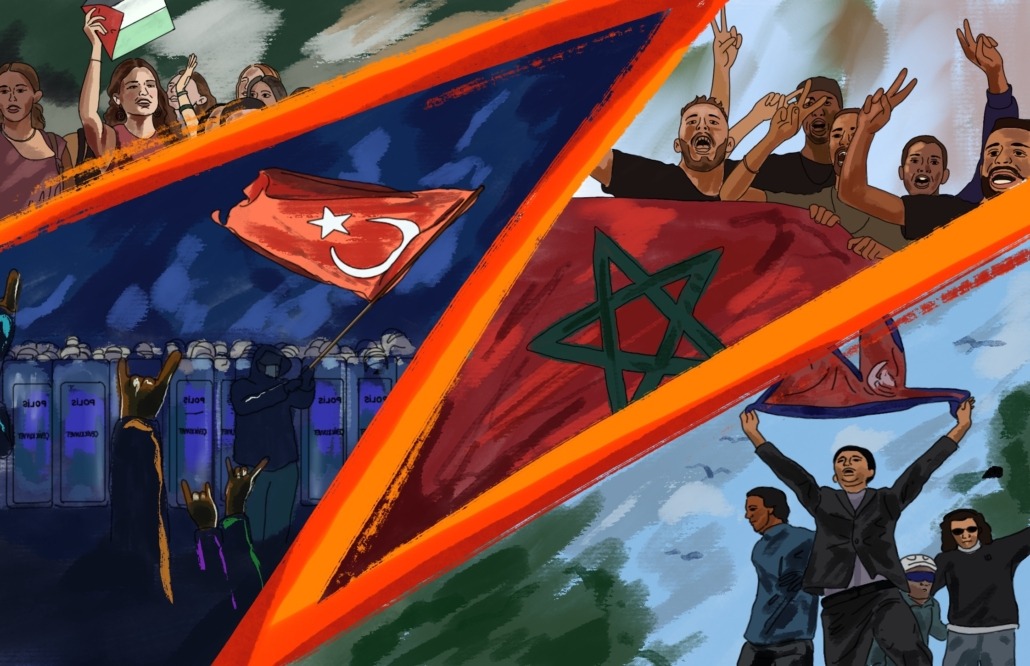

With frequent moral lapses and political disasters, young Americans should not stay on the sidelines.
Perhaps the greatest paradox of American youth politics is that we have more tools for social mobilization and political incentives than any generation before us yet less collective will to activate them. We’ve been nudged toward a carefully curated identity that overanalyzes optics while the real substance slips away.
What felt like occasional climaxes of urgency during the Women’s March in 2017 and March for Our Lives in 2018, among other occasions, are now an omnipresent norm that we have to cope with on a daily basis. Today, we are all exhausted but not morally mute.
The political machines act as though they have a genuine interest in cooperating with us, but they only superficially consult our opinions. This practice curtails our voices more than anything.
They tokenize our age group as symbolic figureheads of advocacy, inviting us to join special interest forums such as the United Nations Youth Office to issue our seal of approval; however, even with entities as influential as the UN, the inclusion of our perspective is not as revolutionary as it’s made to seem.
Even with the opportunity to directly advise and interact with the secretary-general, we are never granted complete ownership over these movements, instead playing small but visible roles in a larger agenda.
However, contrary to the cognitive dissonance in the United States, youth from emerging economies have been enthusiastically channeling their discontent through organized uprisings protesting against corruption, inequality and censorship.
In Nepal, students rallied for accountability from politicians entrenched in decades-old patronage systems. In September, after a series of governmental crackdowns against digital platforms, these young activists projected their anger onto the streets toward the elite political class that appeared immune to public sentiments of outrage.
Nepal’s chief of staff, Gen. Ashok Raj Sigdel, faced pressure to compromise with Generation Z activists to set up an interim civilian government. The state was forced to make concessions, with the first-ever female chief justice, Sushila Karki, taking over. The impacts of its youth are undeniable.
In 2023, Malaysian teenagers rallied digitally through Roblox, of all places. They repurposed the game to build support for Palestinian solidarity and learned to outsmart authoritarian systems by decentralizing the community.
The youth have proven that civic consciousness is not the privilege of established democracies but the lifeblood of societies yearning for change.
And yet, across the Pacific, American youth raised on protest imagery, climate walkouts and school sit-ins have been growing quieter.
One may argue that we just experienced an unprecedented level of involvement following the national campaigns of student encampment across collegiate campuses in spring 2024. However, I argue that this key turning point altered the expression climate, triggering authorities to be more militant and deliberate with their techniques for suppressing protests and killing the unruly sentiments at their roots.
The chilling effect of institutional constraints is visible within our own school. At USC, participants of the encampments were cited for campus violations resulting in suspensions and forced to write apologies, regardless of their real stances. Reviews by administrators of disciplinary cases can stretch for months, delaying graduations or blocking access to crucial academic resources.
By muting our convictions, we become sacrificial tools in the University’s risk management master plans to keep donors comfortable and rankings stable. Yet, the headlines are still awkwardly unflattering for the University. But each time students brush over the fatal flaws of the powerful bureaucracy, the gap between what we learned and what we practice grows wider. So, is it really worth it?
The cruel reality of higher education creeps through crackdowns, as students are asked to comply with a college’s private security force. After years of sitting in classrooms where we are told to champion human rights, our actions are refuted at first sight of their emergence.
American youth haven’t done nearly as much to strategically leverage our positions. We occupy a unique vantage point within global politics, yet these advantages translate into passive awareness. Our culture of individualism and performative engagement often prevents us from doing so effectively.
I remember being in high school and discovering the influences of rallies. About five years ago, according to statistical research conducted by Pew Research Center, Gen Zers were considered one of the most impactful groups in vocalizing their concerns. Yet, the attention war for authentic activism is losing to outbursts of heightened anger. We gave in to the clout of virality at the expense of constructing long-lasting movements.
Perhaps that is the lesson our peers across continents have already internalized: In the coming years, civil disobedience may no longer resemble the mass marches and sign-waving spectacles that defined earlier eras.
The next march might not happen on the streets of Washington, D.C., but, instead, it will take place in Discord channels where we find one another with concealed usernames and encrypted online meeting spaces. To be unseen is to be ungovernable.