Daily Trojan Magazine
Another round of the admissions game: club recruitment
This is how competitive club recruitment affects students’ mental health.
By MIAOFU TIAN
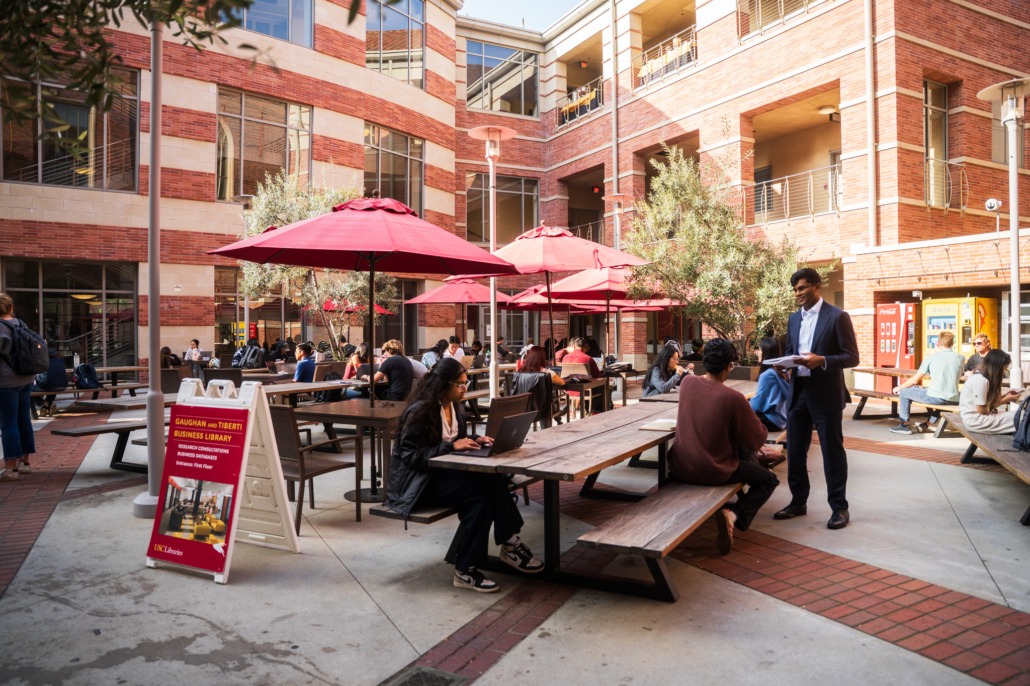

This is how competitive club recruitment affects students’ mental health.
I used to believe, naively, that once I got into college, the stress around recruitment would finally be over. No more endless applications, no more rejection emails, no more anxiously waiting for decisions. I thought I had crossed the finish line.
I was wrong.
In high school, joining a club was simple: you showed up, and you participated. But in college, the rules of the game have changed. Now, I find myself filling out round after round of application forms, attending interviews and refreshing my inbox for decisions. Joining a campus club, something which is supposed to be about shared passions and community, feels like applying to college all over again.
“Before I’m actually starting to apply for these clubs, I thought it would be a more simple process,” said Vincy Wu, a freshman majoring in business administration. “But actually, the application process … it’s more complicated than I thought:”
For freshmen, the challenges of transitioning from high school to college don’t just come from academics or social life; they emerge in the competition involved in joining clubs.
According to USC Campus Activities, there are more than 800 active student organizations on campus. Last year, the University created a rule that required clubs to be open to all interested students if they wanted to remain as Registered Student Organizations. Several clubs responded by creating a general membership tier and kept their earlier selective programs in place.
Each has its own expectations, culture and selection process. Some require auditions or essay responses. Others conduct behavioral or even case interviews in business clubs.
In other words, club recruitment at USC isn’t just about enthusiasm and passion; it’s also about strategy. Each organization looks for different qualities in its members, so applicants must learn to tailor their approach accordingly.
And it’s not only freshmen who are feeling the pressure. Transfer students, too, are adapting to this new environment. According to Undergraduate Admission, the University enrolled 1,544 transfer students in Fall 2025. Transfers make up a vital part of the Trojan community, and have to adjust to things like competitive club culture.
Hallie Jing, a sophomore majoring in art history, transferred from Wesleyan University, a small liberal arts college in Connecticut. She said the club culture at Wesleyan differed from USC.
“[Wesleyan doesn’t] have those kinds of job-related clubs. They’re mostly recreational clubs and about arts, literacy and philosophy,” Jing said. “I didn’t attend any clubs [at Wesleyan]. But at USC, attending clubs and getting to know people and networking is a major thing.”
For many transfer students, the transition from smaller liberal arts environments or community colleges can be especially jarring. USC’s competitiveness can quickly become unnecessary pressure.
“At first, I was anxious because I got rejected,” Wu said. “When I asked all my friends, all freshmen, none of them got into a specific team [of a club].”
Clubs are designed to promote a sense of belonging on college campuses, but paradoxically, they can deepen feelings of exclusion. According to a report from the Center for Collegiate Mental Health, anxiety was the top mental health concern among college students seeking treatment in 2024. This partially reflects how even seemingly low-stakes experiences like club recruitment can amplify stress and self-doubt.
The anxiety surrounding club recruitment isn’t limited to those who are new to USC. It also affects students who have been part of campus life for years. The cycle continues with the pursuit of higher positions: leadership roles, executive boards and director titles that symbolize success and ambition.
“I hate myself for being in the same spot. I just want to try something new each year,” said Christy Li, a sophomore majoring in arts, technology and the business of innovation.
For others, the pressure comes from shifting career interests and the growing uncertainty of the job market after graduation. According to the U.S. Bureau of Labor Statistics, the youth unemployment rate reached 10.8% in July 2025, a full percentage point higher than in the same month last year.
With job security feeling increasingly fragile, students are more anxious than ever about their post-graduation futures. Joining pre-professional organizations, especially those affiliated with Marshall School of Business, has become almost a reflexive move for many students seeking to future-proof their résumés.
“Even as a student who’s leaning more toward pre-law and more toward social sciences … I’ve been dragged or convinced into applying to consulting clubs … just because everyone else is doing that,” said Grace Zhuang, a sophomore majoring in international relations (global business).
This experience reflects a broader trend on campus: the gravitational pull of pre-professional clubs, which often promise networking opportunities, skill-building and a sense of direction in an uncertain economy. This isn’t just an individual experience; it’s collective. According to a report conducted by Handshake, a popular job search platform, 57% of 2025 graduates express concern about their career prospects.
At a consulting club, Jing gained hands-on experience through case studies because she knew it would help her prepare for her career; it’s the type of thing that builds a resume and impresses employers.
As the path to employment grows more unpredictable, students are turning to clubs as a way to regain some sense of control. Building the perfect resume — stacked with leadership positions, case competition experience and impressive titles — has become an attempt to carve out certainty in an uncertain future.
The anxiety around club applications and hustle culture is not an isolated phenomenon; it’s an extension, or perhaps a rehearsal, for the anxiety-inducing job application process itself.
The drive to belong, to perform and to secure one’s future has transformed what used to be a social or creative outlet into another competitive arena. Club recruitment becomes more than just a campus ritual; it’s a mirror reflecting the broader culture of career anxiety that defines college life today.
Aside from pre-professional organizations, the University also offers a wide range of passion-based and recreational clubs, from performing arts to cultural associations to volunteer groups. But the issue of club selectivity isn’t unique to the pre-professional organizations.
“I’ve been trying to apply for [a music performing group] for the past three semesters, and they never wanted me,” said James Zhang, a sophomore majoring in global studies.
Despite being driven by creativity and community, the group Zhang applied to maintains a highly selective recruitment process. His experience highlights how even passion-oriented clubs can mirror the same competitive structure found in pre-professional spaces. For many students, rejection becomes not an occasional setback but a recurring theme woven into college life.
Whether driven by limited capacity, high demand or the prestige attached to selective membership, the culture of “fitting in” and “proving yourself” seems to overshadow the original purpose of these groups: to connect people through shared interests and joy.
Still, amid this cycle of applications and rejections, students are finding their own ways to cope and redefine success on their own terms.
“Just like on Google Maps, if you go to the wrong road, it will always suggest you another better [route],” Li said.
Li’s metaphor captures something essential about resilience in the face of rejection: College life isn’t a straight path but a collection of many possible routes. For many students, not getting into a particular club may sting in the moment, but it often redirects them toward other communities, new opportunities or even personal growth.
“Don’t be too nervous about it … don’t be scared to try. And also, if you don’t get in, you don’t get it. That’s fine. You could apply next semester or just never apply again, and it doesn’t really harm anyone,” Zhuang said.
Zhuang’s advice reflects a healthier, more grounded mindset; it reminds students that club membership isn’t a measure of worth or capability. Sometimes, the best experiences come from letting go of what doesn’t work out and seeking fulfillment elsewhere, through friendships, classes or even spontaneous passions that don’t require an application form.
“I think [you] should believe in yourself and just go chase your dream,” Jing said.