Daily Trojan Magazine
Trans voices of USC
What can we learn from transgender members of the Trojan Family?
By JAY GARCIA
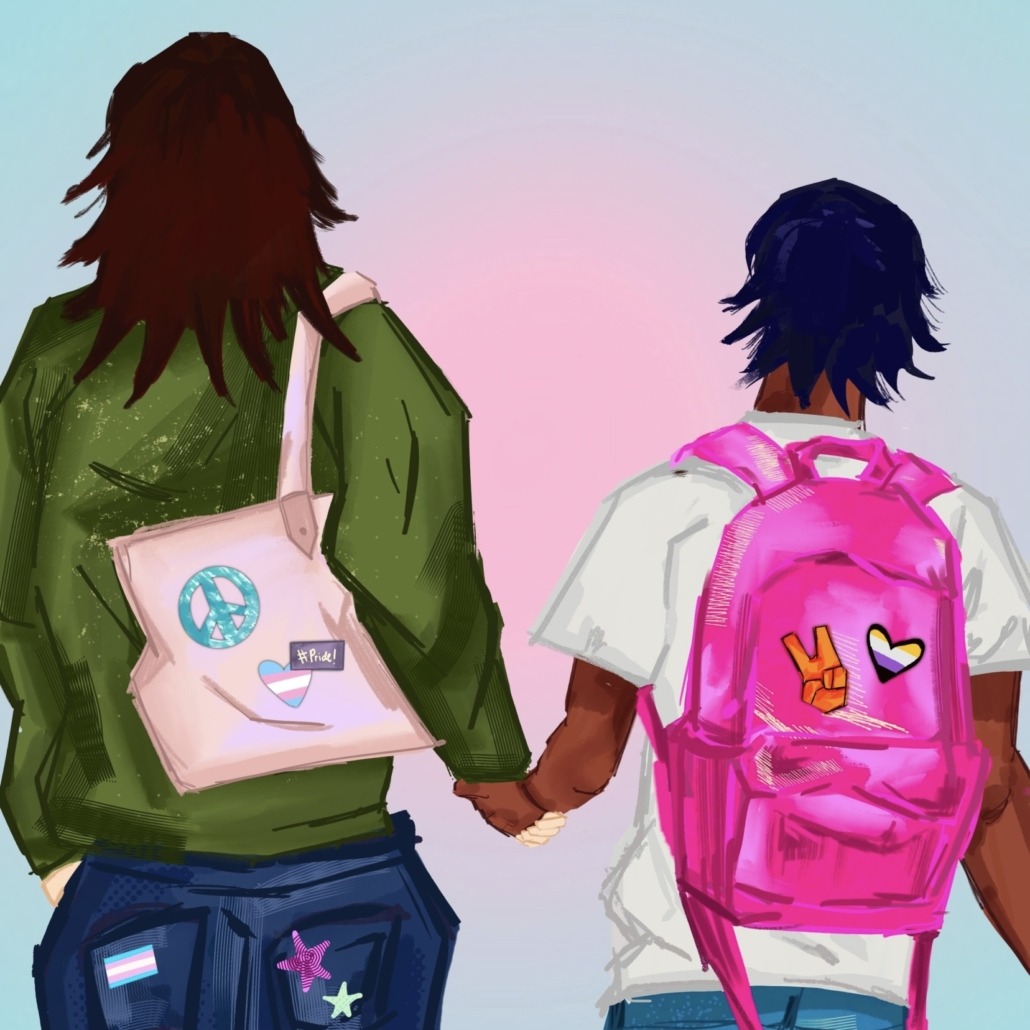

What can we learn from transgender members of the Trojan Family?
We live in a country where the politicization of identities is a societal norm. Be it immigrants, unhoused people or the female body, we are seeing the dehumanization of Americans right before our eyes.
One prominent example of this can be seen in the rise of anti-transgender rhetoric from the Trump administration, which has opened the floodgates for hate speech to be indirectly justified by government support.
To combat the abundance of hatred and bigotry, it is our duty as humans to not only reject this bias, but inform ourselves on the truths of marginalized communities. By amplifying their voices, we are able to form our own opinions without the presence of governmental influence.
“A lot of people just don’t know trans people … or they don’t know that they know trans people. And so it’s very easy to cultivate this perception of us that we are … scary. I think people don’t know any trans people that can counteract that narrative,” said Eli Dunn, a postdoctoral teaching fellow of gender and sexuality studies at USC.
This conversation is especially important at a local level: USC states in its mission statement that it is “unfettered by political control,” which is crucial to its educational integrity. If this is the case, how does the institution create an environment that is not only welcoming for all but also receptive to the voices of its transgender students?
On Oct. 1, the Trump administration sent USC the Compact for Academic Excellence in Higher Education. Containing a list of demands, the document claimed to “represent the priorities of the U.S. government” and ensured complying universities “benefit from the relationship.” With the promise of preferential funding, the compact sparked controversy among students, professors and administrators alike.
Although the University eventually rejected the compact on Oct. 16, the two-week period of irresolution raised high levels of concern. While many were afraid for the future of the University, others found their own identities under threat.
Clause six of the compact states that “institutions [must] commit to defining and otherwise interpreting ‘male,’ ‘female,’ ‘woman,’ and ‘man’ according to reproductive function and biological processes.”
“I was afraid of just being embarrassed and humiliated all the time … Would it be like going back to having [my deadname] on rosters?” said Sam Myerson, an openly transgender senior majoring in musical theater. “Getting that right taken away from me would be the main [fear].”
Beyond the fear of losing one’s right to self-identify, there was also uncertainty from students about interim President Beong-Soo Kim’s willingness to stand by those directly impacted by the acceptance of the compact.
“[Kim] says a lot about open dialogue, but at the same time, I am worried that that also allows for the platforming of hate speech and also people that are discriminatory towards queer people,” said Charli Liu, a nonbinary sophomore majoring in biochemistry.
The uncertainty felt by students across USC represents the broader national conversation about LGBTQIA+ rights, specifically in the discussion of transgender Americans.
In January, the White House released a statement, demanding the “Ending [of] Radical Indoctrination in K-12 Schooling.” In the statement, Trump described the teaching of gender and sexuality as “anti-American, subversive [and] harmful” and goes as far as equating gender affirming care to “surgical and chemical mutilation.”
Though this statement is one among many, it is representative of the current government’s stance on transgender Americans. Throughout his presidency, Trump has not only passed several anti-transgender executive orders but also made wildly disturbing remarks about their existence.
In the 2023 National Rifle Association Institute for Legislative Action leadership forum, Trump stated that the agenda of Democrats is to “demonize patriots and persecute Christians while pushing the transgender cult on [our] children.” With statements like these, Trump politicizes identity and makes a monster out of a group that represents a mere 1% of adult Americans.
“What we’re seeing in real time unfold is the assertion of authoritarian power by scapegoating trans people,” said Karen Tongson, chair of gender and sexuality studies. “The more that people can be turned into enemies, the more effective a regime … can manipulate the feelings of the masses.”
Similar to the current villainization of immigrants, this method of manipulation is not new to the Trump administration. Regardless, its effects are felt on every level, from local to nationwide. In a study done by GLAAD, the rate anti-transgender hate incidents has increased by a shocking 14% in 2025 as compared to last year.
As a reflection of the rhetoric spread by the current presidency, this increase of anti-transgender hate and violence is largely representative. However, as students, we are able to look into the initiatives being made by our institution to not only prevent this, but sustain a community of acceptance in spite of governmental influence.
Although recent initiatives such as the higher education compact have sparked concern, USC has taken several steps to support its transgender students over the course of years, and, in some cases, decades.
In January 2019, the University introduced a system in which students could select a preferred name and pronouns to be shared across USC’s roster. This system also gave students the option to have their preferred name stated on their USC student ID.
The University also has a well-seasoned Department of Gender and Sexuality Studies, which has been operating since the late 1980s. As an extension of USC’s sociology department, this program is a national leader in gender-based research.
Dunn said this distinction was the reason they came to USC in 2016.
“USC was not only open to that kind of work but actively facilitating it, putting resources into it,” Dunn said. “We have a number of graduate students and postdocs and early-career researchers who are working in these areas and bringing notoriety to USC, and they’re here because USC has facilitated that work more than many other universities have.”
For its transgender or gender-nonconforming students, USC Housing also offers gender-inclusive housing. This was introduced in 2001 through the Rainbow Community, a Living Learning Community located in Birnkrant residential college. Essentially, this allows students with differing gender identities to live in a space that creates comfort and support for those who choose to live in these spaces, of which not all identify as transgender or gender-nonconforming.
Though this and other Living Learning Communities have since been dissolved due to “waning interest,” the option for gender-inclusive housing still remains as of November 2025, according to the USC Housing Website.
With a plethora of accessible resources, USC cements itself as an institution willing to change with the times and the needs of students. Though it is easy and undoubtedly human to be weighed down by the expanding presence of anti-transgender media, USC’s history of protecting and supporting its members of the community provides a welcome sense of comfort.
The transgender experience at USC, according to several members of the community who spoke with the Daily Trojan Magazine, has been overwhelmingly positive. Though these stories are not representative of the whole, many have named USC as an incredible place to begin gender-affirming care.
Beyond its available resources, USC cultivates a welcoming environment for its TGNC students. With community and open communication at the forefront of the University’s unifying values, it can only be expected that this is the case.
As of August 2013, students seeking gender-related care through USC’s Engemann Student Health Center have a large variety of resources covered under USC’s Student Health Insurance Plan. For students without this specific insurance plan, USC operates in collaboration with many major insurance networks, though rates of coverage are dependent on the provider.
Moreover, USC’s webpage on “Gender Affirming Care” names itself as “committed to providing comprehensive, integrated care for all students, including transgender and gender-nonconforming (TGNC) students at USC.” Through a USC-appointed primary care clinician, transgender students have access to hormone therapy, mental health resources and, in some cases, gender-affirming surgery.
In fact, USC’s gender-affirming care team is not only diverse but incredibly accessible to its students. For students who do not have a primary care provider, the University maintains a team of specialists who will guide patients through “hormone treatment, counseling, consultations, nutrition services, and referrals,” according to the Student Health website.
“I feel incredibly lucky to have the access I do at this school, because it made it incredibly easy for me,” said Andie Kirby, a senior majoring in journalism and theater. “If there’s one thing that’s been by far the easiest, it has been actually accessing these life-saving drugs.”
With Hormone Replacement Therapy readily available to students, this acts as a tangible option for support, as well as a recurring theme in conversation with USC’s transgender population.
“In general, [my transition] has been — I don’t wanna say easy, because it’s never easy,” said Willow Yeaman, a transgender senior majoring in theater. “[What has] made the process easier is at least knowing that I have people and a community that are going to support me.”
However, amid her gratitude for USC’s gender-affirming services, Yeaman said she has experienced microaggressions in educational settings at the University, including from her acting professor, who misgendered her several times despite corrections.
“I get it. People have to adjust and are going to make mistakes, but also he had only met me as Willow,” Yeaman said. “I had corrected him several times, and it almost felt frustrating, and each time it was a little embarrassing.”
Yeaman largely attributes this treatment to ignorance, mentioning how her interactions with older generations yield similar results.
Despite the challenges that remain, the accounts of students like Kirby and Yeaman reflect a deeply caring environment at USC. In spite of its pitfalls, these stories demonstrate the importance of allyship and how crucial it is to educate ourselves on how to best support our transgender friends and family.
Though USC’s campus may be a best-case scenario for its transgender students, this is in contrast to the nationwide social climate. Beyond USC’s grounds, transgender people remain a scapegoat for American politicians and, in turn, their supporters. As in the case of Yeaman, this hatred largely stems from ignorance.
A study done by the Pew Research Center in 2022 indicates that opinions on whether or not one’s gender can be changed are greatly impacted by their proximity to a transgender person. This study exemplifies how, by knowing a transgender person, an individual is 55% more likely to stand by the validity of transness as opposed to the insistence that biological sex defines someone’s gender.
So, this begs the question, “What can we do to fill in these gaps?” or even, “What do we wish we could tell those who hold these prejudices?”
“I feel the main thing people are scared of is that they don’t understand it at all. They don’t understand how someone could do this. And I would just like to say, truthfully, I don’t really either,” Myerson said. “If I could live a life where I didn’t have to [transition], I would do that. But in the situation that I’m in, this is just how it has to be.”
Often in discussions about the validity of transness, opposing parties fail to consider the shocking and often morbid realities of their hatred. Among transgender people, the rate of suicidal ideation is higher much higher than that of cisgender people, according to a study by the Williams Institute. The Centre for Suicide Prevention attributes this to several environmental factors, such as discrimination, lack of familial support and stigma.
However, these unfortunate statistics are greatly decreased in the presence of the opposite. In cases where members of the community are met with love and support from peers and family, there is a significant decrease in the probability of suicide, according to a 2025 study done by The Trevor Project. In addition, this response is linked to lowered levels of anxiety and depression.
No matter what argument is to be made, the fact of the matter remains constant: Transgender acceptance saves lives.
At its core, the fight for transgender rights has become heavily politicized, despite its clear roots in humanity and acceptance. To make sense of conflicting rhetoric from media, friends, family and even everyday life, the most tangible way to support the transgender community is to listen.
By listening to our transgender peers, we are hearing a voice, unaltered by hatred and implicit bias. Take a moment and check in on your transgender friends. Tell them that you love them, and take the time to hear their story.
After all, if we won’t, who will?
Disclaimer: Sam Myerson formerly served as a cartoonist in the Art & Design section at the Daily Trojan in Spring 2025. Myerson is no longer affiliated with this paper.