USC, are we still a Trojan Family?
The University must fight against authoritarianism to protect students’ integrity.
By DAILY TROJAN FALL 2025 EDITORIAL BOARD
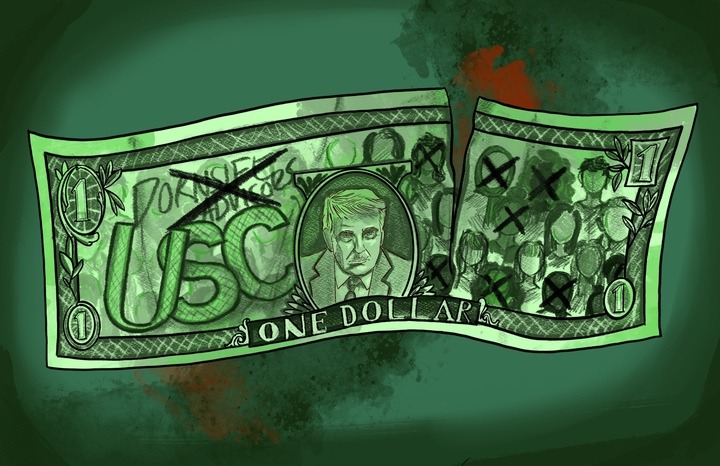

The University must fight against authoritarianism to protect students’ integrity.
When prospective students open USC’s application portal, they see more than a submission form — they see the promise of a dream fulfilled. Attending one of the nation’s top universities should mean entering a community grounded in academic excellence, freedom and opportunity. That promise once defined the USC experience: a balance of prestige and purpose, where students were encouraged to explore freely and challenge convention.
Campus culture is the social atmosphere that shapes the student experience.
On campus, security ambassadors remain at entry points. Daily breaking news headlines consist of budget cuts resulting in massive faculty layoffs and the federal government demanding the University to adhere to its authoritarian demands, and academic initiatives and resources are constantly being restructured — ultimately for the University’s wallet rather than fulfillment of the student experience.
Today, the promise of a “Trojan Family” feels like a relic.
A campus that feels like home
Walking across campus now, there is a distinct sense of emptiness. Green spaces on campus used to be buzzing with life, with picnic blankets laid on the grass, hammocks strung between trees and students lingering between classes.
However, the violent response to student demonstrations in Spring 2024 — followed by gates and ID checkpoints around campus — sent a clear message of intolerance: The University would rather restrict community than protect it.
The removal of the gates did not restore what was lost; if anything, it revealed a deeper fracture in campus culture.
While some students viewed the gates as disruptive or unnecessary, others associated them with safety and reassurance — an attempt to create separation from the surrounding city environment. Still, the University acted without transparency.
Cuts that undermine academic and community life
This pattern continues beyond physical space. Over the past several years — and more acutely within the last two — USC’s campus culture has withered under the weight of administrative “restructuring,” political ambivalence and misplaced financial priorities.
Advising positions across Dornsife College of Letters, Arts and Sciences and the Viterbi School of Engineering — the largest and third-largest schools, respectively — have been slashed substantially, even as degree pathways and postgraduate journeys grow more complex. University leadership speaks of “community” and “open dialogue,” yet its actions increasingly communicate indifference toward student welfare and intellectual vibrancy.
Nearly all Dornsife advisors have been laid off, leaving students to ponder the University’s priorities. New athletic facilities continue to be built, while students are potentially left without guidance.
The University maintains that departmental layoffs are a part of a broader restructuring that will ultimately include 47 fewer positions and a cross-trained advising staff, but the transition has generated significant uncertainty for students. Staff affected by the layoffs will continue in their current roles until at least Dec. 17, but the future of academic support remains opaque at a moment when students need clarity most.
“USC should get their priorities straight; they should prioritize providing resources for their students … and then they can cut budgets in other areas of the school, like the football program,” said Jay Choi, a sophomore majoring in business administration.
Academic excellence cannot exist without structural support. Advisors are not simply registration checkpoints — they are lifelines in navigating complex degree paths and postgraduate ambitions. Slashing these positions at Dornsife and Viterbi undermines the University’s academic promise of a vibrant learning community.
The promise of the Trojan Family
USC has long boasted the strength of its Trojan Family; the upcoming Alumni Weekend will spotlight the University’s claim to a vast network of graduates who uplift one another personally and professionally. That network has launched careers, shaped industries and formed lifelong relationships. But today, that sense of collective responsibility feels strained.
As students and faculty witness the contraction of diversity initiatives, the downsizing of integral research programs and the erosion of academic support, the Trojan Family seems to be estranged.
Where is the shared investment in the University that once defined belonging here? If financial strain is being offered as the justification for layoffs and reduced support, why are alumni with the capacity to give not stepping in?
Part of the answer is understandable: Alumni may be skeptical of how USC allocates funds. Institutional memory of past financial mismanagement, expensive legal scandals and opaque spending has weakened trust. Alumni want assurance that they are not merely contributing to a general budget but that their support directly strengthens the student experience.
This year, the University launched initiatives such as the Trojan Fund for Research Excellence and the Trojan Victory Fund that offer clear avenues for meaningful alumni contribution. These funds do not funnel into generic administrative expansion; they are targeted investments in the academic and human infrastructure that make USC a university worth attending and worth being proud of. But these aren’t enough.
The erosion of support systems contradicts the University’s celebrated ideal of the Trojan Family. USC promotes its alumni network and lifelong community as core strengths. Yet when layoffs, scholarship cuts and academic resource reductions accumulate, that sense of collective responsibility fades.
Although the budget deficit has plagued the University since before former President Carol Folt’s tenure, current negotiations with the federal government have intensified the climate of caution. Resources once dedicated to student support are now treated as negotiable, contingent on political pressures rather than student needs.
USC is at an inflection point, and it cannot stall in the name of political safety. If the Trojan Family is to mean anything beyond rhetoric, it must be active — it cannot hide behind budget language, bureaucratic restructuring or “neutral” rebranding. When a university hesitates to defend its students, it chooses power over principle.
Oppressive federal oversight cannot stop the University from protecting its students
For the past year, the University has faced heightened federal scrutiny, among countless other elite universities across the country. Threats toward federal funding have pressured the USC administration to pick between its students or maintaining federal funding.
The Trump administration has frequently taken combative stances against DEI programs and initiatives. Facing this pressure, USC subsumed its Office for Diversity, Equity and Inclusion into the softer, more politically neutral Culture Team.
The University wrote in a statement: “The term ‘DEI’ has evolved to encompass so many interpretations as it has increasingly become embroiled in broader cultural and political disagreements.”
In June 2024, the United States Department of Education’s Office for Civil Rights opened a Title VI investigation into the University’s handling of discrimination complaints surrounding Spring 2024 pro-Palestinian demonstrations.
After the Supreme Court’s affirmative action ruling, national pressure mounted for universities to scale back race-conscious equity work. By February of this year, President Donald Trump’s Federal Task Force to Combat Antisemitism announced USC was one of 10 schools it was investigating for antisemitic harassment, and soon after, the University reframed DEI into the softer, less accountable language of “community.”
But federal oversight is not an excuse for the University to abandon its students and its core commitments. Now is not the time to bend to the whims of authoritarian sentiments. Rather, it is a moment when the University needs to act decisively to protect the integrity of its campus.
The office’s rebranding reshaped the emotional climate of campus. Resources that once signaled care — affinity spaces, identity-based programming and equity-focused mentorship — are now filtered through language and administrative distance.
Consequently, we are left not with neutrality but uncertainty. Students talk less openly, gather less freely and hesitate before asking for help, unsure of how their needs will be interpreted or weighed. Our campus feels more cautious than connected, not because students stopped wanting community but because the University has made it harder to trust that community will be defended.
Compact for Academic Excellence in Higher Education
This tension was further illuminated when the University delayed its response to Trump’s Compact for Academic Excellence in Higher Education, which USC received Oct. 1, along with eight other universities.
The compact asked universities to ban consideration of race and sex in the admissions process, limit international students to 15% of undergraduate student body, neglect inclusive definitions of gender, require applicants to take standardized testing and shut down any departments that “punish, belittle, and even spark violence against conservative ideas,” among other methods of control, in exchange for preferential funding initiatives.
“I was surprised [USC didn’t sign the compact],” Choi said. “Financially, they were in a very bad place, so the preferential funding would’ve helped them a lot.”
Yet students also recognize the broader stakes.
“[Trump] wants to enforce censorship among international students. … I’ve heard stories where [the U.S. government] would reject visas if they talk bad about the U.S. government,” Choi said. “It goes against U.S. ideals, goes against the Constitution.”
It took USC 15 days to reject the compact. It took USC faculty five days to host an Academic Senate meeting attended by 500 faculty members and interim President Beong-Soo Kim in which the overwhelming consensus was that the compact violated the values, freedoms and mission of the University, and institutions of higher education in general.
On Oct. 6, five labor unions came together, calling on USC to entirely reject the compact in a statement. The Graduate Student Government and International Student Assembly both released statements expressing concern and fear in regard to the possibility of the University’s concession to Trump’s compact. Ninety-three percent of students who engaged in an Undergraduate Student Government survey were in favor of rejecting the compact.
The choice was correct, but the hesitation was telling.
The University must, first and foremost, exist for its students and its faculty, as any institution of education should. The University cannot claim to value intellectual freedom while wavering in the face of political suppression; nor can it claim to value access while cutting the very resources that enable it.
The administration’s choice to refrain from deciding for over two weeks reflects a consideration that went beyond the desires of students, faculty, staff and alumni.
“Let whoever earns the palm bear it”
As USC faces continued budget conversations and national scrutiny, the question is no longer whether the University can protect its mission but whether it will.
USC must reinvest in academic advising, restore scholarship support, uphold DEI commitments and build policy around student wellbeing rather than reputational risk. Leadership must act transparently, decisively and with integrity.
The Trojan Family is only a family if its members are tangibly supported. USC’s motto, “Palmam Qui Meruit Ferat” — let whoever earns the palm bear it — calls on this institution to live up to what it asks of its students.
We have held up our end. It is time for the University to hold up its own.
The Daily Trojan Editorial Board is a group of diverse editors and staffers from the print Opinion section. The views of the Editorial Board do not reflect the Daily Trojan staff as a whole.