‘Animal Farm’ blends absurdity, laughter, truth
Behind the barn doors, a cast of nine redefines George Orwell’s allegory with heart, humor and fearless collaboration.
By KODY CHRISTIANSEN
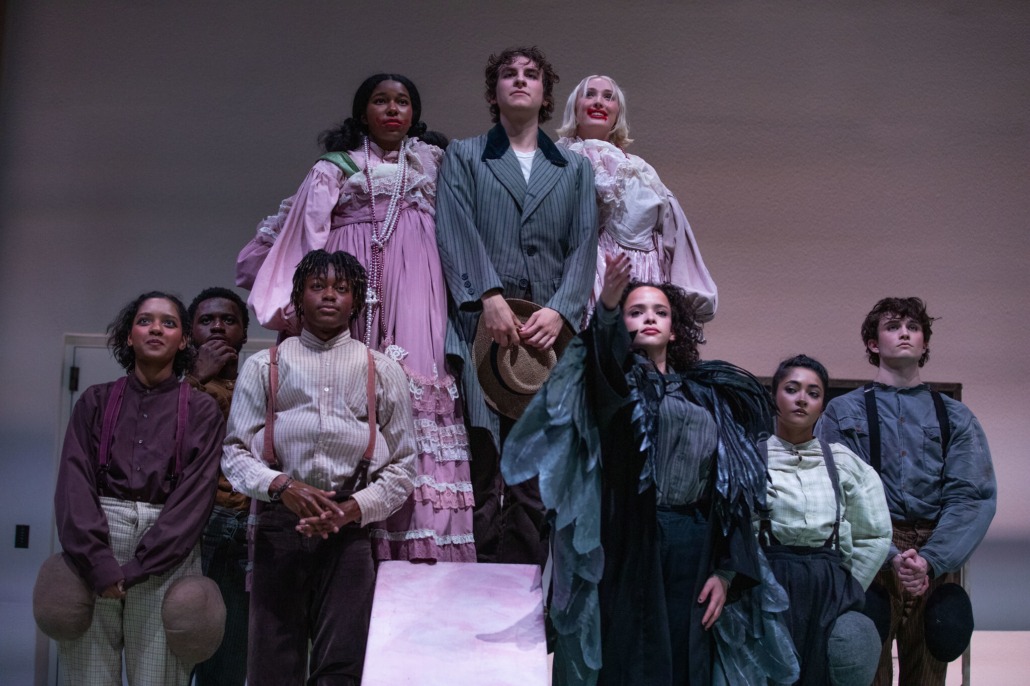

Behind the barn doors, a cast of nine redefines George Orwell’s allegory with heart, humor and fearless collaboration.
A rooster’s call. The soft shuffle of hooves. The distant creak of a gate. The sound of farm life filled the Sanctuary Theatre long before the lights came up. When the barn doors finally opened on the School of Dramatic Arts BFA acting for stage and screen junior class cohort’s “Animal Farm,” the audience was already inside the world.
The actors emerged, their hands shaped into hooves and wings, each movement deliberate. There were no oversized masks or heavy costumes: What emerged was a world built from instinct and imagination, a farm both hilarious and heartbreakingly human.
First published in 1945, George Orwell’s “Animal Farm” remains one of literature’s most enduring political allegories — a story of revolution and control that never loses its bite. SDA brought it to life through laughter and sincerity, transforming Orwell’s fable into something modern and moving.
Director Zachary Steel, associate professor of theatre practice and director of comedy, infused the production with physicality and play.
“I’m always interested in something physical,” Steel said. “It was kind of open-ended in our interpretation of it, which is also fun with students because they can bring a lot of them to it. They can invent. They can be creative. They can choreograph. We can create.”
His approach turned a blank canvas into a world of equal parts chaos and choreography based on a judgment-free environment.
“They can take big risks and be weird and fail and trust that they’re not going to be shamed,” Steel said. “In fact, they’re going to be supported at every step.”
That trust became the foundation for a cast that felt like family. For Aaron Eichenlaub, who played Boxer the horse, the rehearsal process felt like training both body and spirit.
“Zach told us from the first day of rehearsal to pick two or three physical traits to embody as the animal,” Eichenlaub said. “I didn’t know how much horse to bring and how much Aaron to bring. It feels like a gym for actors … discovering how the physicality informed those choices was wonderful.”
Nash Rahman, who played Clover, said she played “a female horse, who depicts the feminist working class at the time.” Her academic and creative work shaped her approach to the role.
“My feminist theory class has been helping me a lot with how I want to build my character structure and give it the lifelike qualities that I want it to have,” Rahman said. “Something that has been helping me is vocalization and becoming comfortable with it, learning how to neigh, learning how to whinny … and working with two legs instead of four.”
That blend of physicality and meaning shaped through collaboration and years of shared experience within a familiar cohort of actors truly defined the entire production.
“We add so much off of each other, each show, each rehearsal, each run,” Rahman said. “It’s feeding on each other’s energy.”
That same energy carried into Yara Raymond’s performance, who played several roles, including Moses the crow, bringing both humor and realism to her characters. For Raymond, comedy became its own form of truth.
“[It is] freeing,” Raymond said. “We don’t really need to display the symbolism; it’s right there for us … It’s incredibly timely. Leaning into the bizarre … and understanding that absurdity and seriousness can exist at the same time, and two things are true at once. We don’t live in a world that’s so black and white.”
Lauren Collins, the show’s stage manager and a sophomore majoring in dramatic arts with an emphasis in stage management, watched it all unfold from the wings.
“They’ve all been working together for years, and throughout the rehearsal, it was their relationship that made them such a joy to work with,” Collins said. “I couldn’t imagine what it was going to look like, and I’m incredibly happy with how it turned out.”
Collins described rehearsals as joyful and unpredictable. One pivotal scene stuck with her. When it came time to decide how the show would shift from humor to heartbreak during a scene where characters are executed, she said it was the cast who came up with the impactful transition.
“The actors had this idea of using a table set piece and dropping it down on the ground and making this huge bang,” Collins said. “The first time that we were blocking this, I had such a pit of dread in my stomach, and I remember watching it and the tone shift between what we had been doing so far.”
By the final act, the laughter turned to silence. Eichenlaub’s cries as Boxer were raw, Rahman’s mournful neighs were soul-piercing and the eerie calm around them was unnerving. The audience sat in stillness, suspended between absurdity and truth. When the final lights dimmed, the audience stayed still for a moment before erupting into cheers.
“It’s thrilling and terrifying at the same time,” Eichenlaub said. “You want audiences to walk away feeling the impact and the weight of what we’ve just done.”
Steel echoed the sentiment, noting that what mattered most wasn’t the politics of the piece, but the sense of connection it created between everyone in the theater.
“More than a call to action, this play is an opportunity to feel a sense of togetherness,” Steel said. “For the time that we’re in the theater together, we can actually feel things … sadness, grief, anger, but also joy and laughter.”
USC’s “Animal Farm” reminded audiences that revolution isn’t only political, it’s personal. Beneath the barn lights and the echo of hoofbeats, nine actors found something deeply human. What remained post-show wasn’t rebellion or ruin, but a reminder that humanity, at its core, is still learning how to stand upright.
“Animal Farm” was performed at Dick Wolf Drama Center’s Sanctuary Theatre Nov. 6-9.