Inaugural Sustainability scholars finish first year
Students worked alongside faculty to find solutions to environmental problems.
By JACK FARRINGER
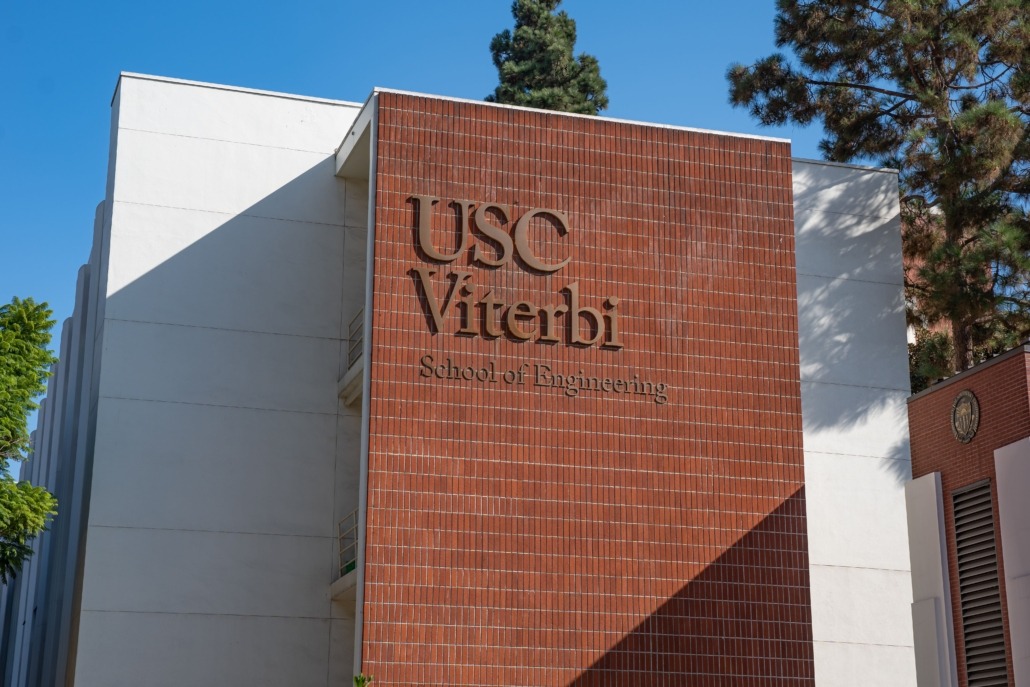

Students worked alongside faculty to find solutions to environmental problems.
As Hang Wu researched the effects of the toxic chemicals found in Los Angeles’ drinking water and air, he considered his motives every day.
“From a research perspective, it’s very important to think [about] why you did this,” said Wu, a former master’s student and current first-year Ph.D. candidate studying environmental engineering. “It’s not only about research, it’s also about life.”
Wu and two other graduate researchers, Venezia Ramirez and Lisa Staugaard, make up the first cohort of Astani Graduate Sustainability Scholars, a program that gives USC master’s students in the civil and environmental engineering department financial assistance and opportunities to work alongside a faculty member on a research project. The inaugural 2024 cohort has just started its second year.
Adam Smith, the director of the environmental engineering program and Wu’s faculty advisor, said students choose a topic they are interested in and are then paired with an advisor working in the same area.
The three students each pursued separate research projects focused on sustainability efforts. Wu focused on the presence of chemicals called per- and polyfluoroalkyl substances, or PFAS, in Los Angeles’s drinking water. PFAS are toxic, long-lasting chemicals found in water, air and soil that have been linked to harmful health effects.
Ramirez, a master’s student studying sustainable engineering, researched the distribution of truck emissions, looking specifically at how emissions impacted disadvantaged communities, while Staugaard took a deep dive into food contamination on a molecular level.
As he researches, Wu said he tries to go beyond the confines of his project and figure out how the information he learns can positively impact lives in a real-world setting.
“Maybe I can use this technology to remove the PFAS from the environment, [or] scale up this technology to products so people can remove the PFAS from their drinking water,” Wu said. “We always need to think about how we can apply the knowledge we learned [on] the campus to the real world.”
This academic year, Wu will continue this research on PFAS and their impact on the community. He has already begun researching PFAS in the dust and air, and said he hopes to find real-world solutions beyond the laboratory.
Smith said the students’ research project typically lasts throughout their time in the master’s program, meaning the Astani scholars could work on the project from one and a half up to two years.
Ramirez said the career opportunities provided by the Astani Sustainability Scholars drew her to the program. She said she hopes to combine her research on technologies that improve air quality with the regulatory experience of her advisor, Jiachen Zang, an assistant professor of environmental engineering, to bring about change.
“I’ve seen the proof of how needed these technologies are,” Ramirez said. “Jiachen Zang then has connected me to her colleagues at [California Air Resources Board] and to numerous colleagues and other agencies.”
The most impactful lesson Ramirez learned from her research was that a uniform reduction of emissions doesn’t solve the uneven distribution of emissions in disadvantaged communities.
“I think that was an incredible finding that I saw, because that shows proof that there has to be tailored local isolations specifically for the communities that we work with,” Ramirez said.
Ramirez’s discovery enabled her to more effectively advocate for changes to regulatory standards in her local community.
“I’ve spoken about my research findings to local community organizations. I’ve spoken about my research findings to agencies,” Ramirez said. “It’s been really nice that I’ve been able to apply my research outside of the laboratory.”
Ramirez, who works a full-time job, said she would recommend the program to other researchers because of its flexibility for professionals like herself.
“[The Astani Scholars Program] allows full-time working professionals to pursue their master’s program but also engage in research,” Ramirez said.
The master’s program also gives students the opportunity to gauge their interest in pursuing a Ph.D. program in environmental engineering. After working closely with Wu on his research project, Smith extended an offer to Wu to join as a Ph.D. student.
“[Wu’s] a success story within the program where we have a master’s student that comes in, starts doing research, gets to know a faculty member, and then they feel comfortable enough or confident enough in their abilities, so then [we] make the offer for a full Ph.D. with four years of funding,” Smith said.
Smith said that the ability of the scholars to balance coursework and still excel in their research efforts impresses him, and that he hopes to increase the number of students in the program, as well as their funding, in the coming years.
“We require 10 hours per week of research on average for the students in the program, but I often see them exceed that. They’re so eager to do research and excited by getting that research out there,” Smith said.