New and enduring businesses in LA’s ethnic enclaves
Two local spots are cultural hubs in Koreatown and Chinatown amid hardships.
By MIRANDA HUANG & SOPHIA KANG
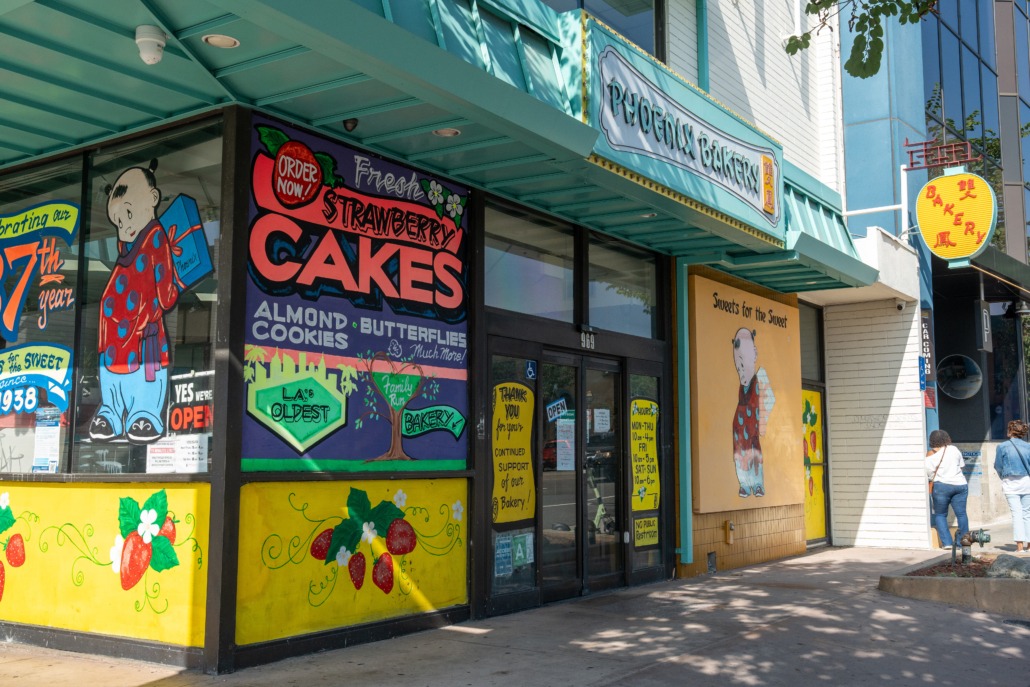

Two local spots are cultural hubs in Koreatown and Chinatown amid hardships.
Walking into Phoenix Bakery, the sweet aroma of pastries and the warmth of churning ovens are wonderfully overwhelming. Bustling workers move in seamless organization past one another as customers eye the cases of desserts, and familiar kitchen noises buzz in the background.
Forget about buttercream frosting or fondant. Sponge cake, whipped cream, strawberries and almonds are all it took for Phoenix Bakery to become a Chinatown staple, according to CEO and USC alum Kathryn Chan Ceppi. For 88 years, Los Angeles locals have flocked to the bakery for its nostalgic goods and familial atmosphere.
“Every day we hear that four generations have come here. My grandmother or great-grandmother brought me here. My mother brought me here. Now I’m bringing my kids here,” Chan Ceppi said.
When they immigrated to the United States, Chan Ceppi’s parents wanted to recreate some of the sweets that their community missed from China. In 1938, they founded Phoenix Bakery, and it has since remained a hallmark of Chinatown. Chan Ceppi said the bakery’s well-known strawberry cream cakes, almond cookies and sugar butterflies are not only its most popular items but also one of the main means of its cultural impact.
“You will see our strawberry cream cakes imitated everywhere you go,” Chan Ceppi said. “If you go to 99 Ranch [Market] or some of the other bakeries, they have a strawberry cream cake that originated right here.”
Although it had long been a part of her childhood, Chan Ceppi did not immediately return to Phoenix Bakery after going to college. She worked as an occupational therapist at UCLA for 40 years before one of her brothers asked her to take over the business.
“The lessons that we were taught here revolved around family. You help out whenever it’s necessary,” Chan Ceppi said. “When I was at USC and I had a final the next day, there was no one else to close the bakery, so I had to come down … I’m going, ‘God, I have a final the next day.’ [But it] didn’t matter.”
Youlen Chan, the bakery’s kitchen supervisor and Chan Ceppi’s first cousin, followed a similar trajectory. Despite working in the bakery since he was 12, Chan initially studied economics at a local college. However, he decided to switch to the baking program at Cerritos College after weighing the benefits of returning to a family business. Soon after, Chan re-entered the kitchen.
“It’s a legacy business, it’s family,“ Chan Ceppi said. “We were hoping to keep it that way.”
Similarly, Archives Of Us, a new cafe in Koreatown, seeks to act as another communal space for locals — family -inspired founder Nick Kim’s decision to start the business.
“I grew up in a background very familiar with food and beverage, and so the concept of hospitality has always intrigued me, and has always been something that I was around,” Kim said. “It was only natural for me to open up a cafe space to welcome in the community, and we still try to apply the things that I grew up hearing stories of.”
Kim spoke of how his grandmother opened one of the first restaurants in South Korea in 1946, four years before the Korean War. Initially just an invitation for neighbors to eat home-cooked meals, Gukil Ttaro Gukbap became a restaurant by chance.
Without support from a larger corporate entity, family businesses like Archives of Us and Phoenix Bakery face unique challenges.
After combating years of discrimination, adhering to new COVID-19 pandemic regulations and enduring recent tariffs placed on Chinese imports, Phoenix Bakery survived because of the loyalty of its customers and their families.
“We get a lot of people that come in and say,… ‘I’ve always got strawberry cakes from here,’” Chan said. “[There are people] here for only a week, and they had to come here because of the experience they had when they were younger.”
Despite the business’s endurance, both Chan Ceppi and Chan expressed concern for how Chinatown is losing its sense of community as businesses relocate to Monterey Park or the San Gabriel Valley.
“It’s been dead for years,” Chan Ceppi said. “Unless we get things that people are willing to come to Chinatown for, it’s not going to happen. L.A.’s a destination city. If you hear [about] some really good restaurant somewhere, you’re going to drive to it.”
Ryan Geng, a sophomore majoring in human biology, said that these ethnic enclaves — communities with a majority ethnic population — are “getting forgotten.” Geng explained that this could affect immigrants looking for aspects of the homes they left behind.
“My mom came to America by herself. My dad came by himself. It’s very hard for them to connect in the same way, physically, to their families,” Geng said. “You have to do it through places of shared culture, places where you are able to feel like you’re not alone.”
Tyler Chong, a freshman majoring in business administration, said he thinks that all the traffic that was once prevalent in Chinatown has now shifted toward Koreatown.
“I have not gone [to Chinatown] in a while, and that’s because … there’s nothing in Chinatown,” Chong said. “Obviously, there are restaurants and those good spots to eat at if you want some Chinese food, but the reality of it is, there’s not much there, and the streets are always empty.”
The benefit of Koreatown’s rising popularity is the emergence of another cultural community. For L.A. native Chong, the area offers a space of comfort and connection with restaurants like his favorite Han Bat Sul Lung Tang. It is a home — both literally and metaphorically.
“We go away for a week and come back, and the first meal we have is soup from [Han Bat Sul Lung Tang],” Chong said. “I’m even forming new memories with the place in college.”
Although he is Korean, Kim chose not to open his cafe in Koreatown because he feels the area is “overly saturated” compared to where it currently stands, bordering Chinatown. Unlike many cafes, which prioritize foot traffic and accessibility, Kim wanted the cafe to be a hidden space, serving as a place of rest.
“When it comes to hospitality, when it comes to cultures mixing and mashing with our menu, we want to go against the grain with a lot of things and be different, but not pretentious,” Kim said.
Regardless of whether these places are new or longstanding, local food establishments continue to impact their customers. With ethnic enclaves disappearing, food has become an essential for building community.
“I think food’s important because there’s a lot of history and a lot of different dishes, and to a lot of these people will feel like home,” Chong said. “It’s really powerful that food is one of those ways that we can speak our differences.”