USC announces free ChatGPT program at inaugural AI summit
Panelists at the artificial intelligence summit discussed the impacts of AI in higher education and the workspace on Tuesday.
By KIYOMI MIURA
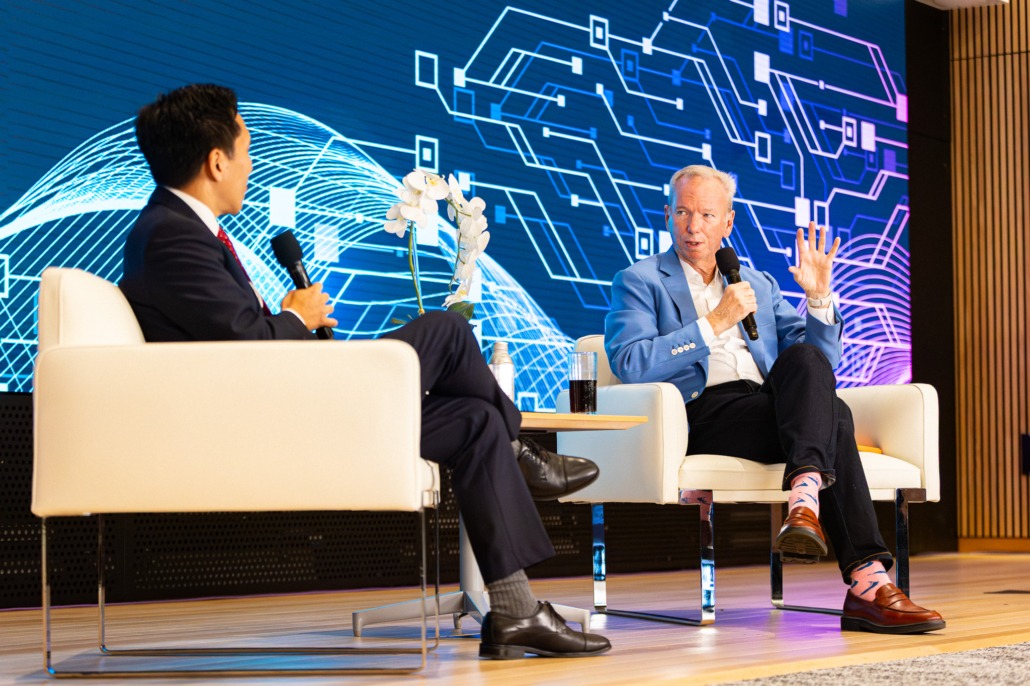

Panelists at the artificial intelligence summit discussed the impacts of AI in higher education and the workspace on Tuesday.
Students, staff and faculty crowded into a sold-out Ginsburg Hall Auditorium to hear industry leaders and USC experts discuss the future of artificial intelligence — and USC’s role in shaping it — at the University’s inaugural AI summit.
At the summit, Geoffrey Garrett, the dean of the Marshall School of Business and chair of the AI Strategy Committee, announced USC will partner with OpenAI to provide students, faculty and staff complete access to GPT-5 and limited access to “more advanced” artificial intelligence models from OpenAI. The announcement came from the AI summit Tuesday, where speakers presented to the AI Strategy Committee the intersection between generative AI and education.
“The expression these days is ‘AI is everywhere,’ and that’s certainly true, including the USC campus,” Garret said. “I think last month, we had over 37,000 active users of ChatGPT on campus.”
The summit’s discussion was facilitated by interim President Beong-Soo Kim. The conversation focused on AI in education, the ethics of AI and the potential impact of AI on creative fields. Speaker and OpenAI Vice President and General Manager of Education Leah Belsky spoke about the importance and challenges that will come with students navigating the use of AI in education.
“We’re at a very, very pivotal moment where universities have a key role to play in enabling all of you to put AI to its highest and best use,” Belsky said. “I see us in a place where the entire global education system can surround this new technology and help us.”
Belsky said one of the reasons she started working at OpenAI was the motivation to improve learning in the world by ensuring all students had access to AI. She said there is a difference between using AI to improve our brains and using it to merely receive quick answers.
“What feels like learning is not actually learning to learn. The brain has to encounter friction. It needs to challenge itself,” Belsky said. “The second thing that’s going to become even more important is the ability to critically think and critique what is generated by AI.”
Speakers at the event presented developments in healthcare, homelessness prevention, neuroscience and more. Each used AI to create agents and tools that augmented their research, emphasizing the realization of AI’s potential without allowing it to overtake their jobs.
Researchers who presented at the summit also spoke on the ethical problems of implementing AI into higher education and the workforce. Nathanael Fast, an associate professor of management and organization at Marshall, said AI companies take a “profit-driven” approach, maximizing engagement while disregarding the harmful effects imposed on their customers.
“In the context of a technology as powerful as artificial intelligence, I don’t think we can afford to take that approach,” Fast said.
Benjamin Hall, a faculty member at the USC Libraries Library Administration, said scholars describe the current AI environment as an “epistemological crisis.” Hall said this means that students lack an understanding of the algorithms and logic behind AI, which causes students to falsely believe that AI outputs are objective and neutral.
“If we want students to be more than passive consumers of algorithmic outputs, as many are with social media, we need to teach them three interconnected literacies that build on each other,” Hall said.
Those three literacies are information, algorithmic and AI literacy, Hall said. These disciplines each relate to the skill of critically evaluating the information we receive in order to use technology as a tool while understanding its limitations.
David Nelson, director of the Mixed Reality Lab at USC’s Institute for Creative Technologies, said AI would eliminate the human touch in the creative industry. He said his early experiences employing AI tools to create a short film as a film producer showed him the threat of AI in his field.
“The moment you realize that you don’t need anyone — you don’t need the film crew; you don’t need the technicians; you don’t need the designers or stylists — something essential disappears,” Nelson said. “That’s when I understood that the potential threat of AI is real and not just coming for our job but for our shared experience on making something together.”
Former Google CEO Eric Schmidt, who is also the former chairman of the United States National Security Commission for Artificial Intelligence, said AI will not replace jobs, teachers and universities, but rather it will foster the transformation from a traditional education to one that employs more “self-learning.”
He proposed a class that teaches students “prompt engineering” — the process of refining user questions to produce a specific output — to understand how to use AI in their education, supporting students’ freedom and independence when it comes to using AI.
“It’s just better to let students do their thing,” Schmidt said. “Let them figure it out.”
Jose Carillo, a graduate student in the Learning Design and Technology Program at the Rossier School of Education who attended the summit, said his background in technology made him optimistic about the use of AI in education.
“It’s important for students to voice their opinions,” Carillo said. “Students are the ones buying this product, this degree, so we should have a big voice in how much AI is integrated into it to make sure that it’s not diluting the value of that degree and to make sure that we have a say in the reformulation of that product.”
The committee plans to host more events to discuss the future of AI on campus.