USC will ‘thoroughly evaluate’ potential Big Ten investment deal, Cohen says
Athletic Director Jennifer Cohen implicitly said football may not play Notre Dame every year moving forward.
By SEAN CAMPBELL
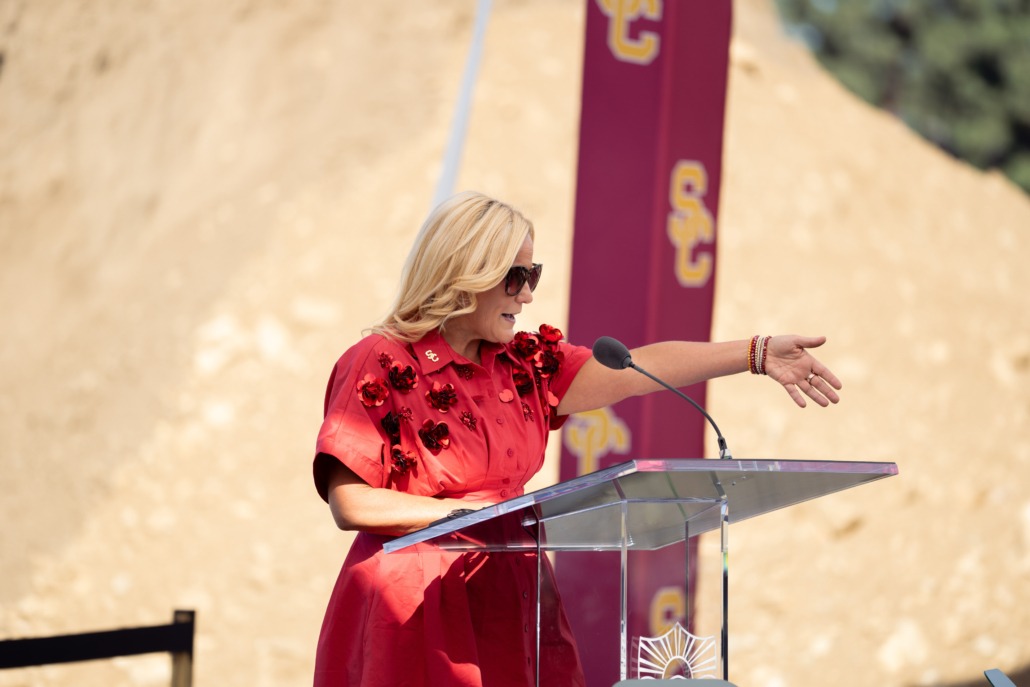

Athletic Director Jennifer Cohen implicitly said football may not play Notre Dame every year moving forward.
USC will continue to “thoroughly evaluate” the Big Ten’s proposed $2.4 billion media rights deal with University of California Investments, Athletic Director Jennifer Cohen wrote in her November The State of Troy update. Yahoo Sports previously reported that the Trojans, alongside Michigan, opposed the move, in part because it would give up the schools’ long-term control in the Big Ten’s media rights for instant cash.
“We greatly value our membership in the Big Ten Conference and understand and respect the larger landscape, but we also recognize the power of the USC brand is far-reaching, deeply engaging, and incredibly valuable, and we will always fight first for what’s best for USC,” Cohen wrote.
If the deal is finalized, UC Investments would own 10% of the newly-created Big Ten Enterprises, a proposed holding company that would control the conference’s media rights and sponsorship deals. The investment would reportedly infuse hundreds of millions of dollars into each member school, though unevenly.
The deal would also extend the conference’s grant of rights until 2046, which would keep USC in the Big Ten at least 10 years beyond the current agreement. Ohio State, Michigan and Penn State would also reportedly get a larger share of conference revenue compared to the other schools.
Big Ten messages sent to USC and Michigan that were obtained by Yahoo Sports said that the Big Ten is prepared to bypass the Trojans and Wolverines by taking the deal to a vote as soon as next week, though a conference spokesperson denied that a vote existed to the publication.
Cohen wrote that she is working with USC administration, including interim President Beong-Soo Kim, to come to a “sensible and effective” decision on the deal.
In The State of Troy, Cohen also implicitly addressed the future of USC football’s historic rivalry with Notre Dame, saying the University wants to play its nonconference games at home and “as early as possible” every year. The Fighting Irish game typically takes place near the midpoint or end of the season, and half of the time in South Bend, Indiana.
Cohen wrote that the biggest goal of scheduling is to set the Trojans up to compete for a Big Ten title and College Football Playoff berths, which could be threatened by a difficult nonconference opponent such as Notre Dame, especially one near the end of the season. After USC lost its second game of the season to the Fighting Irish on Oct. 18, it has been forced into a win-or-be-eliminated situation since a three-loss Big Ten team presumably wouldn’t make the CFP.
“Playing nine games annually in the toughest conference in college football to qualify for a playoff for which future selection criteria remain uncertain, we have a limited number of strategic levers to pull in pursuit of that goal,” Cohen wrote. “Intentionally making our road to the CFP significantly more difficult than our Big Ten peers does not align with our goal to win championships.”
Cohen wrote that USC has never played a Football Championship Subdivision team and that the Trojans will continue to “embrace challenging matchups” by scheduling one Power 4 opponent out of their three nonconference games each year.
“If that opponent is a rival with whom we share a long and storied tradition, all the better,” Cohen wrote, likely referencing No. 9 Notre Dame.
The Los Angeles Times reported in late August that USC offered Notre Dame a multi-year extension to the rivalry, though no verdict has been announced on the offer.
Cohen said football’s nonconference schedule will be released “in the near future” to go alongside a conference lineup that includes current No. 1 Ohio State, No. 2 Indiana and No. 8 Oregon as well as historically competitive Washington and Penn State programs.