‘Unfiltered’ panel talks truth-telling in Black media
Three Black student groups hosted the talk to hold space for unmediated expression.
By DAHLIA SARMIENTO
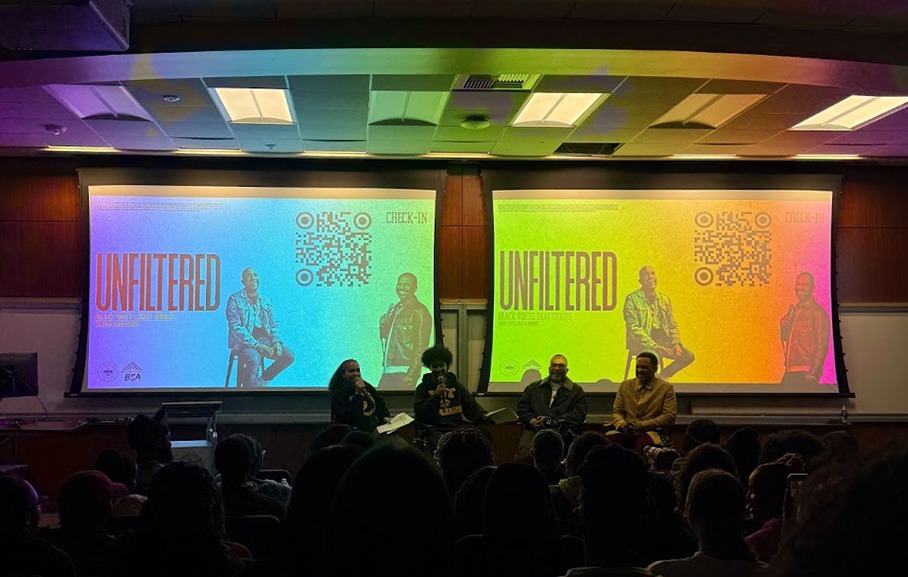

Three Black student groups hosted the talk to hold space for unmediated expression.
Kenya Barris, writer and producer of “Black-ish,” didn’t hesitate when asked what advice he’d give young creators. He didn’t start with industry strategy, networking tips or inspirational anecdotes. Instead, he led with a warning.
“You can’t create out of fear,” Barris said. “Nothing dope has ever been created out of fear. You have to be fearless.”
Barris was joined by comedian Mike Epps on Monday for “Unfiltered: Black Voices, Real Stories,” a panel that challenged students to question who holds power over narratives and what it means for Black storytellers to remain, as Barris put it, “trendsetters” in spaces that have historically shut them out.
The Black Student Assembly, Center for Black Cultural and Student Affairs and Brothers Breaking Bread hosted the panel at the Salvatori Computer Science Center. The event was curated by Clifford James, the associate director for BSA, who said the goal of the panel was to hold space for unmediated expression.
“Sometimes, stories about us are told, but not by us,” said James, a junior majoring in intelligence and cyber operations. “The goal of ‘Unfiltered’ was to create a space where we could just be our authentic selves, free of judgment. … We wanted something that tells Black stories, Black culture, represent Black life in general.”
Barris spoke about creative courage and the importance of resisting pressure to dilute one’s work.
“We just started doing the stuff you couldn’t do,” Barris said of his own career. “Once you start getting a certain amount of success, they keep letting you do it.”
Epps, best known for his work in “Friday After Next” (2002) and “The Hangover,” (2009) said storytelling has long served as a way to reveal truths that are often misunderstood or misrepresented. He also said ambition often requires willingness to take risks and to embrace ideas others might dismiss.
“You have to continue to use your imagination, and don’t be afraid to be delusional,” he said.
Epps said there is both difficulty and reward of pursuing goals that appear unattainable, especially in fields where competition is steep.
Munira Ahmed, a sophomore majoring in public relations and advertising, said the conversation resonated with her experiences navigating media and identity. She also said the panel felt especially meaningful given the limited availability of Black representation in television during her childhood.
“I grew up watching ‘Black-ish,’ and I feel like both of their works [were] really pivotal because there’s not as much Black media, so everything I interacted with when I was younger I’m still really nostalgic over,” Ahmed said.
She said hearing directly from industry professionals helped contextualize challenges she hopes will continue to be addressed in entertainment spaces.
James said the collaboration among student organizations was intentional, and reflected a shared goal of spotlighting authenticity in Black storytelling for students of all disciplines and interests. He said he hopes to make the event into a series to continue featuring Black creators.
“We definitely need more people from the industry coming back to talk about their experiences because we know it’s not really the most diverse,” Ahmed said. “This does fit into the culture of USC, being go-getters and trying to help other Trojans.”