Panel discusses impact of criminalizing immigrants
Panelists said the current rhetoric around immigrants paints them as “dangerous.”
By DUO YANG
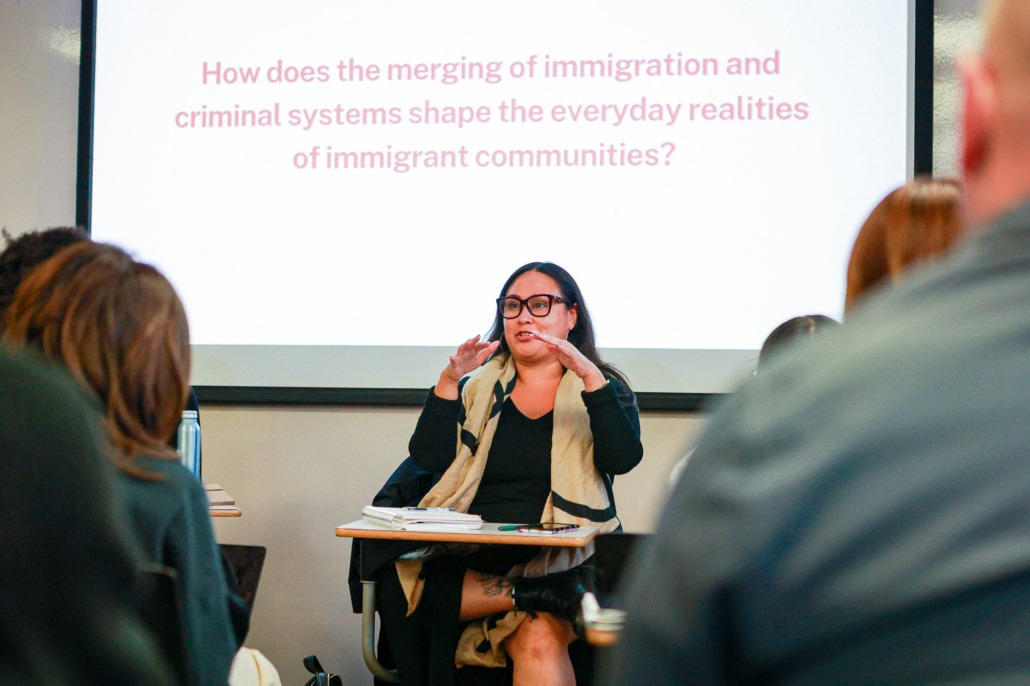

Panelists said the current rhetoric around immigrants paints them as “dangerous.”
Over 300 days into a presidential term that has heavily emphasized anti-immigration policies and rhetoric, the United States has seen a split of opinion regarding immigration enforcement. Student organizations at USC have created spaces for their own discussions on the topic, especially regarding personal experiences and localized efforts of resistance.
While anti-immigration discourse has historically been centered on competition for employment, Robert Werth, an associate professor of sociology at USC, said the characterizations have taken the direction of criminalization; hostile sentiments have begun to include words such as “dangerous” and “bloodthirsty,” he said.
Werth and other guest speakers discussed concerns about “crimmigration” — the increasing criminalization of immigration — in a panel discussion co-hosted by four student organizations Tuesday evening. Speakers addressed topics such as the changing realities of immigrant communities, historical patterns of deportation, health impacts of immigration enforcement and emerging community resistance.
The event was co-hosted by the Undocumented Trojan Success Assembly, USC Prison Education Project, Latino Students in Medicine and South Central Against Labor Exploitation — a group that includes USC students but is not affiliated with the University. The panel was held amidst the current nationwide wave of mass deportations that have put millions of migrants in the U.S. at risk.
Werth said that deportations are not new to U.S. history. He said there has always been tension around migration to the U.S., especially when migration is encouraged for cheap labor, but is pushed back due to xenophobia.
“We’re in a moment now, though, where the U.S. government has decidedly gone a very different direction and [is] very much making a public spectacle of saying, ‘We are going to crack down. We do not want immigrants, and we are going to arrest you,’” Werth said. “They don’t seem to be cracking down very much on employers, which, if you actually want to slow migration, that would be the effective policy.”
Werth said that the U.S. criminal justice system used to be much more committed to a rehabilitative ethos prior to the 1970s, but that the goal of rehabilitation has considerably declined within criminal justice agencies since 1977.
“The goal of rehabilitation has not disappeared, but considerably declined, and criminal justice agencies and state departments of corrections are now much less focused on rehabilitation and helping people,” Werth said. “We’re talking about the merging of immigrant enforcement and the criminal justice system, which, to me, is very problematic.”
Guest speaker Dr. Mohamad Raad, an internal medicine and pediatric specialist at Los Angeles General Medical Center, spoke about immigration in terms of medicine and healthcare institutions. Raad said that institutions of power, such as those in medicine and academia, have been laying the foundation for the dehumanizing process of criminalizing groups of people for a long time.
“The way it does that is by commodifying human life,” Raad said. “In the United States, you have layers of human life that are deemed worth more or worth less, depending on if you’re sick or how much money you have.”
Raad said that undocumented immigrants often have difficulty accessing medical care and treatment. Sometimes, he said this results in emergency room visits where treatment becomes much more expensive and risky.
The enforcement of immigration and violence committed against immigrants also takes a toll on physical health, Raad said. Acute manifestations may include injuries from the violent process of detainment itself, such as damage to the muscular or skeletal systems.
“The care in the detention centers is atrocious. Even when they have medical complaints, it’s substandard care. There’s been a record number of people who’ve died in detention centers,” Raad said. This is supported by a review from NPR, which finds that at least 20 people have died in ICE custody in 2025. This is the highest number of deaths per year since 2005.
Raad said health impacts are not limited to those who experience detention. He said patients and their families who have experienced state violence often suffer from anxiety and post-traumatic stress disorder.
Later in the panel, speakers offered their perspectives on the future of advocacy and resistance to the criminalization of immigration. Jasmin Tobar, board secretary of Homies Unidos and a social worker at California State University, Northridge, said that the social movements in L.A. have much to learn from history and from one another.
“I love being a professor, but the real learning is outside these doors,” Tobar said. “I just had this conversation with my students this morning when we talked about the reality of young people in Nicaragua, your age, picking up arms and fighting against a repressive government. What does it take for [someone] to do revolutionary acts like that?”
Raad said the groups that work together give hope for the future.
“There’s so much happening on the ground, and that’s one of the things that gives me, at least personally, hope for a long time,” Raad said. “What we need to focus on — students, all of us in the community — is organizing, and organizing in a way that’s cohesive, or we move in a way that’s very powerful, because there is a momentum. Despite the horrors that we’re seeing, there is a momentum.”