LA Philharmonic blends the senses with ‘Prometheus’
The colorful and synesthetic concert was the first of the Body and Sound festival.
By ANNA JORDAN
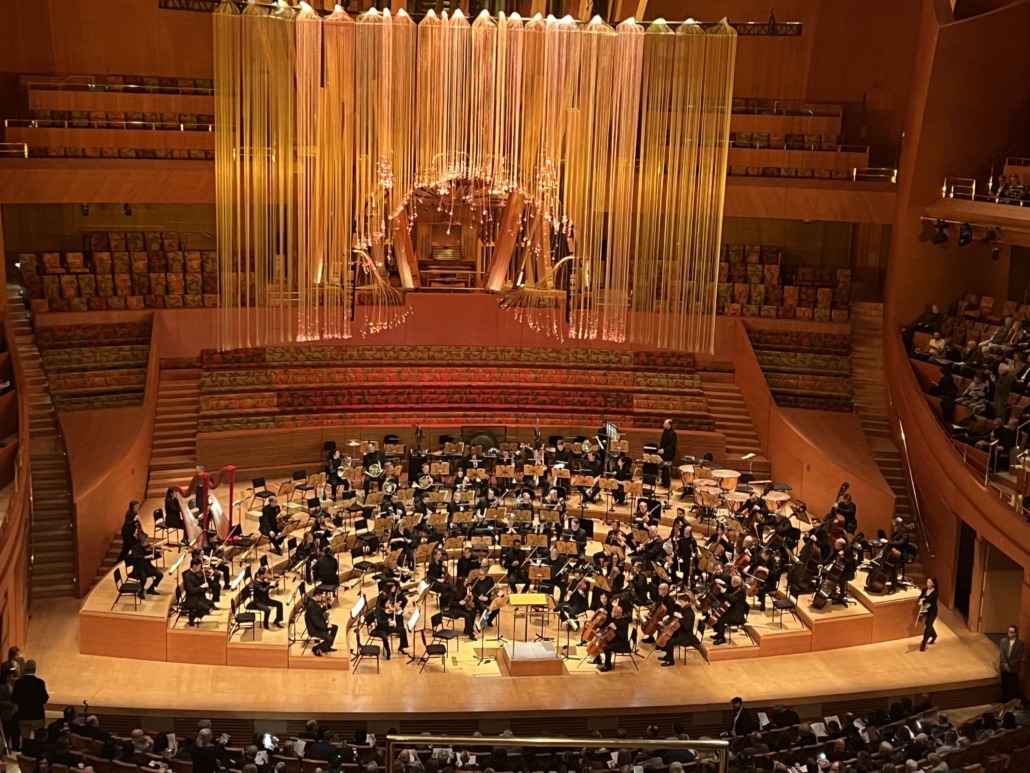

The colorful and synesthetic concert was the first of the Body and Sound festival.
The sloping, polished wooden interior of Walt Disney Concert Hall looked like the ridged belly of a musical beast Sunday, with the rolling hills of its ceiling and the warm brown rows of plush seats; however, a symbiotic being interrupted — or enhanced — its typical visage.
Strung up across the ceiling glared the impressive, alien-jellyfish-esque light sculpture from multimedia artist Grimanesa Amorós to meld the powers of sight and hearing for the first show of the Los Angeles Philharmonic’s Body and Sound festival.
Led by the L.A. Phil’s Conductor Laureate Esa-Pekka Salonen, the night’s lineup of pieces explored how music can be altered or improved through engaging the other senses. The headliner and name of the event, Alexander Scriabin’s “Prometheus, Poem of Fire, Op. 60,” encompassed the synesthetic thesis of the concert, with the piece resulting from Scriabin’s vision of rays of light accompanying each note.
However, the L.A. Phil didn’t show their hand too early, opting to kick things off by dipping their toes into “The Oceanides” by Jean Sibelius, a palatable, albeit semi-safe, choice for such a seasoned company. Nevertheless, any piece with Salonen — the arguable star of the night — at the helm is decadent.
Thanks to Amorós’ sculpture, the room was painted the warmest shade of blue as Salonen brought Sibelius’ inspiration of nymphs playing in the ocean to life, conducting with an enthusiastic yet skillful kindness toward the music.
Alongside the instrumentalists’ deft navigation of dynamics and intoxicatingly playful work from the woodwinds section, the piece took on a new and more complex life thanks to the unerring craft of the musicians, nearly always expected from the L.A. Phil.
Amorós’ piece turned yellow to clear the way for the second piece and the most contemporary of the night, “Rewilding” by composer and environmental activist Gabriella Smith. Before the performance, Smith introduced her piece by contextualizing her relationship to the title: Smith lives on a former U.S. Navy runway that is in the process of being converted back — or “rewilded” — into a functioning ecosystem.
As a result, the piece features natural or eco-conscious elements as percussion, including branches, walnuts and recycled bicycle wheels, a move that might appear gimmicky on paper but made the composition uncanny, haunting and deeply emotional. The piece started with these percussive elements — twigs sliding and tickling the drumhead, walnuts crunching, bicycle wheels cranking. Gradually, other sections crept back in, with wails of horns and breaths of strings as the land rewoke.
In true rewilding fashion, the music was never human for too long, opting instead to emulate something massive, taking its time to wake before stirring and coming alive. The middle section of “Rewilding” took shape as violin bows created dissonant itches that the low introduction of the brass section scratched. Despite being the middle piece in the bill, it nearly stole the show.
However, rather than keep the entire night rooted in tangible inspirations, Claude Debussy’s impressionistic and ethereal “La damoiselle élue” broke the intermission with an orange glow from the light sculpture. The hue turned yellow so gradually that it was hard to know whether the colors had changed or if the music itself had warmed listeners to look at the room with a new perspective.
The orchestra navigated the piece with care; it’s a composition so reflective and filled with instant awe that it sounds like it’s starting at the end, especially with the choir sections written in. The Los Angeles Master Chorale attacked the challenge head-on — rather than overpowering the instrumentation, the vocals were an asset to the music’s emotion, the wildflowers in Debussy’s meadow.
While soprano soloist Liv Redpath’s more traditional approach to the dynamics of the piece was lost to the farther reaches of the room, the lightness of her vocals accentuated the string section with a sentimentality bordering on saccharine. However, mezzo-soprano soloist Jingjing Xu rooted the sweetness with depth all her own, a triumph with source material as lilting as Debussy’s.
As incredible as the first three pieces were, nothing was quite as spectacular as “Prometheus.” The piece was part of a series that Scriabin wrote in an attempt to expand human consciousness, something that felt possible thanks to a turquoise start that evolved into pulsing orange, pink and yellow light, which gathered into the sculpture’s center throughout the piece in a sort of sunset black hole.
The light matched the movement of the song itself, an undulating piece accompanied by a grand piano helmed by Jean-Yves Thibaudet. Thibaudet’s approach to “Prometheus” neared that of a harpist, treating the keys to a mesmerizing assault as Salonen’s footsoldier.
Salonen himself was hypnotic, speaking a physical musical language that suited the near-modern percussion driving the piece. As “Prometheus” grew, the Chorale re-entered a visually rich scene, from Salonen to Thibaudet to the instruments themselves, lightstands illuminated into white beacons by the overhead spotlights.
Every flash of light and color up until the final section was only a prophecy of a finale yet to come, one spectacular enough to warrant another sold-out round of shows for the rest of the festival.
Flashing pure white and purple lights grew faster and faster, so the entire audience was visible in blinks; as it swelled, Salonen’s gesticulations became more and more emphatic until the final swell, where his arms opened in a victorious stretch upwards, head tilted back as the flashes grew to a crescendo.
With a final flare from the strings, horns, and timpanis, the spotlights that were pointed toward the stage swivelled to rest on the audience. With no air left in the room, the conductor’s head fell forward, and the lights went out, offering silence for the first time in 20 minutes, a silence unwanted and broken by applause.