Can we finally hear the people sing?
Public responses to Renee Nicole Good’s death reveal racial disparities in responses to the treatment of individuals.
By PIRIL ZADIL
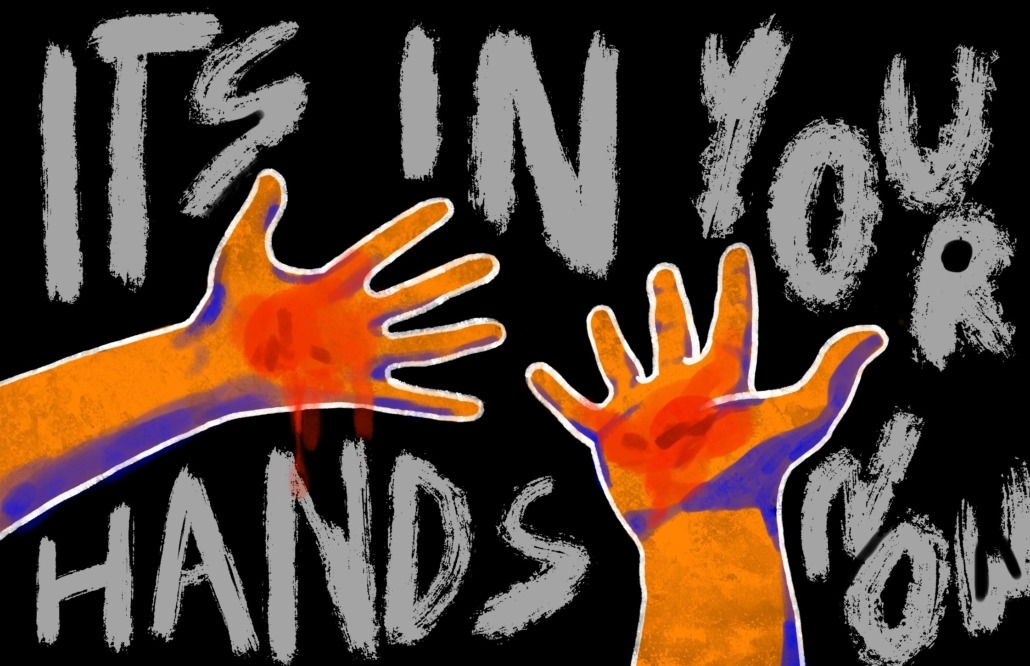

Public responses to Renee Nicole Good’s death reveal racial disparities in responses to the treatment of individuals.
As a journalist hoping to make her readers empathize with a cause, a large part of my job is identifying aspects of a social issue that affect people beyond those it directly harms.
In my experience, most people are apathetic toward matters that do not personally affect them. As such, it often takes a great deal of suffering and an array of people being abused for the general public to collectively rise in defense of a cause.
On New Year’s Day, Keith Porter, a Black man, was shot and killed by an off-duty United States Immigration and Customs Enforcement agent, according to ABC News.
And, on Jan. 7, Renee Nicole Good, a white woman, was shot and killed by an ICE agent in Minneapolis, about 10 blocks away from where George Floyd was murdered five years ago, his breathing blocked by a law enforcement officer’s knee on his neck.
All of these incidents mirror one another as acts of brutality committed by American law enforcement that have seemingly elicited equal levels of outrage from citizens of all races, contradicting my earlier assumption.
On the same day of Good’s killing, Minneapolis Mayor Jacob Frey told ICE to “Get the fuck out,” on local television. According to NPR, over 1,000 events were organized across the U.S. the weekend following Good’s killing.
Similarly, the Black Lives Matter protests of 2020, which stemmed from Floyd’s death, proliferated across all 50 states in the U.S., and even spread to at least 18 other countries, expanding far beyond Minneapolis.
On the surface, the reaction to the unjust death of a Black man seems to be similar, if not identical, to that of a white woman. Yet, a closer examination reveals essential differences.
For the Black community, Floyd’s death merely exposed what was already known: the lives of people of color, especially Black people, are valued by the general public far less than those of their white counterparts.
In contrast, Good’s killing was an anomaly; out of the 38 people who were killed by ICE in 2025 and 2026, she was one of the few white people.
While both events prompted a myriad of protests, it took a significant number of Black people dying for masses of people to mobilize, but it only took one white woman for people to actively protest against the administration that unjustly killed Good and many others.
My current dissatisfaction should not be mistaken for opposition to the protests; I am as glad as any human rights advocate that people are finally doing something active to fight against the injustice we have found ourselves in. However, I question what it took to get us here.
If our concern is to preserve what we believe to be fundamental human rights, why didn’t that concern materialize in the form of widespread outrage and nationwide protests when Black or Hispanic people, ICE’s primary targets, started losing their lives?
Porter’s death was noticeably undermentioned until Jan. 7, when people outraged by the videos of Good’s killing started looking for similar events. It raises the question: Would Porter’s death have ever seen the light if he hadn’t been killed the same way Good was?
Not to mention, among the thousands of TikToks depicting, discussing, or mourning for Good, the names of the Latine people killed by ICE are barely mentioned.
In truth, we, not just as Americans, Europeans, or the like, have failed people of color by normalizing their maltreatment.
With every “what did you expect?” we throw at the news of ICE breaking apart another Hispanic family, we perpetuate the notion that people of color are treated like the “animals,” “illegal aliens” and “savage monsters” that politicians have claimed them to be.
When the National Socialist German Workers’ Party dehumanized certain groups, little girls like Anne Frank found themselves having to hide in attics.
“Terrible things are happening outside. At any time of night and day, poor helpless people are being dragged out of their homes,” Frank wrote in her journal, later published as “The Diary of a Young Girl.” “Families are torn apart; men, women and children are separated.”
Thus, I ask that you protest not just the lives of people who look and think like you but also those of those who do not.
For those who claim that citizens should not be killed in the streets by law enforcement but have only started to actively protest after the death of Renee Good, I ask that you recognize the fact that people of color deserve your outrage as much as anyone else.
The names of those who lost their lives because of ICE in 2025 and 2026, as of January 14th, 2026, compiled by The Daily Trojan
Keith Porter Jr., Renée Nicole Good, Ismael Ayala Uribe, Oscar Duarte Rascon, Lorenzo Antonio Batrez Vargas, Chaofeng Ge, Tien Xuan Phan, Isidro Perez, Johnny Noviello, Jesus Molino-Veya, Abelardo Avelleneda-Delgado, Marie Ange Blaise, Nhon Ngoc Nguyen, Brayan Rayo-Garzon, Maksym Chernyak, Serawit Gezahegn Dejene, Genry Ruiz Guillen, Ramesh Amechand, Pankaj Karan Singh Kataria, Jose Manuel Sanchez-Castro, Juan Alexis Tineo-Martinez, Santos Banegas Reyes, Norlan Guzman-Fuentes, Miguel Ángel García Medina, Huabing Xie, Leo Cruz-Silva, Hasan Ali Moh’d Saleh, Josué Castro Rivera, Gabriel Garcia Aviles, Kai Yin Wong, Francisco Gaspar-Andrés, Pete Sumalo Montejo, Shiraz Fatehali Sachwani, Jean Wilson Brutus, Fouad Saeed Abdulkadir, Delvin Francisco Rodriguez, Nenko Stanev Gantchev and Silverio Villegas González