Men’s basketball returns to form with win over Maryland
After a shaky first half, the Trojans pulled away largely thanks to the efforts of the bench unit.
By KAI ASSAD
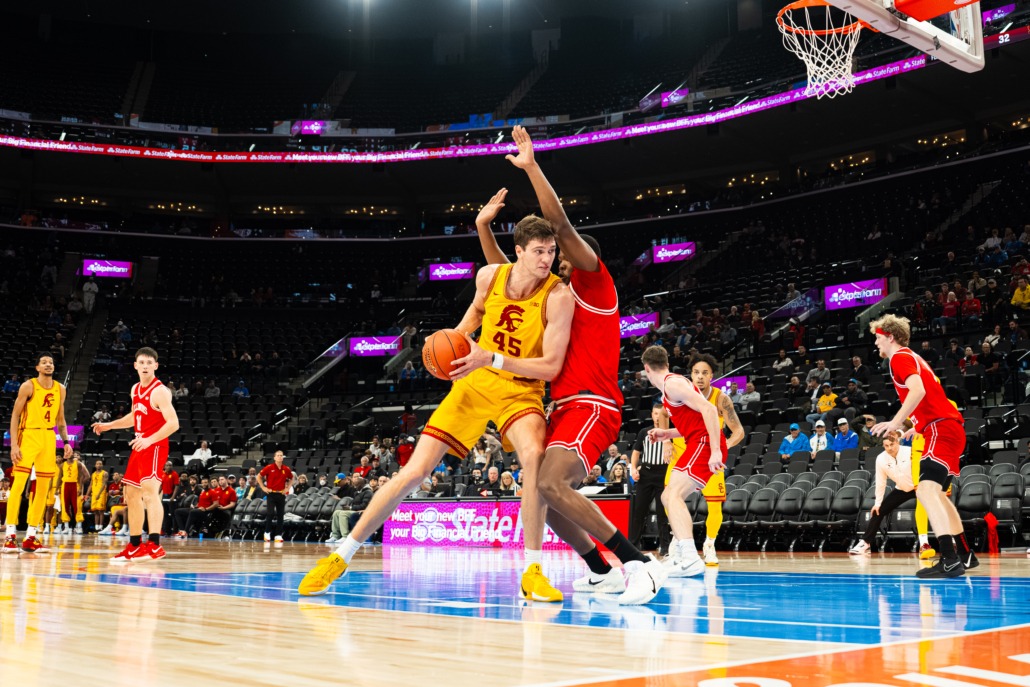
Junior center Gabe Dynes was one of five Trojans to score at least 10 points against Maryland. He is pictured here at a Nov. 15 game against Illinois State University. (Braden Dawson / Daily Trojan)
It’s one thing to see Head Coach Eric Musselman wiping away tears of joy courtside. It is entirely another to see him much cheerier than usual in a postgame news conference.
On Tuesday night, he had a lot of reasons to feel that way.
With star graduate guard Chad Baker-Mazara suffering a neck injury against Minnesota last Friday and playing only eight minutes against Maryland (7-10, 0-6 Big Ten), his lowest in nearly four years, Musselman’s Trojans (14-3, 3-3) still convincingly won 88-71.
Daily headlines, sent straight to your inbox.
Subscribe to our newsletter to keep up with the latest at and around USC.
It’s an especially important win after the team’s recent set of road games in Michigan, where they were trounced by No. 4 Michigan (14-1, 4-1) and No. 12 Michigan State (15-2, 5-1). Although USC by no means played perfectly, the team still put on a performance that — through much of the second half — was emblematic of its best.
“If you would’ve told us Nov. 1 that we were going to win a Big Ten game by double digits, without Alijah [Arenas], without Chad [Baker-Mazara], without Rodney Rice and without Amarion [Dickerson], that wouldn’t happen in our minds,” Musselman said in a postgame news conference. “But it’s a resilient group. It’s a group that’s only worried about who’s suiting up, and [I’m] super proud of this group.”
Trojans moving as a unit
For the first time since their Dec. 17 win against the University of Texas at San Antonio (4-12, 0-4 American), five different Trojans scored in double digits. Senior forward Ezra Ausar and sophomore forward Jacob Cofie — both starting lineup mainstays — each scored 12 points, but junior guard Jordan Marsh, who hasn’t started a single game this season, was especially impressive.
Marsh’s 20-point performance led all Trojans and set a new personal record in the cardinal and gold. Even more impressive is that he only made a single 3-pointer in the first half — his 17 second-half points and four second-half assists were the most out of any player and were huge factors in USC breaking away from a close 42-41 halftime score.
The final members of the double-digits club were freshman guard Jerry Easter II and junior center Gabe Dynes. Easter saw the fewest first-half minutes among the five but was still an effective bench piece and finished on 83% shooting, his second-highest mark of the season.
“Super proud of the togetherness. It showed by the sharing of the basketball,” Musselman said. “We kept getting better as the game progressed.”
Dynes, like Marsh, had one of his best games of the season. His 10-point outing was just his third double-digit game as a Trojan, and he did it while bagging eight rebounds, the most for him this season. Musselman also praised his defensive presence, saying that the 7-foot-5 center “alters shots and alters people from thinking about going [in the paint].”
No good from outside, real good from inside
The paint was an important place for the Trojans, with exactly half of their 88 points coming from inside the lanes. Although this lack of outside shooting was a thought-out decision for some — Ausar, Dynes and Easter didn’t take a single shot beyond the arc — it was also a necessary antidote to the team’s below-average overall 3-point efficiency.
The Trojans shot just above 30% from 3 and came dangerously close to shooting under 20% a few minutes into the second half. Graduate guards Kam Woods, Ryan Cornish, Jaden Brownell and graduate forward Terrance Williams II shot a combined 1-for-11 from 22 feet out and farther.
This was especially dire in contrast with Maryland graduate guard David Coit, who dropped 30 points for the third time this season and was often the driving force keeping the Terrapins competitive.
While problems with 3-point efficiency aren’t new for USC basketball this season, Musselman found a way out by relying on his previous SEC history — notably against current Maryland Head Coach Buzz Williams, who led Texas A&M since 2019 and left just a year ago.
‘We’re constantly reinventing ourselves’
Mismatching has been integral to Musselman’s second season as a Trojan, whether he would prefer it or not. The team has been riddled with injuries, and Baker-Mazara’s neck soreness is just another straw on an already-fatigued camel.
Musselman also projected freshman guard Alijah Arenas to make his debut sometime this week, but a source familiar with his situation told the Los Angeles Times he won’t be ready for at least another week. In good news, Musselman also said in the postgame news conference that junior guard Rodney Rice had surgery the day of the game and that it went well.
However, it seems Musselman is taking this idea of extreme flexibility as a token of pride. For example, Woods logged 44 minutes against Minnesota but only reached 22 against Maryland, with the majority during the first half. The power of the bench was Tuesday’s variable — USC’s bench scored 46 points, the most since a Nov. 20, 2024 win against San José State University.
“Every game’s got a different mismatch, and it’s up to our staff to try to help figure out who and when can help us. And tonight, the bench did that,” Musselman said. “That is going to be game by game. Every game has a different identity. Just because someone has a great game tonight doesn’t mean that their role is going to be the same against Purdue.”
On Saturday, USC will host No. 5 Purdue (16-1, 6-0) at 3 p.m.