A case for the sidewalk activist
Trojans’ resistance to strike up political conversation is a worrying symptom for America’s dying civic culture.
By SAWYER SUGARMAN

Trojans’ resistance to strike up political conversation is a worrying symptom for America’s dying civic culture.
Upon arrival at USC, you are usually bestowed with a few cornerstones of wisdom passed down from one generation of Trojans to the next: Never eat at Everybody’s Kitchen on a bad stomach, don’t go to Dulce on a Saturday morning and, most importantly, when you’re approached by a campaigner at the USC Village crosswalk, do not engage.
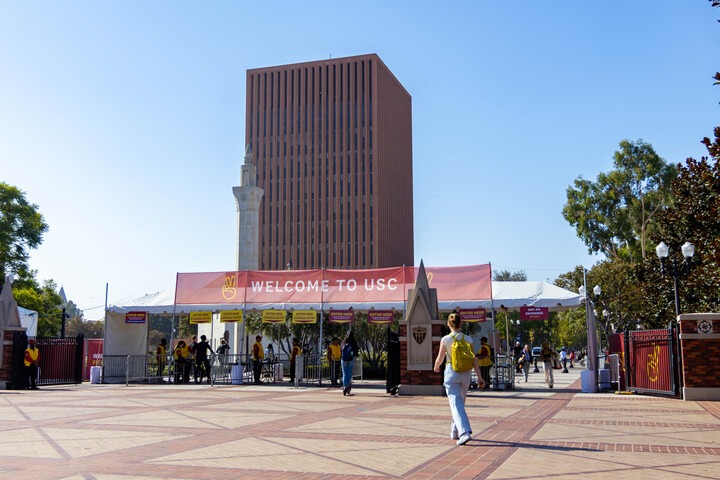
This walkway is, in some ways, a nucleus of USC’s social life. Lined with charity organizers, club members, religious advocates, snack stands, advertisers and political pamphleteers, the area reflects the University’s diversity of opportunity and interest.
Many students, though, sidestep the line of tables altogether, unless of course, someone is offering a complementary açai bowl or Starbucks gift card. Otherwise, most Trojans lower their gaze, quicken their pace and pray they won’t be forced to talk to a socialist or municipal canvasser. I’ve watched some of my most politically-engaged friends scurry past the booths, whispering an aside about ignoring the student walking kindly toward us with a flyer in hand.
To an extent, this tendency is understandable. Sometimes, I also have no desire to tackle capitalism’s shortfalls with a stranger on my way to breakfast, but this habit of aversion doesn’t exist in a vacuum. Students’ resistance to engage with political adversaries is a worrying symptom of an increasingly unhealthy political culture. By treating civil engagement as optional, we risk arguably our most valuable democratic asset: communication.
College students are often hailed as the crux of the electorate. According to the Center for Information & Research on Civic Learning and Engagement,more than half of college students who were registered to vote did so.
Considering USC’s status as a storied research institution in one of the country’s most active political enclaves, you might expect its students to eagerly embrace the opportunity for ground-level engagement, not ostracize its practitioners. So, why are Trojans so hesitant to stop and have an uncomfortable conversation? Well, the issue extends beyond campus.
Current college students arrived at social consciousness during Trump’s first term, right when American politics began devolving into a series of deplorable sideshows and a total negligence of longstanding political etiquette.
Our political moguls were not the steady voices of the Obama-Romney election cycle, but instead the divisive agents of Trumpism — the American sociopolitical phenomenon meant to describe our departure from normalcy since Donald Trump’s arrival to politics.
America’s decade of political drivel has left Generation Z fatigued, eroding our faith in political institutions and traditions, like civil conversation. In the Institute of Politics at Harvard Kennedy School’s 51st Youth Poll conducted last fall, only 13% of those aged 18 to 29 indicated that they felt that the country was headed in the right direction. While it may be tempting to label Generation Z as apathetic for swerving political contention, our lack of grassroots engagement can more likely be attributed to a lack of spaces for good-faith dialogue.
Similarly, social media has only deepened our insulated understanding of the world. Algorithms are eerily attuned to our interests and values, so most young people almost exclusively watch content that matches our political identification to a T. A 2025 study published in Vox EU showed that Republicans’ and Democrats’ partisan Facebook consumption varied about as much as the news media shared on X by Republican Sen. Marco Rubio and Democratic Sen. Chuck Schumer.
In spending around four hours a day reinforcing our fixed beliefs, we naturally grow wary of anyone who may disagree with us. Our narrow-minded media consumption is moving us farther away from one another, making it more and more difficult to find common ground.
Supplementing some social media arguments for face-to-face conversation eases the divide, forcing both parties to operate on the basis of mutual respect and fact. When avoiding USC’s sidewalk advocates, you rob yourself of this opportunity for meaningful civil participation, which has become the method of choice for a number of recent political winners, like New York City mayor Zohran Mamdani.
Mamdani’s underdog victory sent shockwaves through a stratified country, ushering in newfound optimism, especially for downtrodden Gen Z.
His accessible campaign scored with young voters because it rejected the platitudes and institutional backing that have informed our cynicism about the political process. The now-mayor didn’t connect to his electorate by airing hyperbolized smear campaigns or raking in massive donations. Instead, he spoke to his future constituents.
His grassroots-online hybrid strategy amassed a coalition of over 100,000 volunteers who canvassed at over 3 million doors before his November nomination. This angle came to define Mamdani’s effort, its success a testament to the public’s craving for real-life interaction.
Mamdani’s victory signals that young people haven’t relinquished hope for progress, we just need an adjusted approach to coax it out of us. Maybe the first step is to strip back the theater and just talk to one another, even when it’s inconvenient or awkward.
As we enter a uniquely contentious and polarizing era in American political history, it’s imperative that young people, especially college students, are civically engaged. But, I also empathize with the anger and hopelessness that naturally accompanies a descent into political turmoil with few healthy outlets.
My plea isn’t that you debate every person who strikes up a conversation on Trousdale, but tyranny hinges on our division, anger and exhaustion. Don’t let the news or the algorithm erase your identity as a valuable member of our political body. Connect with someone, debate them, disagree, learn something new, open yourself up to a novel perspective. Maybe, you’ll leave the interaction feeling a little bit more human.