Conversation on Nina Simone investigates freedom
The extensive Q&A about the famous musician’s life and legacy took place Friday.
By ANNA JORDAN
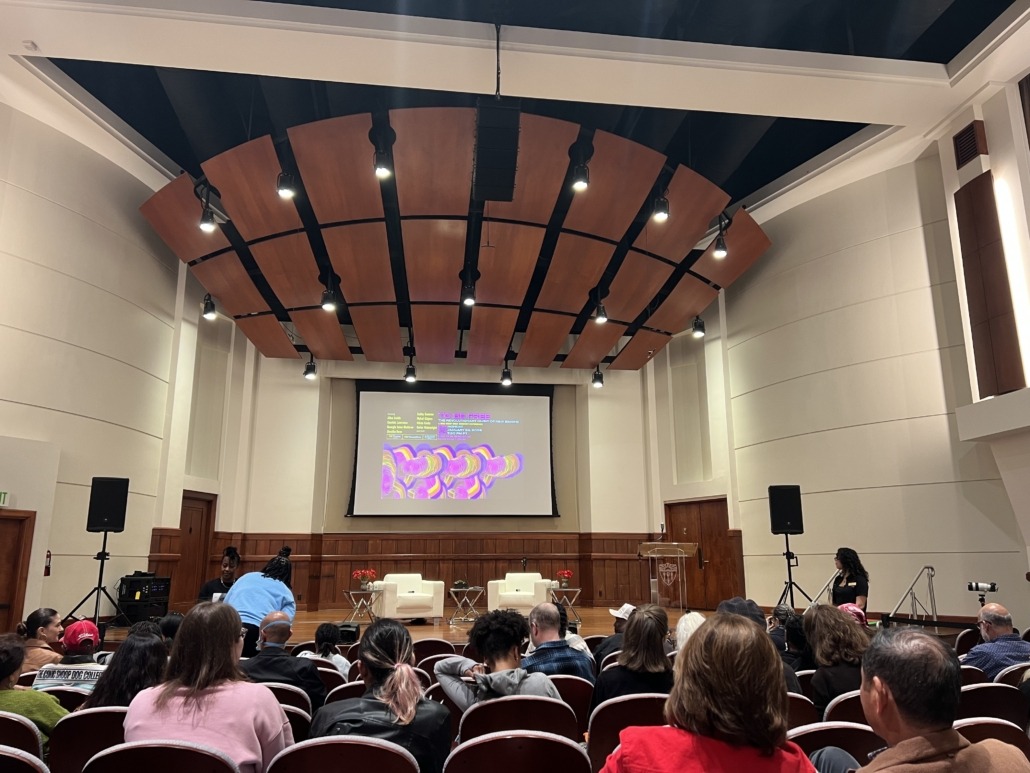

The extensive Q&A about the famous musician’s life and legacy took place Friday.
An all-age audience was feeling good as they filtered into the Hancock Foundation Building on Friday night, ready for Pulitzer Prize-winning critic and political activist Salamishah Tillet to put a spell on them at “How Nina Simone Changed the World.” The event was a second-of-its-kind collaboration between Visions & Voices, the Thornton School of Music and the Recording Academy’s Black Music Collective.
Students and Los Angeles community members populated the wooden chairs, ready to delve into the complicated life of musician and political activist Nina Simone, both a household name and a mysterious woman. Her talents included virtuosic piano performance and composition, biting political commentary translated into lyricism, and a haunting, “gender-expansive” contralto in which listeners can find themselves.
Attendees had ranging experience levels with Simone’s background. Nathalie Frisch, a first-year graduate student studying law, considered herself a casual fan of Simone’s but more so hoped to enjoy the easy access to intellectual curiosity that a student could find at the on-campus event.
“I wanted to make the most of what USC has to offer — [its] cultural offerings,” Frisch said. “I also wanted to take the opportunity to learn more.”
Simone is the latest artist honored in Thornton’s “Beyond Category” series that Thornton Dean Jason King described as “an annual initiative that focuses on cultural leaders past and present, whose work is singular, genre-defying and visionary,” previously highlighting artists including Quincy Jones, H.E.R. and Solange.
“These are artists who move across mediums, across disciplines, traditions, and they often anticipate the kind of creative convergence that now defines the 21st century,” King said in the night’s opening remarks.
King then introduced Tillet to the stage, but not before a clip of Simone performing her famous political statement song, “Four Women.” Tillet entered to read an excerpt from the introduction of her forthcoming book about Simone, “Nina Simone and the World She Made,” to be released in 2027.
Tillet’s history with Simone started well before she put pen to paper on her book. Despite her current evident expertise surrounding Simone’s rich history, Tillet revealed in the excerpt of her introduction that her connection to Simone’s music came later in life, particularly because of “Four Women.”
As an undergraduate student, Simone’s song helped Tillet learn to accept her identity and traumatic experiences as load-bearing parts of herself based on Simone’s own traumatic experiences that she wrote about with candor. According to Tillet, Simone’s honesty about her identity and pain keeps her art evergreen.
“Nina Simone gave me permission to tell my story,” Tillet read from her excerpt. “Through her lyrical anguish and anger, her voice helped me and many others find a way out of trauma and back to ourselves.”
As King rejoined Tillet on stage for a conversation surrounding both Tillet’s upcoming book and Simone’s vast diversity of experiences, the subject shifted to Simone’s artistic versatility. Part memoir, part-biography, Tillet’s draft is developing around her personal experiences with Simone’s words and music to expand both the life and legacy of the cultural powerhouse.
“I wanted to tell her story in a way that I felt she deserved,” Tillet said in conversation with King. “I had to almost interpret her and get close to her, and then I acquired a lot of honesty and vulnerability in myself as a writer.”
King and Tillet broke down Simone’s tumultuous path to becoming one of the most revered musicians of the 20th century. Her life was filled with heartbreak and disappointment, spanning from an early rejection from the Curtis Institute of Music to suffering from an undiagnosed mental illness to constant exploitation from the industry professionals and Andrew Stroud, her husband and manager, and all the racism, sexism and classism in between.
“I’m continually, in my life, struck by the paradox of artists who liberate others through their work, especially musicians who liberate others through their music, or just from their example, but they struggle to liberate themselves,” King said.
Despite — or perhaps because of — her constant pain, Tillet said that Simone’s legacy is one of providing relief for others through her music, singing what people feel while rooting those words in singularly dynamic compositions.
As the conversation came to a close, King and Tillet said Simone’s relief is born of her prodigious talent and lack of inhibition to blend genres including classical music, jazz, gospel, musical theater and soul, all in the pursuit of capturing the truth sonically, lyrically and authentically.
“[Simone] gives us the possibility of rejecting what we see or hear as some version of the truth in order to create something much more expansive,” Tillet said. “She faced many consequences for being a truth teller, but … her insistence on revealing an unmarked truth in the context of the United States is always both historical and forward-facing.”
After a brief Q&A with the audience, songs from “Little Girl Blue” and “I Put A Spell On You” followed attendees out into the night, along with a developed sense of gratitude toward Simone’s legacy as a musician and civil rights activist.
“[Simone] is a beacon of what it means to break the boxes of gender conformity, of genre conformity,” said alum and attendee Azmera Hammouri-Davis-Ojogho. “I really appreciated that [Tillet and King] lifted up the way that she really broke those boxes.”
A second event, “To Be Free: The Revolutionary Music of Nina Simone,” will be held Monday night. The event will be a concert celebrating Simone’s discography, featuring Thornton faculty and students, as well as guest performers.