Gazan poet reflects on writing in exile
The exiled poet visited USC to speak on his experience in Gaza as well as his poetry.
By LIZZY LIAUTAUD
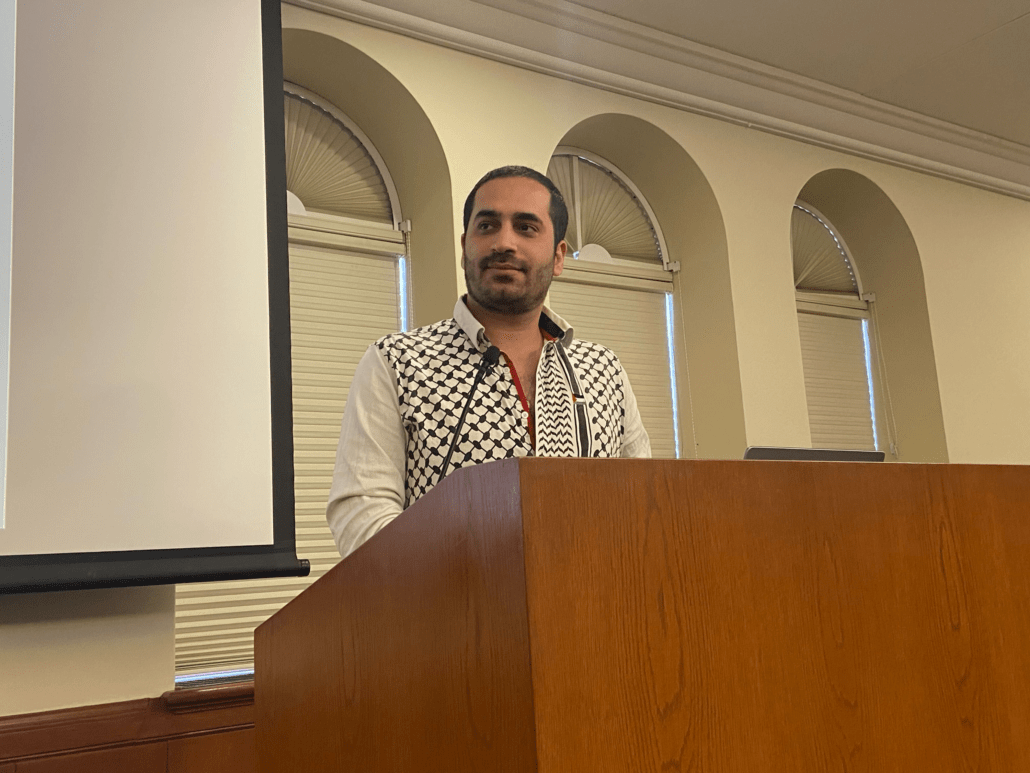

The exiled poet visited USC to speak on his experience in Gaza as well as his poetry.
Yahya Ashour never thought he would flee his home. But when Gaza became “unlivable,” he left in September 2023, just before the now over two-year-long Israel-Hamas war began.
“I [could] see, walking the streets of Gaza alone, that this place is about to explode,” Ashour said. “I was always thinking that something is going to happen, but I never in my worst dreams thought a genocide would happen.”
Ashour visited USC on Friday to speak about his experience as a writer and teacher living in exile with USC professor and Pulitzer Prize-winning author Viet Thanh Nguyen. According to a flier for the event, it was co-sponsored by the Department of Comparative Literature, the Department of Middle East Studies, the Writing Program, USC Libraries, the USC Sidney Harman Academy for Polymathic Study and USC Faculty for Justice in Palestine, an advocacy group not affiliated with the University.
Ashour opened the event by reading a few of his poems, most of which explored themes of war and grief. When Nguyen asked Ashour about his experience as a Gazan poet living in exile, Ashour said that being away from home was difficult.
“Getting stuck outside Gaza, it broke everything I’ve ever known about living, normal living,” Ashour said. “All of these things that we do without thinking became huge tasks for me. … I have a poem called ‘To-Do Lists,’ and I list all the things [that] are now decisions that I can no longer think of as normal living.”
In exile, Ashour said he became uninterested in almost everything. Normal conversations about the weather were difficult for him to enjoy, as he said he felt disconnected from the media around him that did not understand what it is like “to survive genocide.”
“I became disgusted by art, by books, by movies, by everything, because a lot of times, nothing felt like it could live up to what I was feeling inside,” Ashour said. “The second thing was, a lot of these writers and artists and movie makers were still silent back then, and did not talk a word about [genocide].”
Eventually, Ashour was invited to read his poetry at universities across the country, which he said made him feel reconnected with himself.
“Getting called to speak and talk and read my poetry, it became something that really helped me,” Ashour said.
Nguyen asked Ashour how being in exile in the United States shaped his perspective on his work and writing.
“I’m wondering what it does to your relationship to language as a poet, because part of what we saw during the last few years was not just an actual genocide taking place, but a struggle over language,” Nguyen said.
In Ashour’s response, he said the first time he struggled with language was when he was asked to speak at universities. Ashour said he realized that he either needed to start writing in English, which felt “foreign,” or translate his poems written in Arabic.
“At first, I gave the poems to someone who volunteered to translate them, and when they came back, I read the poems, and I was like, ‘These are not my poems,’” Ashour said. “I started to love translation because it became like a challenge to me.”
Speaking English, on the other hand, was more challenging for Ashour’s identity. He said he constantly battled with the feeling of identity loss while living and working in an English-speaking country.
“I still feel like it is a big burden to speak English … especially when I’m teaching my students,” Ashour said. “I wish I can tell you the jokes I would tell my students back home in Arabic.”
Ashour ended the event by reading a few more of his poems, in both English and Arabic, and his essay “The Ostrich.”
One poem he read, “Pencils,” centers on a photo that Ashour saw of the rubble and remnants of his home. Ashour’s home was hit on Oct. 12, 2023, according to the Detroit Free Press.
“I stared at this photo for a long time, trying to find something or a part of it that I could recognize, other than the gate,” Ashour recalled.
In another poem at the start of the event, “Waste Management,” Ashour wrote about the feeling of seeing the rest of the world watch as the war went on, asking, “Was it a movie where we eat popcorn?” He also wrote in “Waste Management” about how language felt useless to grapple with his grief of losing his homeland.
“No matter what I write about war, my words always appear reduced, reused, recycled nowhere near enough to knock the body of war to the ground,” Ashour said. “The body of war is cemented in mine. As for the soul of war, I fear it has replaced mine.”