USC community discusses AI presence in education
Attendees shared reflections and strategies for applying chatbots into universities.
By DAHLIA BECK
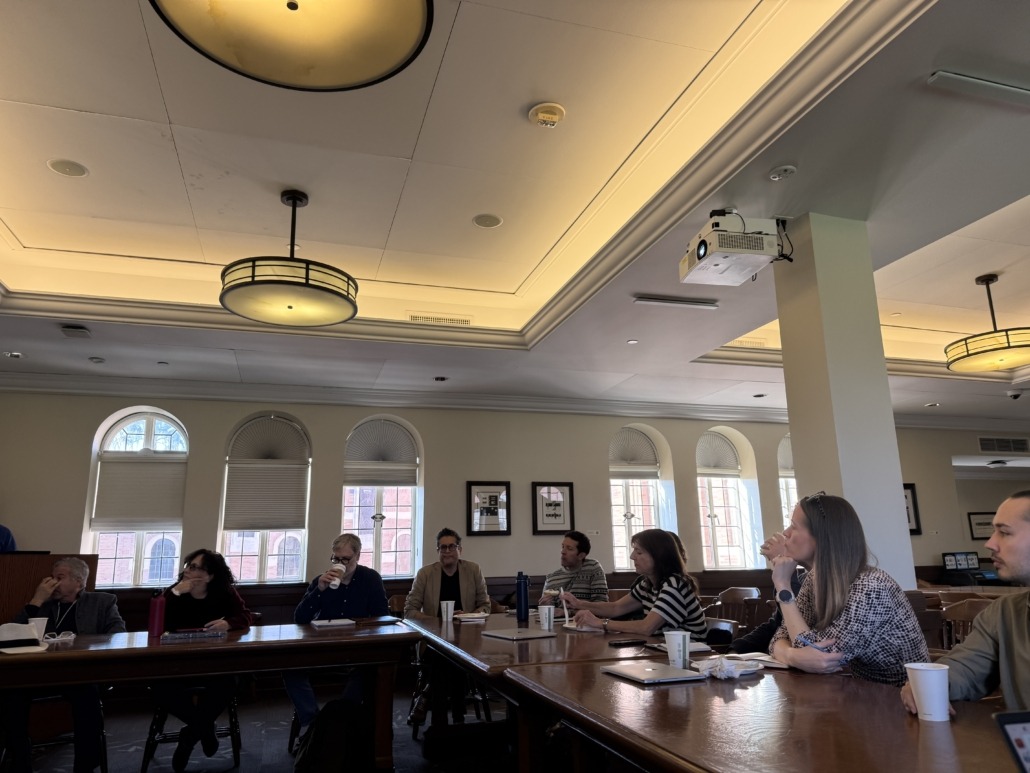

Attendees shared reflections and strategies for applying chatbots into universities.
When Mark Marino sits down to grade his students’ writing and finds a grammatical error, he sighs.
Not in anger or frustration, but in relief because, he said, that means the student wrote in themselves.
Marino, a professor of writing, also said his students have started to avoid using em-dashes because they feared being flagged for using chatbots to write.
Appreciating grammatical mistakes and switching up old punctuation habits are just some of the ways the USC community is adapting to AI in the classroom, more of which were discussed at the “AI & The University” event co-sponsored by the Institute of Ethics & Trust in Computing, the Ahmanson Lab and the Humanities and Critical Code Studies Lab. About 20 faculty, staff, students and alumni from across different disciplines shared their thoughts, Friday, on how USC should respond to chatbots becoming a staple of University life.
USC launched its ChatGPT Edu workspace, which provides free access to ChatGPT’s advanced modules for active students, staff and faculty, on Jan. 13. The $3.1 million program was launched to criticism from some faculty, 12 of whom called the partnership an “unthought-through collaboration” in a letter sent to the Daily Trojan in November.
Faculty at the discussion said they felt uneasy at the idea of introducing generative AI into their established curriculum and assuming a new style of instruction. During Wednesday’s Academic Senate meeting, Geoffrey Garrett, chair of the President’s AI Strategy Committee and dean of the Marshall School of Business, said there will be no mandates to use chatbots in undergraduate education.
Andrew Taylor, a webmaster for USC Annenberg Press, said generative AI was a “necessary evil” because it won’t go away.
“We have a duty to inform, to say, here’s what’s out there, because there is such a misunderstanding of its capability,” Taylor said.
With many chatbot platforms requiring paid subscriptions for their most advanced models, Bridgid Fennell, a librarian who works primarily with the Rossier School of Education, said students coming from colleges without partnerships with generative AI companies are less fluent in the technology than their peers, creating socio-economic disadvantages in the classroom.
“I’m seeing students that are very savvy. Some of my students are wealthy and can afford these subscriptions, which are not insignificant, and then others can’t. It results in their productivity and their output,” Fennell said. “Someone who can afford $20 a month … what can they put out? When I worked [at a] community college, a lot of students could not afford this.”
Alexandra Petrus, a Ph.D. candidate in cinema and media studies, said there was a fine line between preparing students for a job market that demands skills in AI and continuing to foster a culture of critical thinking at USC, rather than one of reliance on AI chatbots.
“We’ve got several generations of young people trained just to prompt, not to write the symphony, but to prompt the symphony,” Petrus said. “The symphony will never be a good symphony.”