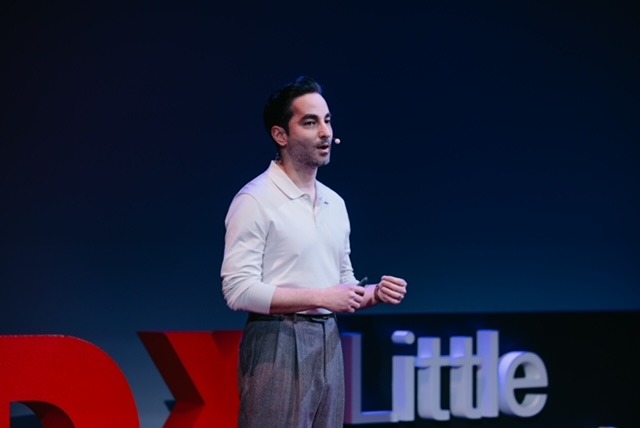
TEDxLittle Armenia showcases hybridity across community
The Bing Theatre event featured Armenian speakers with a theme of “hybrid identities.”
By JACKSON MILLS

The Bing Theatre event featured Armenian speakers with a theme of “hybrid identities.”
In the first week Ani Adjemian went to UCLA, she said she came home crying every day because she couldn’t find a place to belong. But Adjemian, now an attorney and Gould School of Law lecturer, said hearing a simple Armenian greeting, “barev,” was all it took to make her feel like she belonged.
Fittingly, that was also the word she used to start TEDxLittle Armenia on Friday at Bing Theatre, with nearly the entire building full. It ran from 6 p.m. to 9 p.m., with TED talks from seven speakers.
The event’s theme centered on hybridity. For speakers from a variety of industries, all with Armenian heritage, how could the various identities and geographies they existed within become a source of creativity?
TEDxLittle Armenia was a joint collaboration between the USC Institute of Armenian Studies and TEDxYerevan and was the first licensed diaspora chapter of TEDx.
Shushan Karapetian, director of the Dornsife Institute of Armenian Studies, said in an interview with the Daily Trojan that a key feature of the event was its challenge to what people would expect when they related hybridity to the Armenian community.
“There’s a public discourse of hybridity as an Achilles heel,” Karapetian said. “And what I want [is] to turn that narrative on its head, and say this is actually our superpower.”
Karapetian said that she felt like the event was particularly important for young audiences, who she said would get the opportunity to see an Armenian event where they’d rethink everything from artificial intelligence to the purpose of design.
“The expectation is that there’s going to be a story of woe, and then there’s going to be a global community that will rally around to patch that hole,” Karapetian said. “Very rarely, is it: ‘I’m gonna go and meet probably the most inspiring people I’ve met in my life, Armenian or non-Armenian.’”
The speakers ranged from startup founders to filmmakers, and the event included discussions on topics such as artificial intelligence, ecology and education.
Aroussiak Gabrielian, co-founder and design director of Foreground Design Agency, challenged the audience to rethink how systems — especially natural ones — are represented and understood as static and unchanging.
“Maps don’t just orient us,” Gabrielian said. “They train our perception.”
Gabrielian said her work emphasized the entanglement between humans and their environment, with projects that merge from wearable and edible landscapes to shiitake mushrooms that can be grown with human breath. This, Gabrielian said, was an attempt to see living systems as “relational.”
“These ideas have been known by indigenous and land-based cultures throughout millennia, including our own ancestors of the Arax River Valley, who understood the river as alive and called her Mother Araks,” Gabrielian said.
The event also featured Karen Khachikyan, co-founder and CEO of Robin the Robot — a company focused on using artificial intelligence to provide companionship to hospital patients. In an interview with the Daily Trojan, Khachikyan said hybridity is a vehicle for him and others to come to their “authentic self.”
Sev Ohanian, a speaker at the event and the first Armenian American to receive a best-picture nomination for his work on “Sinners” (2025), spoke about his journey through filmmaking despite the lack of Armenian representation he initially found within the industry.
Ohanian initially pursued journalism, as he said he felt like it was a more practical path than filmmaking. But over time, Ohanian said that small, deeply personal film projects such as his film “My Big Fat Armenian Family” (2008) began to resonate with audiences far beyond his immediate community, so he switched.
Following the event’s theme of hybridity, Ohanian spoke to the challenges he faced growing up with the pressure to choose a “safer bet,” but also to the help his entire family gave him as his film profession started to grow.
“This is not a story about somebody who had nothing and made it work despite that. It’s a story about someone who had it the whole time,” Ohanian said. “My Armenian background was never a disadvantage. It was a support to me the entire time.”
Maral Tavitian, managing director of the Institute of Armenian Studies, said the event’s location at Bing Theatre was meant to make the atmosphere of the campus accessible to everyone who came.
“We could have done this event anywhere in [L.A.], but we were very intentional about hosting on campus,” Tavitian said. “It’s important that our Armenian diaspora community comes to USC and experiences the atmosphere of the event on this campus.”
The event received a Certificate of Recognition from the City of Los Angeles, presented by City Councilmember Hugo Soto‑Martínez, who represents Little Armenia on the City Council. The award said that the event’s theme of hybrid identities captured the “diverse intersections of culture and experience,” representative of both the district and the city.
Kristine Sargsyan, founder of TEDxYerevan, said the goal for TEDx is to introduce ideas that are bigger than the speakers themselves, ones that open up “new pathways of thinking.” In an interview with the Daily Trojan, she said that the theme of hybridity was tied to how she had come to love Armenia itself.
“When I first met my diaspora friends, I think I learned to love Armenia thanks to them,” Sargsyan said. “Discovering Armenia from [the] outside in has been [a] very humbling experience for me, and I think we will be better off as Armenians and as humans if we just learn to see these different perspectives.”