The USC Scripter Awards celebrate the written word from page to screen
The 38th Scripter Awards honored the year’s best film and television adaptations.
By NINA KREMER
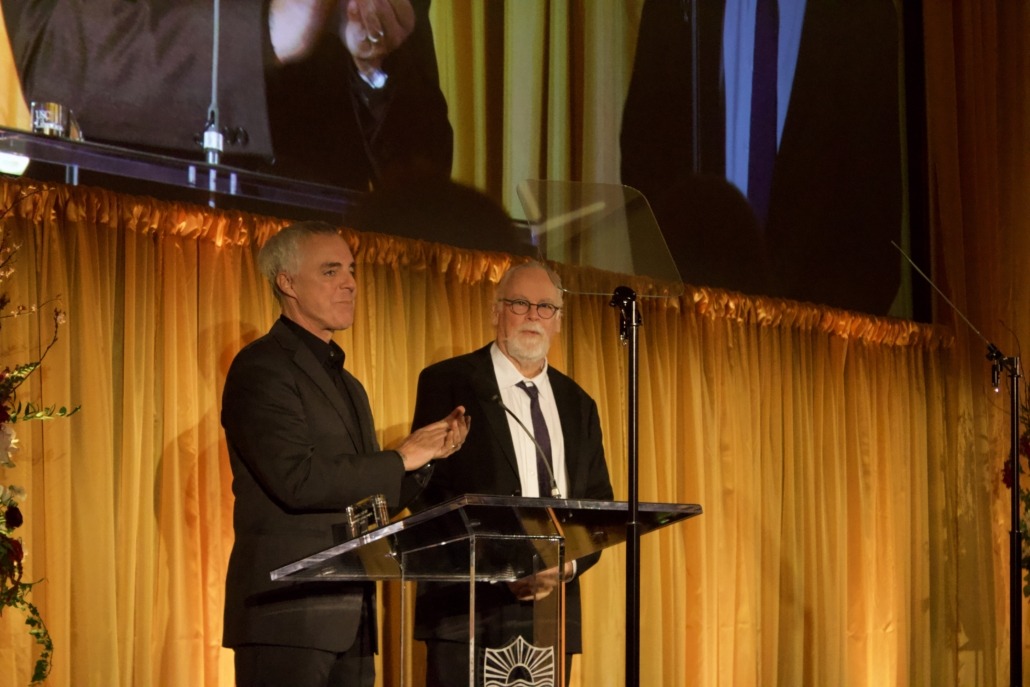

The 38th Scripter Awards honored the year’s best film and television adaptations.
Writing the film and television adaptation is a difficult feat; the screenwriter takes on the role of the tightrope walker, carefully toeing the line between faithfulness and originality. Some falter, failing to live up to the glory of the book it’s based on, while others soar.
Oscar-nominated screenwriters, award-winning authors, and University librarians walked the red carpet at the 38th annual USC Libraries Scripter Awards on Saturday night at the Town & Gown ballroom, honoring the year’s best adaptations of literature into film and television.
“The Scripter Awards are unique because we’re the only award that specifically celebrates the written word, which ties in so well with what we do in libraries … recognizing the continuum of the story from one medium to another,” said Melissa Just, dean of the USC Libraries, in an interview with the Daily Trojan. All proceeds from the Scripter Awards gala support the USC Libraries.
Just emphasized that what makes the Scripter Awards special is that they recognize both the screenwriters who adapted the work and also the authors of the original source material.
The first award of the night was the USC Libraries Literary Achievement Award, presented to author Michael Connelly for his mastery of mystery storytelling. Connelly has written over 40 novels, many of which have been adapted for the screen, including 10 seasons of the television series “Bosch” and its spinoff, “Bosch: Legacy.”
Actor Titus Welliver, who portrayed Los Angeles Police Department detective Harry Bosch in the television series, presented Connelly’s award and thanked the author for entrusting him with the responsibility of depicting the beloved character.
Connelly’s novels take place in Los Angeles, a city he has been writing about for three decades. Just called him a “foremost chronicler” of L.A. and a “great contributor to our shared cultural memory as Angelenos.”
In an interview with the Daily Trojan before the ceremony, Connelly said he hopes his novels have captured the evolving nature of a city like L.A., where so much is always changing.
“My first book with Harry Bosch came out in 1992, and now here we are,” Connelly said. “I’m writing one right now with him in it, so it’s almost like I’ve been given this opportunity to do an anthropological dig on the city.”
Before introducing interim President Beong-Soo Kim, Glenn Sonnenberg, a USC Trustee, Scripter Awards co-founder and USC Libraries Board of Councilors member, gave a speech in which he paid respect to Alex Jeffrey Pretti, a 37-year-old ICU nurse who was shot and killed by federal agents in Minneapolis that morning.
“I say this not as a political statement, but to recognize that film lifts us and yet art also reminds us of the world in which we live and the challenging times within which we live. May his memory be a blessing,” Sonnenberg said.
Interim President Kim then gave remarks on the value of libraries, speaking positively about expanding the use of AI at USC while still recognizing and centering the work of writers.
“USC Libraries is committed to expanding its offerings and meeting the moment,” Kim said. “We’re using cutting-edge digital tools and harnessing the vast potential of AI to enhance human creativity, thought and scholarship, and we’re doing it responsibly by keeping writers and artists and their crafts at the center of everything we do.”
After his speech, Kim performed Max Richter’s “On the Nature of Daylight” — a piece featured in the film “Hamnet” (2025), one of this year’s nominees — on the cello alongside Thornton School of Music students Eric Cheng, Chloe Hong, Logan Nelson, Matthew Pakola and Dylan Tyree.
Scripter jury chair Howard Rodman, a USC professor and former president of the Writers Guild of America West, announced that this year will be his last year as chair, before reflecting on why it is essential to support libraries, especially during the current media landscape.
“Roughly one-third of [Americans] say that human activity has no effect on climate change, that the United States used to own Greenland, that Renee Good was a domestic terrorist,” Rodman said. “Our nation lacks a simple, basic, agreed-upon set of facts. Now more than ever, what a deep pleasure, then, to celebrate [a] signature institution, the library.”
He then awarded best film adaptation to Paul Thomas Anderson and Thomas Pynchon for “One Battle After Another” (2025), adapted from Pynchon’s novel “Vineland.” Neither honoree was present at the event, but Anderson sent in a video acceptance, saying he had a “terrific excuse” as he is currently working on another project.
The night concluded with the presentation of the award for best adapted episodic series. Rodman presented the award to Mike Makowsky, for the episode “Destiny of the Republic” from the series “Death by Lightning,” and to Candice Millard, the author of the nonfiction book “Destiny of the Republic” that the series is based on.
“It was about eight years ago now that I was at The Grove L.A. Barnes & Noble at the buy two, get one free table, and I needed a third book. And I picked up this book … about the assassination of our 20th president, James Garfield,” Makowsky said. “I immediately called up my agent, and I was like, ‘I want to write a limited series.’”
The Netflix miniseries “Death by Lightning” tells the story of Garfield’s assassination, which Makowsky said he was unaware of prior to reading the book, but once he picked it up, he said he read it all in one sitting.
“It was really that source material that convinced me that the story was not only interesting but potentially vital to our current moment,” Makowsky said in an interview with the Daily Trojan. “And to be able to celebrate not just the show but the original impetus for the show, this miraculous book, is what makes this event in particular so cool.”